A second passport for Libyans typically involves citizenship pathways such as Turkey, Caribbean citizenship-by-investment schemes like Dominica and St. Kitts and Nevis, or European residency-to-citizenship pathways like Portugal to gain stronger global mobility and long-term stability.
For Libyan citizens, these destinations are among the most commonly pursued options due to faster processing, investment routes, or residency-to-citizenship programs.
Questo articolo tratta di:
- Where do most Libyans migrate to?
- Which country is best for a 2nd passport?
- Is the Libyan passport strong?
- Is it a good idea to have two passports?
Punti di forza:
- Libya has a restrictive stance on dual citizenship, with inconsistent enforcement.
- Libyan passport mobility is limited, pushing demand for second citizenship.
- Caribbean citizenship-by-investment programs are among the fastest routes for Libyans seeking a second passport.
- A second passport expands visa-free access and provides a legal fallback option in case of travel or political restrictions.
I miei recapiti sono hello@adamfayed.com e WhatsApp +44-7393-450-837 se avete domande.
Per i visti per nomadi digitali o di residenza che richiedono un reddito, un patrimonio o investimenti qualificati, possiamo aiutarvi a strutturare soluzioni di investimento adatte a soddisfare tali requisiti, a seconda delle vostre circostanze.
Le informazioni contenute in questo articolo hanno carattere puramente indicativo, non costituiscono una consulenza finanziaria, legale o fiscale e possono essere cambiate rispetto al momento in cui sono state scritte.

Is Dual Citizenship Allowed in Libya?
Doppia cittadinanza is not generally allowed under Libyan law, and Libya officially requires exclusive nationality in most cases.
This is established in both historical constitutional provisions and current nationality legislation.
Ai sensi del 1951 Constitution of Libya, Article 10 explicitly states that no person may hold Libyan nationality and another nationality at the same time .
While this provision has evolved over time, the principle of single citizenship has remained central in Libya’s legal framework.
More recently, Law No. 24 of 2010 on Libyan Nationality maintains a restrictive stance, providing that Libyan citizens who voluntarily acquire another nationality without approval from the Ministry of Interior may lose their Libyan citizenship .
The law does allow exceptional approval for dual nationality, but only on a case-by-case basis and at the discretion of the state.
In practice, enforcement is inconsistent.
Some Libyans who obtain a second passport may retain their Libyan nationality informally, but they can still face legal limitations or administrative complications, particularly in government roles, official documentation, or security-related matters.
What are some reasons for people migrating to another country?
People from Libya migrate to other countries primarily due to instability, limited economic opportunities, and the search for better long-term living conditions.
- Political instability and security concerns: Ongoing political fragmentation and periodic conflict create uncertainty, prompting many to seek safer environments abroad.
- Better employment and income opportunities: Limited job markets and lower wage levels push skilled and unskilled workers to look for higher-paying opportunities overseas.
- Access to higher-quality education and healthcare: Many migrants move to countries with more advanced universities, training systems, and healthcare infrastructure.
- Family reunification: A significant number of Libyans migrate to join close family members who are already living abroad.
- Business expansion and international mobility: Entrepreneurs and professionals relocate to access more stable regulatory systems and broader international markets.
- Seeking long-term residency stability: Some migrants pursue countries with clearer pathways to permanent residency or citizenship for long-term security.
Where do most Libyans immigrate to?
Most Libyans migrate to nearby countries in North Africa and Europe, especially Tunisia, Egypt, Italy, and Turkey, with additional communities in Germany and Canada for skilled migration and asylum pathways.
Multiple migration studies and EU arrival datasets show that a large share of Libyan-linked mobility is concentrated along the Central Mediterranean route, particularly toward Italy.
In fact, recent migration flow data indicates that around 60% of irregular migrants reaching Italy from North Africa have departed from Libya in recent years, making it one of the main transit and departure hubs toward Europe.
At the same time, regional migration patterns show strong movement to neighboring countries such as Tunisia and Egypt due to visa-free or low-friction travel, shared cultural ties, and proximity.
Europe, especially Italy and Germany, remains attractive for those seeking asylum, employment, or long-term residency pathways.
Common destinations include:
- Turkey (popular for Western Libyan communities and business ties)
- Italy (primary European entry point via Mediterranean routes)
- Tunisia (visa-free access and established Libyan communities)
- Egypt (education, business, and regional mobility)
- Germany (skilled migration and asylum routes)
- Canada (points-based skilled migration system)
Overall, Libyan migration is shaped more by regional proximity and safety routes than by a single dominant destination country, with Europe and neighboring North African states absorbing the largest share of movement.
Which country is best for a second passport?
Il best second passport options for Libya include Turkey, Dominica, St. Kitts and Nevis, Antigua and Barbuda, and Portugal.
These countries offer improved visa-free travel access, and also address additional limitations of the Libyan passport, including limited long-term residency options abroad and the need for regional or EU mobility.
Each option is relevant for Libyans for different practical reasons:
Turchia (Investment-based citizenship)
- Turkey is especially attractive for Libyans due to geographic proximity, strong trade links, and easier cultural integration.
- The most common route is through real estate investment of at least $400,000, with citizenship typically granted within 3–6 months.
- Turkey also serves as a major business and travel hub between the Middle East, Europe, and North Africa, making it practical for both mobility and commerce.
Dominica (Citizenship-by-Investment)
- Dominica is a relatively affordable citizenship-by-investment option, making it suitable for Libyans seeking improved global mobility without extremely high capital requirements.
- Applicants can qualify through a non-refundable government contribution starting at $200,000 for a single applicant or a real estate investment of at least $200,000 in approved projects.
- Processing typically takes 3–6 months, and the program requires no residency obligation, making it highly convenient for international applicants.
St. Kitts e Nevis (Citizenship-by-Investment)
- This program is valued for its high passport strength and fast processing, often completed in about 3–6 months.
- The minimum contribution is typically a donation from around $250,000 or real estate investment options.
- For Libyans, it is often chosen for strong visa-free access, fast approval, and improved international financial credibility.
Antigua e Barbuda (Citizenship-by-Investment)
- Antigua is particularly relevant for family applications, allowing dependents under one application with investment starting around $230,000+ (donation or real estate options available).
- Processing usually takes around 3–6 months, and applicants are required to complete a short physical visit (at least 5 days within the first 5 years), making it practical for families seeking flexibility without relocation.
Portogallo (Residency-to-citizenship pathway)
- Portugal is one of the most strategic long-term options for Libyans aiming for EU citizenship access, education opportunities, and stable residency pathways.
- Il Golden Visa program requires qualifying investment (commonly €250,000–€500,000 depending on route), followed by 5 years of legal residency before citizenship eligibility.
- It leads to full EU mobility rights, making it a long-term but powerful option.
What is the easiest second citizenship to get?
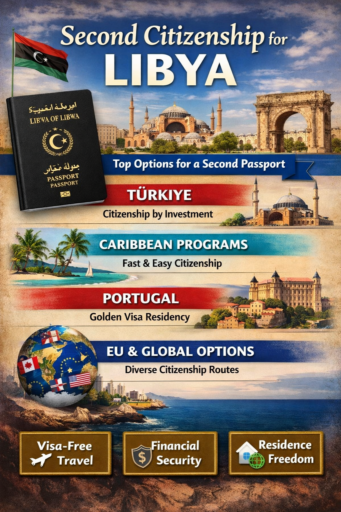
The easiest second citizenships for Libyan applicants are typically Caribbean citizenship-by-investment programs and Turkey, because they offer fast approval timelines, minimal residency requirements, and simplified application processes compared to traditional immigration systems.
These pathways are considered easier mainly because they remove common barriers such as long-term physical residence, employment sponsorship, language tests, or extended naturalization periods.
Caribbean citizenship-by-investment programs (Dominica, St. Kitts and Nevis, Antigua and Barbuda)
- Processing time: Typically 3–6 months from application to passport
- No residency requirement: No need to live in the country before or after approval
- No language or interview requirements in most cases
- Simple qualification: Based mainly on a financial contribution (from ~$200,000+)
Turkey (Investment-based citizenship)
- Processing time: Typically 3–6 months (best case), but more realistically 6–12 months from investment to passport
- No residency requirement: You are not required to live in Turkey long-term
- Clear threshold: Citizenship granted through a fixed investment (e.g., ~$400,000 real estate)
- No language test or long naturalization period
Selected Latin American residency routes (varies by country)
Some countries in Latin America are considered easier because:
- Shorter timelines to citizenship: Often 2–5 years of residence (e.g., Argentina ~2 years, Brazil ~4 years)
- Lower barriers to entry: No large upfront investment required
- Flexible residency rules: Easier to maintain legal residence compared to stricter regions
However, unlike investment programs, these still require physical presence and time commitment, so they are slower but more affordable.
How strong is a Libyan passport?
The Libyan passport is generally classified as a low-ranking passport in global mobility indexes, reflecting its limited travel freedom compared to most countries worldwide.
| Index | Libya Passport Rank | Note |
| Henley & Partners | 93rd | Based on visa-free + visa-on-arrival scoring system ~39 destinations |
| Arton Capital | 85th | Mobility score-based ranking (not strict visa count) Uses Global Passport Power Rank methodology 51score |
| Capitalista nomade | 183rd | Evaluates beyond visa-free access (taxation, perception, dual citizenship freedom) 39.5 score |
Why is it good to have two passports?
Having two passports is beneficial because it expands international access and provides legal and strategic advantages that a single nationality may not offer, especially for citizens of countries with limited travel freedom like Libya.
- Greater visa-free travel options: Expands the number of countries you can enter with little or no visa requirements.
- Backup nationality during uncertainty: Provides an alternative citizenship that can be useful if conditions change in your home country.
- Access to stronger global rights and privileges: Can include broader residence rights and smoother entry into certain regions or agreements.
- Tax planning and financial flexibility (depending on jurisdiction): May allow more efficient international tax and asset structuring.
- Expanded business and investment access: Makes it easier to open accounts, register companies, and operate across borders.
- Greater personal security and mobility freedom: Allows more options to relocate or travel when needed without major restrictions.
Dual citizenship is often viewed as a long-term strategic asset rather than just a travel document.
Investment vs Residency vs Ancestry for Second Citizenship
Investment, residency, and ancestry pathways differ mainly in speed, level of control, and long-term commitment, which is more important than the definitions themselves when choosing a second citizenship for Libya.
- This is the most variable and eligibility-dependent option, as it relies entirely on proving lineage.
- While it can be highly advantageous when available, it is not a controllable or widely accessible strategy compared to the other two.
Citizenship-by-Investment (CBI)
- This is the most predictable and fast-track option, where approval is primarily based on financial qualification rather than long-term stay.
- It is generally chosen by applicants who prioritize speed and mobility over relocation.
Residency-to-citizenship pathways
- This route is more commitment-based, requiring applicants to actually live in the country for several years before qualifying for citizenship.
- It is typically preferred by those planning long-term relocation, education, or settlement in a new country.
- A relationship-based pathway that may lead to citizenship over time, but typically involves strict verification, residency requirements, and longer timelines depending on the country.
Conclusione
A second passport for Libyan citizens is ultimately about reducing dependency on a single jurisdiction.
In a world where mobility, regulation, and opportunity vary widely by country, having access to another system can significantly change what is possible, personally and financially.
The key is not to rush into the fastest option, but to choose a route that aligns with your long-term direction, whether that is mobility, relocation, or asset protection.
When approached correctly, a second passport becomes a long-term positioning tool, not just a short-term solution.
Domande frequenti
Does Libya have birthright citizenship?
No, Libya does not have unrestricted birthright citizenship.
Citizenship is primarily based on parentage (jus sanguinis), meaning at least one Libyan parent is generally required.
Why is Libya so hard to get into?
Entry into Libya is difficult due to strict visa requirements, security concerns, and limited consular processing in many countries.
Ongoing political instability and administrative challenges also make travel approvals less predictable.
Which countries do not allow dual citizenship?
Some countries that generally do not allow dual citizenship include China, India, Saudi Arabia (with limited exceptions), Japan (typically requiring renunciation), and Singapore (strict policy).
Rules can vary depending on individual circumstances and may change over time.
Why should you not travel to Libya?
Travel to Libya is often discouraged due to ongoing security risks, political instability, and the potential for civil unrest or armed conflict.
Limited consular support and rapidly changing conditions can also make travel difficult and unpredictable.
Siete afflitti dall'indecisione finanziaria?

Adam è un autore riconosciuto a livello internazionale in materia finanziaria con oltre 830 milioni di visualizzazioni di risposte su Quora, un libro molto venduto su Amazon e un contributo su Forbes.