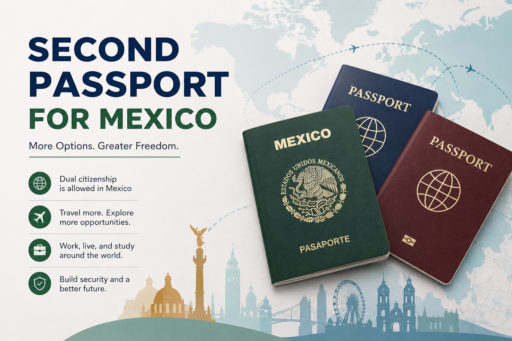
Mexicans can pursue a second passport in countries such as Spain, United States, Canada, or Italy, as Mexico permits dual citizenship and does not require citizens to give up their Mexican nationality when acquiring another passport.
This flexibility has made it easier for Mexicans to access residency, work rights, and long-term settlement options abroad.
Questo articolo tratta di:
- Is Mexico still offering dual citizenship?
- What is the best second passport to have?
- What is the easiest country to get a second passport in?
- Where do Mexicans migrate to the most?
- Why do people move out of Mexico?
- How strong is a Mexico passport?
- What are the advantages and disadvantages of dual citizenship?
Punti di forza:
- Mexico permits dual citizenship with no requirement to give up Mexican nationality.
- Spain and other ancestry or residency-based routes are among the easiest options for Mexican second citizenship.
- A second passport for Mexico improves global mobility, work access, and security.
- Migration of most Mexicans is largely driven by economic opportunity, education, and safety factors.
I miei recapiti sono hello@adamfayed.com e WhatsApp +44-7393-450-837 se avete domande.
Per i visti per nomadi digitali o di residenza che richiedono un reddito, un patrimonio o investimenti qualificati, possiamo aiutarvi a strutturare soluzioni di investimento adatte a soddisfare tali requisiti, a seconda delle vostre circostanze.
Le informazioni contenute in questo articolo hanno un valore puramente indicativo. Non costituiscono consulenza finanziaria, legale o fiscale e non rappresentano una raccomandazione o una sollecitazione a investire. Alcuni fatti potrebbero essere cambiati dal momento della stesura.

Il Messico consente la doppia cittadinanza?
Yes. Mexican citizens can acquire another nationality without losing their Mexican citizenship.
Since reforms in the 1990s, Mexico recognizes dual nationality, allowing individuals to hold a Mexican passport alongside another country’s passport.
However, when in Mexican territory, citizens are generally treated as Mexican nationals only.
This framework has made it legally straightforward for Mexicans to maintain ties with both Mexico and their adopted country without complex renunciation requirements.
Which country is best for a second passport for Mexicans?
The best second passport options for Mexicans is determined by eligibility routes such as ancestry, residency, or investment, with the most common and practical options including Spain, United States, Canada, Portugal, and Italy.
- Routes: Residency-to-citizenship (fast-track for Latin Americans)
- Key requirement: Legal residence in Spain
- Investment: No direct investment requirement for citizenship; costs are mainly tied to legal residency, living expenses, and application fees
- Linea temporale: 2 years for Latin Americans (including Mexicans)
- Why it stands out: One of the fastest EU citizenship paths for Mexicans due to historical and linguistic ties
- Routes: Family sponsorship, employment-based immigration, naturalization
- Key requirement: Green card before citizenship eligibility
- Investment: Varies (employment or family-based; investor visa options exist)
- Linea temporale: 5+ years depending on route
- Why it stands out: Largest Mexican diaspora and strongest economic migration destination
- Routes: Express Entry, provincial nominee programs, study-to-work pathways
- Key requirement: Skilled work experience, language proficiency
- Investment: No direct investment required (points-based system)
- Linea temporale: 3-5 years
- Why it stands out: High quality of life and strong demand for skilled workers
- Routes: Residency (D7 visa, digital nomad visa, investment routes)
- Key requirement: Proof of income or investment
- Investment: Moderate to high; Portugal’s Golden Visa typically requires a minimum investment starting at around €250,000
- Linea temporale: 5 years to citizenship
- Why it stands out: Flexible residency options and relatively low cost of entry into the EU
- Routes: Citizenship by descent (jus sanguinis) or residency
- Key requirement: Proof of Italian ancestry or long-term residence
- Investment: Low for citizenship by descent (mainly administrative and document costs)
- Linea temporale: Variable (2-4 years for descent, 10 years for residency)
- Why it stands out: One of the most accessible EU citizenships for Latin Americans with European heritage
What is the easiest second citizenship for Mexicans?
The easiest second passport for Mexicans is typically obtained through citizenship by descent or fast-track residency pathways in countries like Spain and Italy.
Caribbean citizenship-by-investment programs also offer the fastest processing times for those who can meet the investment requirements.
- Cittadinanza per discendenza – Especially in countries like Spain or Italy where ancestry-based claims are well established and documentation-driven
- Naturalization after residency – Spain is one of the fastest routes for Latin Americans due to reduced residency requirements and cultural ties
- Programmi di cittadinanza per investimenti nei Caraibi – The fastest route overall, with approval typically ranging from 3–6 months across countries like Dominica, Grenada, Saint Kitts e Nevis, Antigua e Barbuda, e Santa Lucia, with timelines occasionally extending longer depending on due diligence and application complexity.
In general, Spain is often considered one of the most accessible pathways for Mexicans due to shared language, historical ties, and relatively shorter residency requirements.
What countries are Mexicans moving to?
The United States remains the primary destination for Mexican emigrants, accounting for the vast majority of migration flows, followed by smaller but consistent movement to Canada and Spain, according to recent OECD migration data.
Common destinations include:
- Stati Uniti – Dominant destination for employment and family-based migration
- Canada – Skilled worker programs and student-to-residency pathways
- Spagna – Cultural and language familiarity with accessible residency routes
- Germania – Employment opportunities in engineering, healthcare, and technical fields
- Regno Unito – Education and professional career pathways
Why are so many leaving Mexico?
Emigration from Mexico continues to be driven by a combination of economic gaps, social, and security concerns in certain regions.
These factors have contributed to steady outward migration trends over time:
- Higher income opportunities abroad
- Access to better education systems
- Safety concerns in certain regions
- Family reunification with relatives overseas
- Career advancement and global mobility
Migration is not only driven by challenges within Mexico but also by increasing access to global pathways that allow individuals to build careers and lives abroad.
Is Mexico a strong passport?
Yes, the Mexican passport is considered moderately strong.
It offers visa-free or visa-on-arrival access to around 150 countries, giving holders broad global mobility across Europe, Latin America, and parts of Asia.
In global passport rankings, Mexico consistently performs in the mid-to-upper tier across major indices:
| Index | Ranking | Key Insights |
| Indice dei passaporti di Henley | 20th | Measures travel freedom based on IATA data; Mexico ranks well due to strong Latin American and European access |
| Indice dei passaporti di Arton Capital | 19th | Uses mobility score including visa-free, visa-on-arrival, and eTA access, with emphasis on real-time travel usability |
| Indice del passaporto nomade capitalista | 59th | Weighs broader factors beyond travel, including taxation policies, global reputation, and personal freedom |
Overall, Mexico is not among the world’s elite passports, but it remains strong enough to provide meaningful international mobility without major visa barriers in most regions.
What are the benefits of having dual citizenship in Mexico?
For Mexicans, dual citizenship provides greater access to international work, migration pathways, and long-term opportunities without losing their rights in Mexico.
- Freedom for Mexicans to live and work abroad while still maintaining full rights and ties in Mexico
- Easier cross-border travel and entry using multiple passports, especially for work, study, or family visits
- Access to stronger foreign economies for employment, business expansion, and investment diversification
- A safety option for Mexicans seeking stability during economic, political, or regional uncertainty
- Ability to access education, healthcare, and residency benefits in both Mexico and the second country
What are the cons of having dual citizenship in Mexico?
Dual citizenship can create added legal, tax, and administrative obligations for Mexicans based on the requirements of the second country, even though Mexico itself imposes very few restrictions on dual nationals.
- Possible tax obligations in both Mexico and the second country, depending on residency and income sources
- Civic or military duties required by the second country, which may not apply in Mexico
- More complex legal responsibilities for Mexicans managing two jurisdictions with different rules
- Administrative challenges when handling passports, renewals, or cross-border documentation
Tax Implications of Dual Citizenship for Mexicans
For Mexicans, dual citizenship does not automatically create additional tax obligations in Mexico, as taxation is based on tax residency rather than citizenship.
However, cross-border income and relocation can still create complex reporting requirements based on the second country.
For complex cross-border situations, it is often advisable to consult a licensed financial advisor in Mexico to properly structure income, assets, and residency planning.
Key tax considerations include:
- Tax residency rules – Mexicans living abroad may still be considered tax residents if they maintain strong economic or residential ties in Mexico
- Foreign income reporting – Some countries require declaration of worldwide income, which may affect dual nationals depending on where they reside
- Double taxation agreements – Mexico has treaties with several countries to help prevent income being taxed twice
- Asset disclosure requirements – Holding accounts or investments across borders may require additional reporting depending on the country
Conclusione
A second citizenship for Mexico expands legal and financial flexibility in an increasingly mobile world.
Its main value lies in the access it provides, whether that is faster entry into the European Union, stronger economic opportunities in North America, or broader global mobility through investment-based pathways.
Different routes serve different priorities. Cittadinanza per discendenza is typically the most cost-efficient, residency pathways require longer-term planning but offer stability, and investment programs prioritize speed in exchange for higher capital requirements.
Each approach involves trade-offs in time, cost, and eligibility.
In the long term, dual citizenship functions as a strategic tool for diversification.
For many Mexicans, it strengthens options across work, relocation, and international access without replacing their original nationality.
Domande frequenti
Is it expensive to get Mexican dual citizenship?
It can be low-cost if obtained through citizenship by descent, as expenses are mainly administrative.
Residency or investment-based pathways are significantly more expensive due to legal fees, living costs, and capital requirement.
Is Mexico getting rid of dual citizenship?
No. Mexico continues to recognize dual citizenship and there are no current policies indicating that this will change.
What’s the hardest citizenship to get?
Citizenship difficulty varies, but countries with strict citizenship requirements include Japan, Switzerland, and China, mainly due to long residency requirements and strict integration rules.
Quali sono i 4 tipi di cittadinanza?
The four main types of citizenship are citizenship by birth (jus soli), citizenship by descent (jus sanguinis), cittadinanza per naturalizzazione, e cittadinanza per investimento.
Each type is based on how nationality is acquired, either through place of birth, ancestry, residency over time, or financial contribution.
How hard is it to get dual citizenship in Mexico?
It is generally not difficult if you already meet eligibility requirements for another nationality.
Mexico allows dual citizenship freely, so the difficulty is based more on the second country’s immigration laws rather than Mexico’s rules.
Siete afflitti dall'indecisione finanziaria?

Adam è un autore riconosciuto a livello internazionale in materia finanziaria con oltre 830 milioni di visualizzazioni di risposte su Quora, un libro molto venduto su Amazon e un contributo su Forbes.