Nicaragua does not generally permit dual citizenship under current rules, and acquiring another nationality may result in the loss of Nicaraguan citizenship.
Despite this, a second passport for Nicaraguans is most commonly obtained through Spain (fast-track naturalization), Paraguay (low-cost residency), Italy (by descent), or Caribbean citizenship-by-investment programs.
The right path depends on budget, timeline, ancestry, and long-term goals such as relocation or mobility.
Questo articolo tratta di:
- Does Nicaragua recognize dual citizenship?
- What is the best second passport to have?
- Where do most Nicaraguans immigrate to?
- Why are people migrating from Nicaragua?
- How strong is the Nicaraguan passport?
- Why is it good to have two passports?
Punti di forza:
- Nicaragua no longer recognizes dual citizenship under its 2026 rules.
- Spain and Paraguay remain among the most practical second passport for Nicaraguans.
- Citizenship by descent is the fastest pathway if eligibility through ancestry exists.
- A second citizenship for Nicaraguans can significantly improve mobility, financial access, and long-term personal security.
I miei recapiti sono hello@adamfayed.com e WhatsApp +44-7393-450-837 se avete domande.
Per i visti per nomadi digitali o di residenza che richiedono un reddito, un patrimonio o investimenti qualificati, possiamo aiutarvi a strutturare soluzioni di investimento adatte a soddisfare tali requisiti, a seconda delle vostre circostanze.
Le informazioni contenute in questo articolo hanno un valore puramente indicativo. Non costituiscono consulenza finanziaria, legale o fiscale e non rappresentano una raccomandazione o una sollecitazione a investire. Alcuni fatti potrebbero essere cambiati dal momento della stesura.

Does Nicaragua allow dual citizenship?
No, Nicaragua no longer allows dual citizenship.
Following a 2026 constitutional reform, Nicaraguans can lose their nationality upon acquiring another citizenship, marking a significant shift from previous policy.
This means obtaining a second passport is no longer a dual-status strategy but a potential replacement of nationality.
Individuals considering this path must weigh the legal and practical consequences, including loss of rights tied to Nicaraguan citizenship.
Which country is best for a second passport for Nicaraguans?
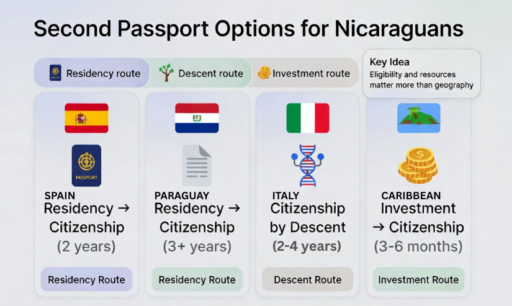
The best countries for a Nicaragua second passport are Spain, Paraguay, Italy, the Dominican Republic, and Caribbean citizenship-by-investment programs, each offering distinct advantages based on eligibility, budget, and timeline.
However, under Nicaragua’s current legal framework, acquiring another nationality can lead to the loss of Nicaraguan citizenship, making this a replacement-of-nationality decision rather than a dual citizenship strategy.
- Route: Residency → naturalization (fast-track for Latin Americans)
- Key requirements: Legal residency, clean record, basic integration (language/culture)
- Investment: Low to moderate (cost of living + residency setup)
- Timeline: 2 years of residency + processing
- Why it’s ideal: Nicaraguans qualify for an accelerated citizenship timeline, making Spain one of the fastest and most accessible European options
- Route: Citizenship by descent (jure sanguinis)
- Key requirements: Proof of Italian ancestry without generational breaks
- Investment: Low to moderate administrative costs only (legal fees, document processing)
- Timeline: 2-4 years processing (varies widely)
- Why it’s ideal: One of the fastest routes if eligible, with no residency requirement and full EU citizenship benefits
- Route: Residency → citizenship
- Key requirements: Proof of income or economic activity, local ties
- Investment: Low (mainly residency application fees, proof of financial means, basic documentation, and possible local setup costs; no fixed investment or donation required)
- Timeline: 3+ years to citizenship
- Why it’s ideal: Affordable and relatively simple pathway, popular among Latin Americans seeking a second nationality
- Route: Residency → naturalization
- Key requirements: Legal stay, local presence, documentation
- Investment: Moderate (residency fees + living costs)
- Timeline: 5 years of temporary residency + 2 years of permanent residency
- Why it’s ideal: Cultural familiarity, Spanish language, and relatively flexible residency options
Caribbean Citizenship-by-Investment Programs
(e.g., Dominica, Saint Kitts e Nevis, Antigua e Barbuda)
- Route: Direct citizenship by investment
- Key requirements: Clean background check, qualifying financial contribution
- Investment: $200,000+ (donation or real estate)
- Timeline: 3-6 mesi
- Why it’s ideal: Fastest route to a second passport, with strong visa-free travel, though significantly more expensive
Qual è il secondo passaporto più facile da ottenere?
The easiest second passport for Nicaragua is typically obtained through Caribbean citizenship-by-investment programs, Turkey’s investment route, and fast-track naturalization systems like Argentina and Spain, each offering different advantages in speed, cost, eligibility requirements, and long-term flexibility.
Investment-based citizenship with minimal relocation: Caribbean CBI programs (Dominica, St. Kitts and Nevis, Antigua and Barbuda)
No residency, language tests, or physical stay are required, with citizenship granted after a qualifying financial contribution and background check.
Costs typically range from about $200,000, depending on the country, investment option (donation vs. real estate), and number of dependents included.
Investment pathway with strong geopolitical access: Turchia
Citizenship is obtained through a qualifying real estate purchase (typically around US$400,000 minimum) or other approved capital investments, with strict but clearly defined legal criteria.
Processing usually takes 6–12 months, and there is no long-term residency requirement before or after approval.
Low-cost naturalization system with relocation requirement: Argentina
Citizenship is available after establishing legal residency and maintaining a basic presence in the country, without any investment or donation requirement.
The legal framework allows eligibility for citizenship in as little as around 2 years of residency, although real-world processing times can extend based on documentation, court workload, and continuity of stay.
The main cost involves standard residency application fees, documentation (translations, apostilles), and living expenses, rather than financial investment.
EU pathway with regional advantage: Spain
Nicaraguans and other Latin Americans can qualify for citizenship after just two years of legal residency, one of the fastest routes into the European Union.
The main requirement is sustained legal stay and integration during the residency period.
Where do Nicaraguans migrate to?
Most Nicaraguans migrate to Costa Rica, the United States, Spain, Panama, and Mexico, with Costa Rica by far the largest and most immediate destination.
As of 2025–2026, Costa Rica hosts hundreds of thousands of Nicaraguans, including over 240,000 refugees and asylum seekers, around 80% of them Nicaraguan, and up to 600,000 Nicaraguans living in the country overall (around 15% of the population), according to World Population Review.
Nicaraguans most commonly migrate to:
- Costa Rica (primary destination for work, asylum, and proximity)
- United States (employment, asylum, and family reunification)
- Spain (legal pathways and fast-track citizenship for Latin Americans)
- Panama (regional business and residency opportunities)
- Mexico (both transit and growing settlement destination)
These countries often serve as stepping stones toward long-term residency or eventual citizenship, especially in Spain and the United States.
Why are so many people leaving Nicaragua?
Many Nicaraguans are leaving due to escalating political repression, loss of civil rights, and economic hardship, especially following recent government actions in 2025–2026.
Reports show increased arbitrary arrests, surveillance, and even the stripping of citizenship from critics, alongside constitutional reforms that concentrate power and restrict freedoms.
Since the 2018 political crisis, the situation has evolved into a prolonged humanitarian and governance crisis, with ongoing human rights concerns and a climate of fear driving people to leave.
At the same time, economic realities remain difficult, with limited formal employment and rising living costs affecting a large portion of the population.
This combination of political pressure and economic constraints has significantly increased interest in long-term solutions like residency or second citizenship abroad, rather than temporary migration alone.
Is a Nicaraguan passport strong?
The Nicaraguan passport is considered mid-tier globally, offering visa-free or visa-on-arrival access to around 125–130 destinations.
Across major passport rankings, it typically sits in the middle range:
- Indice dei passaporti di Henley: Ranked 38th; focuses strictly on visa-free travel access, where Nicaragua ranks mid-range due to strong regional mobility in Latin America and parts of Asia and Africa, but limited entry to high-income countries.
- Indice dei passaporti di Arton Capital: Ranked 38th; weights visa-free, visa-on-arrival, and eVisa access more broadly, giving Nicaragua a similar mid-tier position but slightly improved perception due to broader entry categories.
- Nomad Capitalist Passport Index: Ranked 91st with 78 power score equivalent; uses broader factors beyond travel such as tax system, global reputation, dual citizenship flexibility, and personal freedom, where Nicaragua ranks lower due to higher political and economic constraints.
Overall, the passport performs reasonably well within its region but lacks strong direct access to major economic hubs like the United States, Canada, and the Schengen Area.
What benefits do I get if I have dual citizenship?
A second citizenship for Nicaragua significantly expands mobility, economic access, and personal security compared to relying on a single passport.
- Expanded global mobility with easier access to regions like the EU, North America, and parts of Asia without relying solely on a Nicaraguan passport
- Improved employment and income opportunities through access to higher-paying labor markets abroad
- Access to international education systems, including universities with lower tuition for citizens in certain countries
- Broader financial access, including stronger banking options, currency diversification, and investment opportunities outside Nicaragua
- Greater personal and political security, providing an alternative nationality during periods of instability or travel restrictions
What are the negatives of dual citizenship?
For Nicaraguans, holding a second nationality can create legal and administrative friction between Nicaragua and the second country, especially when rules and obligations do not align.
- Cross-border tax and residency conflicts, depending on income sources and where residency is officially recognized
- Legal uncertainty in changing nationality rules, particularly relevant in regions where citizenship laws and political conditions can shift
- Conflicting civic obligations, such as military or legal duties required in the second country but not in Nicaragua
- Higher compliance workload, including renewals, reporting, and maintaining documentation across two systems
Dual citizenship can expand opportunities, but it also adds ongoing legal and administrative complexity for Nicaraguans.
How second citizenship rules are changing in Nicaragua and the region
Nicaragua’s 2026 removal of dual nationality has made citizenship status more restrictive, turning second passport planning from a convenience into a higher-stakes legal decision.
Across Latin America, citizenship and residency rules are also becoming more closely tied to compliance, background checks, and political considerations, reflecting a broader tightening of nationality frameworks.
In this environment, eligibility is no longer purely procedural, as approval and retention of status can depend on legal interpretation and shifting administrative enforcement.
As a result, second citizenship is increasingly treated as a long-term structural safeguard rather than just a mobility upgrade, especially in countries where legal definitions of nationality can change over time.
Conclusione
Nicaragua second citizenship has become a practical response to shifting legal realities at home and uneven access to global mobility.
The most suitable route is determined less by reputation of a country and more by structural fit, such as eligibility through ancestry, available capital, or ability to sustain residency abroad.
Each pathway operates on a different logic: investment programs prioritize transactional speed, residency systems reward time and continuity, while descent-based options depend entirely on documented family history.
In some cases, structured financial planning and local advisory support, such as guidance from financial advisors in Nicaragua, can help clarify the legal and tax implications of cross-border citizenship decisions.
Domande frequenti
What are the passport requirements for Nicaragua?
Applicants for a Nicaraguan passport generally need a valid national ID (cédula), birth certificate, passport photos, and payment of applicable fees.
The process is typically handled through government offices in Nicaragua or Nicaraguan consulates abroad.
Why are there refugees from Nicaragua?
Refugees from Nicaragua often flee due to political persecution, civil unrest, and human rights concerns.
Since 2018, many have sought asylum in neighboring countries, particularly Costa Rica.
Is Nicaragua a poor or rich country?
Nicaragua is closer to the status of a poor country than a rich one.
It is officially classified as a lower-middle-income developing economy, meaning income levels and infrastructure are limited compared to developed nations, though it is not among the world’s lowest-income countries.
Siete afflitti dall'indecisione finanziaria?

Adam è un autore riconosciuto a livello internazionale in materia finanziaria con oltre 830 milioni di visualizzazioni di risposte su Quora, un libro molto venduto su Amazon e un contributo su Forbes.