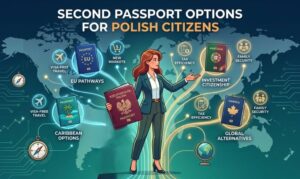
Polish citizens can obtain a second passport through countries such as Portugal, Turkey, and select Caribbean nations without losing their Polish citizenship.
A second passport for Poland expands global mobility, financial flexibility, and long-term security beyond what a single nationality can offer.
Questo articolo tratta di:
- Does Poland allow two passports?
- What is the best country to get a second passport?
- Qual è il posto più facile per ottenere un secondo passaporto?
- How powerful is a Polish passport?
- Quali sono i pro e i contro della doppia cittadinanza?
Punti di forza:
- Poland allows dual citizenship without requiring renunciation.
- The Polish passport is already strong, offering high global mobility and full EU freedom of movement.
- Top second passport options for Polish citizens include Portugal, Caribbean CBI programs, and Turkey.
- Dual citizenship adds value through expanded mobility, financial flexibility, and additional residency rights.
I miei recapiti sono hello@adamfayed.com e WhatsApp +44-7393-450-837 se avete domande.
Per i visti per nomadi digitali o di residenza che richiedono un reddito, un patrimonio o investimenti qualificati, possiamo aiutarvi a strutturare soluzioni di investimento adatte a soddisfare tali requisiti, a seconda delle vostre circostanze.
Le informazioni contenute in questo articolo hanno carattere puramente indicativo, non costituiscono una consulenza finanziaria, legale o fiscale e possono essere cambiate rispetto al momento in cui sono state scritte.

Can Polish people have two passports?
Yes, Polish citizens can legally hold more than one passport. Poland allows doppia cittadinanza and does not require individuals to renounce their Polish nationality when acquiring another citizenship.
However, the country follows the principle that within Poland’s jurisdiction, only Polish citizenship is recognized.
This means dual nationals are treated solely as Polish citizens when entering, residing in, or dealing with Polish authorities.
This framework reflects Poland’s approach to administrative clarity and sovereignty, ensuring that citizenship rights and obligations are applied consistently under domestic law while still allowing individuals to benefit from additional citizenships abroad.
Does dual citizenship affect Polish citizenship?
Dual citizenship does not invalidate or weaken Polish citizenship.
Once obtained, whether by descent, naturalization, or birth, Polish citizenship remains secure unless formally renounced.
Historically, Poland did not fully embrace dual citizenship under earlier legal frameworks, and in the past, holding another nationality could create administrative complications.
However, modern Polish nationality law no longer penalizes or restricts citizens for acquiring a second passport, reflecting a more flexible approach aligned with international mobility trends.
This means that while you may benefit from another passport abroad, your legal obligations such as compliance with Polish laws and regulations when residing or conducting official matters in the country, remain unchanged.
Why are Polish people leaving Poland?
Polish emigration is driven mainly by economic opportunity, career mobility, and lifestyle differences rather than political instability or safety concerns, with many citizens moving abroad to access higher wages, stronger career progression, and broader professional opportunities across Western Europe.
Common reasons include:
- Higher salaries and stronger purchasing power in countries like Germany, the Netherlands, and the UK
- Broader career opportunities in larger labor markets
- Access to international education and professional experience
- Lifestyle factors such as work-life balance and perceived quality of life improvements
Since Poland joined the EU, freedom of movement has made relocation significantly easier, allowing citizens to live and work across Europe without visa barriers.
This structural mobility has been a key driver of long-term migration patterns.
In recent years, the motivation to seek second citizenship for Poland has also been influenced by broader global developments.
Economic pressures such as inflation and cost-of-living increases across Europe have made some individuals consider additional passports as a hedge for financial and geographic flexibility.
At the same time, geopolitical uncertainty in parts of Europe and shifting labor markets have reinforced interest in non-EU citizenship options that provide access to regions outside the Schengen area.
Interestingly, migration patterns are also becoming more dynamic.
While emigration remains steady, there has been a visible trend of return migration as Poland’s economy has strengthened, with improving wages and living standards encouraging some citizens to come back after years abroad.
This shifting balance highlights that mobility decisions are increasingly flexible rather than permanent.
Which country is best for a second passport?
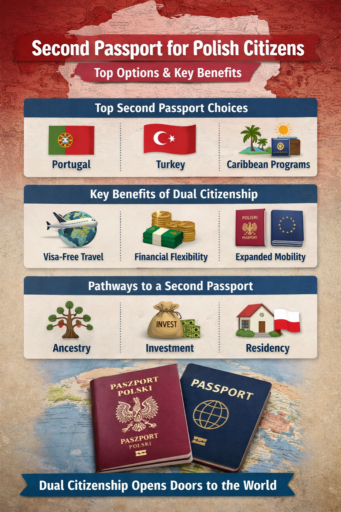
The best second passport options for Polish citizens are Portugal, Caribbean citizenship-by-investment programs, and Turkey, each offering different routes in terms of timeline, cost, and global mobility outcomes.
- Requires approximately 5 years of legal residency before applying for citizenship
- Residency maintained through programs such as the Visto d'oro or other legal stay routes
- Basic integration requirements include lawful stay continuity and language adaptation
- Leads to full EU citizenship with the right to live, work, and study across all EU member states
- Ideal for Polish citizens seeking long-term stability and expanded EU mobility beyond Poland
Caribbean countries (Dominica, St. Kitts e Nevis, Antigua e Barbuda)
- Citizenship-by-investment programs with contributions starting from around USD 200,000 to USD 250,000+
- Additional government fees and due diligence costs apply depending on application size
- No physical residency requirement in most programs
- Processing typically completed within a few months (3-6 months)
- Provides visa-free or visa-on-arrival access to multiple global destinations
- Suitable for Polish citizens prioritizing speed and travel flexibility
- Citizenship through real estate investment starting from around USD 400,000 under current rules
- Citizenship processing usually completed within 6–12 months after approval
- Requires maintaining qualifying investment for a set period
- Offers strategic geographic access between Europe, Asia, and the Middle East
- Provides a non-EU second passport with strong regional mobility and investment potential
- Attractive for Polish citizens seeking faster alternative citizenship with asset-backed investment
Each pathway reflects a different strategy—Portugal for long-term EU integration, Caribbean programs for speed and mobility, and Turkey for investment-driven citizenship with regional advantages.
Other options to consider
Beyond Portugal, the Caribbean, and Turkey, Polish citizens can also explore a few additional pathways for a second passport:
- Spagna (residency-based citizenship) – Requires around 10 years of legal residency before naturalization. It is slower than Portugal but grants full EU citizenship and strong lifestyle benefits for long-term residents.
- Latin American countries (Argentina, Brasile, Messico) – Offer relatively short naturalization timelines (often 2–5 years of residency), with lower financial barriers and strong passport strength in regional mobility. These routes are attractive for relocation-focused applicants rather than investment-driven ones.
These alternatives are generally less commonly used by Polish citizens compared to Portugal or investment programs, but they can be strategic depending on long-term relocation goals, budget, and preferred region.
Which is the easiest second passport to get?
The easiest second passports for Polish citizens are typically found in countries such as Dominica, St. Kitts and Nevis, Antigua and Barbuda, Vanuatu, and select ancestry-based options in countries like Italy and Ireland.
These jurisdictions prioritize fast approval, minimal residency requirements, and straightforward documentation processes rather than long-term settlement.
- Caribbean citizenship-by-investment countries (Dominica, St. Kitts and Nevis, Antigua and Barbuda) – These programs are widely regarded as the most streamlined, offering citizenship in a matter of 3-6 months through a government contribution or approved investment, with no physical residency requirement and a largely document-based process.
- Vanuatu – One of the fastest citizenship programs globally, with approval timelines often ranging from 1 to 3 months through a government donation starting at around USD 130,000 for a single applicant, requiring minimal documentation, no residency, and no relocation.
- Italy (citizenship by descent) – Offers a relatively straightforward pathway for eligible applicants with Italian ancestry, often without residency requirements, provided full documentation of lineage is available.
- Ireland (citizenship by descent) – Allows citizenship through parental or sometimes grandparental lineage, making it one of the simplest EU-related routes for qualifying applicants with verifiable family ties.
Is Poland a strong passport?
Yes, the Polish passport is considered a strong global passport, offering high visa-free mobility (around 180 countries) and full access to the European Union’s freedom of movement system.
Poland passport ranking in global indices
| Index | Latest ranking (approx.) | Key note |
| Indice dei passaporti di Henley | 6th | Strong EU mobility and global travel access |
| Indice dei passaporti di Arton Capital | 5th | High mobility score with strong EU weighting |
| Indice del passaporto nomade capitalista | 26th | Weaker ranking due to taxation/residency factors despite strong mobility |
What are the perks of dual citizenship with Poland?
Dual citizenship with Poland provides expanded global mobility, additional residency and work rights, and greater flexibility for travel, business, and long-term international planning.
It expands visa-free access beyond what the Polish passport alone offers and creates more options for living and working outside Poland and the EU.
It also improves financial and business flexibility by opening access to different banking systems and regulatory environments, while diversifying political and economic risk exposure.
It can also serve as a contingency option for families seeking long-term stability across multiple jurisdictions in an increasingly uncertain global environment.
Quali sono le sfide della doppia cittadinanza?
The main challenges of dual citizenship with Poland include potential legal conflicts between countries, tax complexity, administrative burdens, and limited consular protection in Poland.
It may involve conflicting legal obligations between countries, particularly in areas such as military service, reporting rules, or residency-based requirements.
Tax complexity can also arise depending on the jurisdictions involved, especially where global income reporting or dual tax residency rules apply.
Managing multiple passports adds administrative responsibility, including renewals, documentation updates, and compliance with differing entry and exit rules.
In addition, consular protection in Poland is limited, as dual nationals are treated strictly as Polish citizens while in Polish territory.
Is a second passport necessary for Polish citizens or just a strategic advantage?
Polish citizens generally do not need a second passport because the Polish passport already provides strong global mobility and full EU freedom of movement rights.
In most cases, it is a strategic tool used to expand options beyond the EU framework.
The relevance of a second passport depends on personal profile and objectives.
Business owners often use additional citizenship or residency to improve banking access, regulatory flexibility, and cross-border operational efficiency.
Frequent travelers prioritize faster visa-free access and reduced administrative friction, where passport strength and global reach matter more than long-term settlement.
For families, the focus is usually stability, education access, and relocation flexibility, making EU-based pathways more attractive due to their integration benefits and long-term residence rights.
Investors tend to view second citizenship as a diversification strategy, using it to spread geopolitical and economic risk while increasing jurisdictional optionality.
A second passport becomes most valuable for individuals with international lifestyles, cross-border income, or long-term plans outside Europe.
Conclusione
The practical question is not whether a second passport for Polish citizens is useful, but when it actually changes outcomes.
In many cases, the marginal benefit is low for day-to-day travel, since Poland already sits in a high-mobility position within the EU framework.
Where it becomes more relevant is in edge cases, where timing, jurisdiction, or access rules create friction that cannot be solved by the Polish passport alone.
That includes situations like relocating on short notice, structuring income across borders, or accessing markets where administrative barriers are not symmetrical for EU citizens.
Another under-discussed point is that second citizenship decisions are rarely reversible in effect.
Once obtained, they tend to shape future financial and residency behavior more than expected at the time of application, often influencing where people open accounts, register businesses, or eventually settle.
Because second citizenship decisions often intersect with tax residency, asset structuring, and succession planning, Polish citizens may benefit from seeking specialist cross-border advice before applying.
A second passport should be assessed not only as a mobility tool, but as part of a broader international planning strategy.
Domande frequenti
Is it easy to get Polish dual citizenship?
Yes, obtaining Polish dual citizenship can be relatively straightforward if you can prove Polish ancestry, as there is no strict generational limit for citizenship by descent.
Otherwise, naturalization is possible but requires meeting residency and integration requirements in Poland.
Is it difficult to get a Poland visa?
For EU citizens, a visa for Poland is not required, while for non-EU nationals the process is generally straightforward but based on the visa type and eligibility.
Work, study, and residency visas require standard documentation, financial proof, and compliance with immigration requirements.
Is Poland a wealthy or poor country?
Poland is considered a high-income, developed economy within the EU.
It has experienced strong economic growth over the past decades and continues to improve in infrastructure, living standards, and investment opportunities for expats.
Siete afflitti dall'indecisione finanziaria?

Adam è un autore riconosciuto a livello internazionale in materia finanziaria con oltre 830 milioni di visualizzazioni di risposte su Quora, un libro molto venduto su Amazon e un contributo su Forbes.