Russian citizens can obtain second citizenship through citizenship-by-investment programs such as Turkey and Caribbean countries, or through residency-based pathways in Europe that lead to citizenship over time.
However, dual citizenship comes with mandatory reporting rules and limited foreign protection while inside Russia.
Questo articolo tratta di:
- Does Russia allow second citizenship?
- Which country is best for a 2nd passport?
- Qual è il paese più facile per ottenere un secondo passaporto?
- What are the benefits of a second passport?
Punti di forza:
- Russia allows dual citizenship but requires official notification.
- A second passport improves travel freedom and financial flexibility.
- The most practical second passports for Russians include Portugal, Greece, Turkey, and Caribbean nations like St. Kitts and Nevis.
- Russian passport strength is moderate, making diversification valuable.
I miei recapiti sono hello@adamfayed.com e WhatsApp +44-7393-450-837 se avete domande.
Per i visti per nomadi digitali o di residenza che richiedono un reddito, un patrimonio o investimenti qualificati, possiamo aiutarvi a strutturare soluzioni di investimento adatte a soddisfare tali requisiti, a seconda delle vostre circostanze.
Le informazioni contenute in questo articolo hanno carattere puramente indicativo, non costituiscono una consulenza finanziaria, legale o fiscale e possono essere cambiate rispetto al momento in cui sono state scritte.

Can you have two passports in Russia?
Yes, Russian citizens are legally allowed to hold two passaporti. Russia recognizes doppia cittadinanza, but it comes with specific rules.
A Russian national who acquires a second passport must notify the government, typically through the Ministry of Internal Affairs of Russia. Failure to declare dual citizenship can result in penalties.
However, Russia treats dual citizens primarily as Russian nationals within its territory.
Questo significa che:
- Foreign consular protection may be limited while in Russia, especially in legal or administrative matters involving Russian authorities
- Russian laws fully apply regardless of second nationality, including taxation, military obligations, and legal responsibilities
Why do Russians need two passports?
Russians need two passports to manage domestic identification and international travel efficiently, while also securing flexibility for visas and global mobility.
Every citizen must have an internal passport for life in Russia and an international passport for travel abroad, and frequent travelers can carry a second Russian international passport to apply for multiple visas or avoid delays.
Beyond these requirements, Russians often obtain a foreign passport to overcome travel restrictions, protect assets internationally, and gain greater personal and economic freedom.
- Travel flexibility
A second passport can help bypass visa restrictions and geopolitical limitations, allowing easier entry to countries where Russian passport holders may face stricter visa requirements or delays. - Political and economic stability
Holding another citizenship provides a safety net in uncertain times, giving individuals the option to relocate, live, or operate in a more stable political or economic environment if conditions change. - Financial diversification
It allows access to foreign banking systems, investments, and property ownership opportunities, reducing exposure to domestic financial risks and enabling international wealth structuring. - Education and healthcare access
Many second passports grant easier entry to high-quality international services, including universities, healthcare systems, and social benefits in more developed jurisdictions.
From a legal perspective, dual citizenship in Russia is governed by the Russian Constitution and the Federal Law on Citizenship of the Russian Federation, which allow citizens to hold another nationality.
While this has been permitted since the 1990s, enforcement tightened in 2014 with mandatory notification requirements through the Ministry of Internal Affairs of Russia.
In addition, a 2015 decree signed by Vladimir Putin expanded the practical use of multiple passports by allowing Russian citizens to hold two international (foreign travel) passports at the same time, according to The Moscow Times.
Previously, this was limited to individuals who traveled abroad frequently for work.
This change addressed real-world travel issues, including:
- The ability to apply for multiple visas simultaneously without waiting for passport returns
- Avoiding complications when visiting countries with conflicting diplomatic relations
- Reducing delays for frequent international travelers
Historically, the demand for second passports grew after the collapse of the Soviet Union, when mobility increased but remained constrained by visas and geopolitical factors.
Today, evolving sanctions, stricter entry requirements, and global uncertainty continue to reinforce the purpose of holding a second passport for Russia, not just for convenience, but as a long-term strategy for mobility, security, and global access.
What is the best second passport to have?
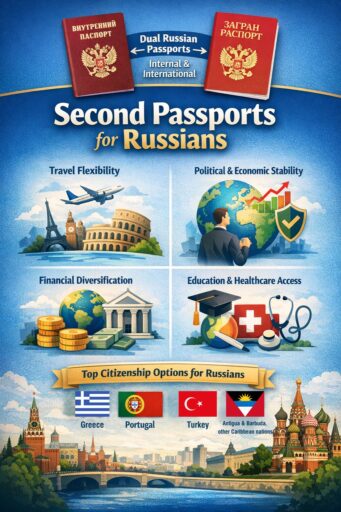
The best second passports for Russians are typically from Portugal, Greece, Turkey, and Caribbean countries such as St. Kitts and Nevis, as they offer stronger global mobility and financial flexibility.
The right choice depends on how much visa-free access, stability, and banking access you need.
Russians should prioritize passports from politically neutral countries with strong travel access and minimal restrictions.
Here are the top second passport options for Russians:
Portogallo
- Portugal is one of the most attractive options due to its pathway to EU citizenship, offering access to the entire European Union.
- Key requirements include a minimum residency of 5 years (through the Visto d'oro), a qualifying investment, and basic language knowledge.
- It provides long-term stability, strong passport power, and access to European banking and lifestyle benefits.
Grecia
- Greece Golden Visa program provides a practical EU citizenship pathway, which requires a real estate investment of at least €250,000.
- Citizenship can typically be obtained after 7 years of residence.
- It grants EU travel freedom, access to European banking, and a favorable geographic location for both Europe and the Eastern Mediterranean.
Saint Kitts e Nevis
- St. Kitts and Nevis citizenship-by-investment program is a leading Caribbean option known for fast processing and visa-free travel to many countries, including parts of Europe and the UK.
- Key requirements include a financial contribution to the Sustainable Growth Fund or a qualifying real estate investment, with no residency requirement.
Other Caribbean Programs
- Countries like Dominica e Antigua e Barbuda offer similar benefits at relatively lower costs.
- Requirements typically include a financial contribution or immobiliare purchase, a clean criminal record, and minimal physical presence, usually a few days per year if at all.
Turchia
- Turkey provides a fast and relatively affordable citizenship route through real estate investment of at least $400,000 or capital investment.
- Applicants benefit from no lengthy residency requirements and gain access to both European and Asian markets, making it a practical option for Russians seeking a balance between cost, speed, and geographic reach.
Mentre CBI programs are the fastest and most predictable route for Russians to secure a second passport, non-investment routes exist through ancestry, marriage, or residency, but they usually take years rather than months, and often require time spent living in the country.
Some of the most practical non-investment second passport options include:
- Italia – Citizenship through ancestry (jure sanguinis) allows individuals with Italian parents or grandparents to claim citizenship without residency. It provides full EU rights, excellent travel freedom, and access to European banking.
- Polonia – Descendants of Polish citizens can apply for citizenship. This is especially useful for Russians with family roots in Poland and offers EU mobility and stability.
- Irlanda – Citizenship through an Irish-born parent or grandparent is relatively straightforward and grants a strong EU passport with visa-free access to Europe and many other countries.
- Portogallo – Beyond investment, Portugal also offers naturalization after 5 years of legal residence, making it one of the fastest EU residency-based paths to citizenship.
- Spagna e Francia – Marriage to a citizen or long-term residency (typically 1–5 years through marriage, longer through regular residence) can lead to naturalization, giving Russians EU access and long-term stability.
Which is the easiest second passport to get?
The easiest second passport for Russia is typically obtained through citizenship by investment (CBI) programs, which are designed for speed and efficiency.
Popular options include:
- Caribbean nations – such as St. Kitts & Nevis, Dominica, and Antigua & Barbuda; they offer fast processing, minimal residency requirements, and relatively low costs.
- Turchia – citizenship through real estate or capital investment, with no lengthy residency required and access to both European and Asian markets.
- Vanuatu – known for one of the quickest approval timelines globally, often granting citizenship in just a few months.
Vanuatu and similar programs are less focused on long-term European access or global visa strength, but they excel in speed and simplicity, making them ideal for Russians who prioritize a quick and straightforward route to a second passport.
How powerful is a Russian passport?
A Russian passport offers moderate global mobility, allowing visa-free or visa-on-arrival access to approximately 113 countries, ranked 44th according to the Henley Passport Index.
Arton Passport Index ranks it slightly higher with mobility score of 123, reflecting a broader measure of travel freedom, while the Nomad Capitalist Passport Index emphasizes geopolitical flexibility, rating it as mid-tier among global passports.
While it allows:
- Visa-free or visa-on-arrival access to parts of Asia, Latin America, and CIS countries
- Regional mobility advantages within neighboring states
It still faces limitations compared to top-tier passports from the European Union, Japan, or Singapore, particularly for travel to Western Europe and North America.
How Recent Instability in Russia Drives Demand for a Second Passport
Recent events in Russia have significantly increased interest among citizens in obtaining a second passport.
The ongoing war in Ukraine, along with the partial mobilization announced in 2022, has created widespread uncertainty, prompting many Russians to consider options that provide security and mobility abroad.
Large numbers of citizens left the country during these periods, with hundreds of thousands remaining abroad, and many are now actively seeking ways to maintain global access while avoiding potential risks at home.
Economic instability has also played a role.
Sanctions, disrupted trade, and domestic economic pressures have affected day-to-day life and business opportunities, making the appeal of a second passport that allows access to foreign banking systems, investimenti, and employment more tangible.
At the same time, the domestic political climate including increased surveillance and stricter enforcement of government policies has heightened concerns about personal freedoms and long-term stability.
For Russians, a second citizenship offers a form of insurance against these uncertainties. It provides not only a means of travel and international mobility, but also a legal and financial safety net in case of emergencies or sudden restrictions.
Together, these developments help explain why the demand for second passports among Russians is growing rapidly, with many viewing it as a necessary safeguard rather than merely a convenience.
Conclusione
A second passport for Russians is increasingly about choice and control, not just convenience.
In today’s world of political shifts, economic uncertainty, and regional instability, it offers a tangible way to secure freedom and protection for oneself and one’s family.
Beyond travel benefits, a second citizenship provides financial flexibility, access to global opportunities, and long-term resilience.
Choosing the right passport is therefore a strategic decision, allowing individuals to transform uncertainty into actionable options for stability and opportunity.
Domande frequenti
How to become a dual citizen of Russia?
To become a dual citizen of Russia, you must legally acquire a second nationality through ancestry, residence, marriage, or investment, and notify Russian authorities, typically via the Ministry of Internal Affairs.
Russia does not require renouncing your original citizenship, but you must also comply with the laws of the other country.
Is it safe to travel to Russia with dual citizenship?
Yes, but caution is required. Russia treats dual citizens as Russian nationals while in the country, so you must enter and exit using your Russian passport, and foreign consular assistance may be limited.
Always stay informed about travel advisories and legal obligations.
How many passports can a Russian citizen have?
A Russian citizen can hold one internal passport for domestic identification and one or more international passports for travel.
They may also possess foreign passports through dual or multiple citizenships, as long as these are properly declared to Russian authorities.
What are the advantages of having a Russian passport?
A Russian passport provides access to the country’s large domestic economy, eligibility for state services and benefits, and the ability to travel visa-free or with simplified procedures within the CIS region.
Siete afflitti dall'indecisione finanziaria?

Adam è un autore riconosciuto a livello internazionale in materia finanziaria con oltre 830 milioni di visualizzazioni di risposte su Quora, un libro molto venduto su Amazon e un contributo su Forbes.