The best second passport for Somalis includes Turkey, Caribbean citizenship-by-investment countries like St. Kitts and Nevis and Dominica, and European residency pathways such as Portugal and Spain.
These citizenship options are typically used to improve global mobility, access safer long-term residency options, and expand economic and educational opportunities.
Questo articolo tratta di:
- Can Somalis have dual citizenship?
- Why are Somalis leaving Somalia?
- Why is it good to have two passports?
- What is the best second passport to have?
- Is a Somali passport strong?
Punti di forza:
- Somalia permits dual citizenship, allowing Somalis to legally hold a second passport.
- Caribbean programs and Turkey are among the fastest routes to a second passport.
- The Somali passport has very limited visa-free access compared to global averages.
- A second passport significantly improves mobility, safety, and long-term opportunity access.
I miei recapiti sono hello@adamfayed.com e WhatsApp +44-7393-450-837 se avete domande.
Per i visti per nomadi digitali o di residenza che richiedono un reddito, un patrimonio o investimenti qualificati, possiamo aiutarvi a strutturare soluzioni di investimento adatte a soddisfare tali requisiti, a seconda delle vostre circostanze.
Le informazioni contenute in questo articolo hanno carattere puramente indicativo, non costituiscono una consulenza finanziaria, legale o fiscale e possono essere cambiate rispetto al momento in cui sono state scritte.

Does Somali allow dual citizenship?
Yes. Somalia officially permits doppia cittadinanza under its nationality law, allowing citizens to legally hold a second passport.
This means Somalis who acquire another nationality do not automatically lose their Somali citizenship.
The policy has made it easier for members of the Somali diaspora to settle abroad while still maintaining formal ties to Somalia.
It also allows individuals to combine their original identity with the benefits of a stronger passport for travel, work, and residency opportunities.
Why do people move from Somalia?
People leave Somalia for a combination of security, economic, environmental, and humanitarian reasons, and these pressures have intensified in recent years.
The country continues to face ongoing conflict and insecurity linked to armed groups and political instability, which directly affects civilian safety and daily life.
At the same time, Somalia is experiencing a worsening humanitarian situation, with millions at risk of hunger due to repeated droughts, climate shocks, and food insecurity affecting livelihoods and livestock-based communities.
In 2025–2026, reports show that millions of people face acute food shortages and displacement driven by overlapping drought, conflict, and limited humanitarian access, pushing many families to seek safety elsewhere.
Beyond survival concerns, many Somalis also migrate due to limited job opportunities, weak infrastructure, and underdeveloped public services, which make long-term economic stability difficult.
Access to reliable healthcare, education, and consistent employment remains a major challenge in many regions.
As a result, large Somali communities have formed across Europe, North America, and the Middle East, where people often seek safety, stability, and better long-term opportunities for themselves and their families.
Why have two passports?
For Somalis, holding two passports is often a practical necessity rather than a luxury, mainly due to limited travel freedom and long-term instability.
A second passport significantly expands global mobility, allowing easier access to countries that typically require visas for Somali nationals.
It also provides an important safety net during periods of conflict or crisis, giving individuals the option to relocate quickly if needed.
Beyond security, dual citizenship opens doors to better education systems, healthcare access, and formal employment opportunities in more stable economies.
It also allows Somalis to build businesses, own property, and live or work across multiple countries with fewer restrictions.
In many cases, a second passport becomes a long-term strategy for stability, opportunity, and resilience for individuals and families in the Somali diaspora.
Which country is best for a second passport?
For Somalis, the most practical second passport options are Turkey, Caribbean citizenship-by-investment countries like St. Kitts and Nevis and Dominica, and European residency pathways such as Portugal and Spain, based on budget, timeline, and long-term settlement goals.
Programmi di cittadinanza per investimenti nei Caraibi
- Countries: St. Kitts e Nevis, Dominica, Antigua e Barbuda
- Pathway: Citizenship-by-investment (donation or investimento immobiliare)
- Key requirements: Around $200,000–$250,000+ minimum investment, strict due diligence, no long residency requirement
- Why it suits Somalis: Fast processing and strong visa-free travel access, ideal for quick mobility and security diversification
- Pathway: Citizenship-by-investment (usually real estate purchase)
- Key requirements: Around $400,000 property investment, legal documentation, and registration requirements
- Why it suits Somalis: Geographic proximity, cultural familiarity, and strong Somali diaspora presence, making settlement and business setup easier
Portugal and Spain
- Pathway: Residency → long-term residency → citizenship
- Key requirements: 5–10 years of residence, legal stay through work, study, or investment routes, plus language/integration requirements
- Why it suits Somalis: Access to EU residency, healthcare, education, and eventual EU citizenship, ideal for long-term stability
Canada and the United States
- Pathway: Asylum, family sponsorship, skilled migration, or work-based visas
- Key requirements: High documentation standards and competitive immigration systems
- Why it suits Somalis: Large Somali diaspora communities and strong economic opportunities, but long and complex pathways to citizenship
Other second passport options to consider
- Nordic countries (Sweden, Norway, Danimarca, Finlandia) – asylum or family-based routes leading to citizenship after ~5–8+ years; strong Somali communities and high-quality welfare systems.
- Regno Unito – asylum, work, or family routes; citizenship typically after ~5–6 years; one of the largest Somali populations in Europe.
Each option serves different Somali priorities, whether the focus is speed, diaspora integration, income opportunity, or long-term EU/Western settlement.
Which country gives the quickest citizenship?
If speed is the main priority and cost is not a major constraint, the fastest second citizenship options for Somalis are generally found in Caribbean citizenship-by-investment programs and Turkey, with a few other small-state programs globally offering similar timelines.
Caribbean citizenship-by-investment countries (Dominica, St. Kitts and Nevis, Antigua and Barbuda) typically offer citizenship in around 3–6 months through approved investment routes.
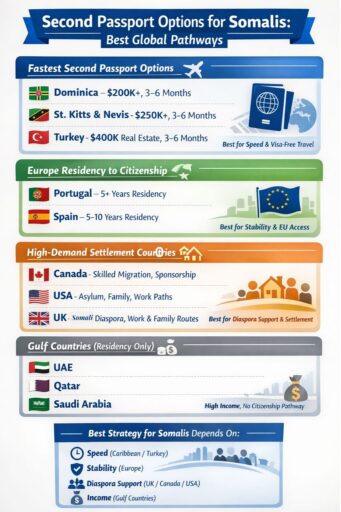
These are among the fastest globally because they are designed for direct economic contribution rather than long-term residency.
However, for Somalis, the main drawback is the high upfront cost and strict source-of-funds checks, which can be difficult without strong financial documentation or international banking history.
Turkey also offers a relatively fast citizenship route, often within 3–6 months, through qualifying real estate investment.
While more accessible geographically and culturally for Somalis, the main limitation is the large capital requirement (property investment threshold) and exposure to currency and property market risks.
Globally, a few other small jurisdictions (such as Vanuatu) can also process citizenship quickly, sometimes within a few months.
However, these options often come with weaker passport strength, limited visa-free access compared to Caribbean or Turkish passports, and higher regulatory scrutiny from international banks, which can reduce their practical value for long-term mobility.
Overall, the fastest routes tend to prioritize speed over flexibility, meaning Somalis choosing these options should carefully weigh cost, documentation readiness, and long-term usability of the passport, not just processing time.
How strong is a Somali passport?
The Somali passport is considered one of the weakest passports worldwide, offering very limited visa-free access and ranking consistently at the bottom across major global passport indices.
Global passport index standings:
| Index | Standing of Somali Passport | Key Insight |
| Indice dei passaporti di Henley | 97th | Very limited visa-free access, typically only a small number of destinations |
| Indice dei passaporti di Arton Capital | 90th | Low global mobility score compared to most countries |
| Indice del passaporto nomade capitalista | 191st | Weak performance in travel freedom, taxation, and perception factors |
Somalia’s passport offers limited travel freedom, with visa-free or visa-on-arrival access to around 30–40 countries mainly in Africa, the Caribbean, Oceania, and parts of Asia.
Key destinations include places like Dominica, Haiti, Micronesia, Seychelles (visa on arrival/eVisa), Comoros, Maldives, and Bangladesh (visa on arrival in some cases).
Most countries in Europe, North America, and much of Asia still require advance visas, significantly restricting mobility for travel and relocation.
However, Somalia’s passport is slowly improving as diplomatic relations expand and international reintegration continues, which may gradually increase visa access over time.
What are the negatives of dual citizenship?
For Somalis, the main downside of holding dual citizenship is that it can create additional legal, financial, and administrative obligations across two countries instead of one.
- Possible tax obligations in more than one country, depending on residency status and income sources.
- Complicated legal responsibilities across jurisdictions, especially when laws differ between Somalia and the second country.
- Military service obligations in some countries, which may still apply even if citizenship is held alongside Somali nationality.
- Administrative complexity, including managing passport renewals, visas, and compliance requirements in both systems.
- Risk of conflicting laws between countries, particularly in areas like taxation, eredità, or legal residency status.
Common mistakes Somalis make when applying for a second passport
One of the biggest risks in pursuing a second citizenship for Somalia is not the process itself, but avoidable mistakes that can lead to delays, rejections, or financial loss.
- Using unlicensed agents or unofficial intermediaries – This can lead to fraud, loss of funds, or invalid applications. Applicants should always verify that agents or firms are officially authorized by the destination country.
- Ignoring tax residency rules – Poor planning can result in unexpected tax obligations in both Somalia and the second country, especially if residency status is not clearly structured.
- Choosing the wrong program for long-term goals – Some applicants prioritize speed over strategy, selecting quick citizenship options when they actually need long-term residency, EU access, or family migration pathways.
- Underestimating documentation requirements – Many programs require strict paperwork such as proof of funds, background checks, and source-of-wealth verification, which can delay or block applications if incomplete.
- Assuming all second passports offer the same benefits – Different passports vary widely in visa-free access, renewal conditions, and legal restrictions, so benefits should be carefully compared before applying.
Conclusione
Pursuing a second passport for Somalia is ultimately a strategic response to limited mobility and uneven global opportunity access.
The most effective choice depends less on which passport is strongest and more on which pathway fits long-term life goals, financial capacity, and migration intent.
Some routes prioritize speed and immediate travel freedom, while others focus on gradual access to long-term residency, stability, and eventual citizenship in more developed economies.
In practice, outcomes often depend as much on planning, documentation quality, and compliance as on the country program itself.
A well-chosen second passport strategy should therefore be viewed as a multi-year decision shaped by stability, opportunity access, and future mobility needs, rather than a one-time application outcome.
Domande frequenti
Can I get a Somali passport if I’m not Somali?
No. You cannot get a Somali passport unless you are a Somali citizen.
Foreigners who have legally acquired Somali citizenship (e.g., through naturalization) are eligible to apply.
Why are people seeking asylum from Somalia?
Many people seek asylum due to conflict, insecurity, persecution, and humanitarian crises.
Others apply for protection due to lack of stable governance or exposure to environmental disasters such as droughts.
What is the main problem in Somalia?
The main challenges in Somalia include political instability, security issues, poverty, weak institutions, and climate-related hardships.
These factors significantly affect daily life and economic development.
What countries have the most Somalis?
The countries with the largest Somali populations are Somalia, Ethiopia, Kenya, Djibouti, and Yemen, where significant Somali communities are found due to both historical presence and regional migration patterns.
Siete afflitti dall'indecisione finanziaria?

Adam è un autore riconosciuto a livello internazionale in materia finanziaria con oltre 830 milioni di visualizzazioni di risposte su Quora, un libro molto venduto su Amazon e un contributo su Forbes.