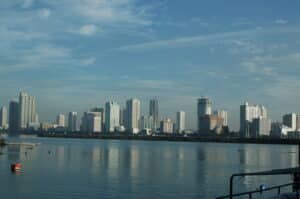
Buying a condo in Manila (Philippines) – is it a good idea? That will be the subject of today’s article.
Before reading this article, it has to be mentioned that the long-term performance of the market has been poor, at least in USD terms.
My general view, therefore, is that it is a bad idea to buy most forms of real estate in Manila, but this article, written by my staff, will also consider some of the positives.
If you want to invest in more productive assets, don’t hesitate to contattatemi, e-mail (advice@adamfayed.com) o utilizzare la funzione WhatsApp qui sotto.
Introduzione

The Philippines is a tropical country in the Pacific Ocean, blessed with beautiful natural landscapes, active volcanoes and extreme weather conditions.
Technically, this archipelagic state consists of more than 7,000 islands bordering Taiwan to the north, the Pacific Ocean to the east, Indonesia and Malaysian Borneo to the south, and the South China Sea to the west. Tourism here increased by 8.3%. up to 7.1 million visitors in 2018, according to the country’s Ministry of Trade and Industry.
So in this article we’ll try to explain in details the process of purchasing condominium in the Philippines and of course discuss every possible way of making it become a reality. In fact you’ll figure out for yourself is it a good idea and plan your further steps.
The country attracts not only tourists. The Philippines is home to a large and welcoming community of expatriates who enjoy low cost of living, attractive beaches, beautiful flora and fauna, tropical climate and friendly locals to name just a few of the amenities.
Overseas retirement publishing group InternationalLiving.com estimates that most expats can live comfortably in the Philippines for about $ 1,525 a month, including food, activities, and basic health care and housing costs. Housing makes up a significant portion of the budget.
Although many expats rent out, buying can be more cost effective, especially if you plan to stay in the country for more than a few years. In general, foreigners are prohibited from owning land in the Philippines, but they can legally own a residence. Here are some options.
One of the highlights when moving abroad is which part of the destination country you call home. There are many factors to consider before setting off. Do you want to be close to all the hustle and bustle living a lot abroad? Or do you really want to leave everything behind and live without problems?
If you want to be at the center of it all, consider major cities like Quezon City, home to nearly three million people. Manila, the capital, with a population of about 1.8 million, is one of the most populous cities in the world. Finally, the city of Davao, with a population of 1.6 million, is one of the country’s tourist centers.
These cities, along with other major metropolitan areas, have all the benefits you expect, including dining, nightlife and entertainment right at your fingertips. There are also many markets as well as access to medical facilities. But remember that with all these amenities there is a lot of traffic and large crowds of people.
You might be bored with city life and would rather try something less urban. Tagaytay is a popular destination among tourists, both domestic and foreign. Located in a mountainous region, it is known as one of the country’s summer capitals due to its cooler climate.
With a total population of around 72,000, there is plenty to do, from golf courses and other outdoor activities. Dumaguete is slightly larger, with a population of over 130,000. It is the main seaport with beautiful beaches. Baclayon with a population of about 21,000 is located on the island of Bohol has beautiful colonial Spanish possessions.
Buying a condominium
Perhaps the easiest option is to purchase a condominium, a hybrid type of property that transcends traditional structures. With traditional ownership, you own the building and the land on which it is located.
However, if you buy a condominium, you only own the apartment itself, not the land underneath. The Philippine Condominium Act specifies that foreigners can own condominium units if 60% of the units in the building are owned by Filipinos.
Remember, there are a few things you need to consider if you are looking to buy an apartment in the Philippines. As elsewhere, you will have a monthly condominium fee. And depending on where you live, you might have to share amenities such as a pool, gardens, and shared outdoor spaces.
The best you can do is not blow it up. Perform an on-site inspection and complete inspection of the property prior to purchase. After all, you don’t want surprises when you take a big step.
Buying a house
As we mentioned, foreigners can legally own houses and other types of buildings, but they are prohibited from owning the land on which they are located. To get around this, you can buy a detached house but rent it out. Foreigners can own a house, but not the land on which it is located.
Under the Philippines Investor Lease Act, a foreign national can enter into a lease with a Filipino landowner for a long-term lease with an initial period of up to 50 years, renewable once for 25 years.
Of course, the purchase price will depend on where you buy. The closer you are to a major city, the higher the price. The median price per square foot downtown across the country is about $ 164, and a 1,200 square foot home is $ 196,800.
If you choose to live outside the city, that would be roughly $ 91 per square foot, which means a home of the same size costs just under $ 110,000. The average interest rate on a 20 year fixed rate mortgage is around 7.59% nationwide.
Before buying, consider hiring a local agent – someone who works exclusively with foreigners. This person will guide you through the process and help you avoid costly mistakes. You, of course, will have to pay for the service, but this can pay off the investment.
Real estate in the Philippines: pros and cons
Acquisition of real estate abroad is always a responsible step. It must be done carefully, being informed, taking into account many criteria. But when it comes to an exotic market like the Philippines, it is not so easy for a potential buyer to find the information he needs.
First criterion. Geographical
Let’s start with the minus. The Philippines is 10-12 hours of flight from European countries. From the eastern regions of Europe, the flight time is slightly less – you can keep within eight hours.
However, we can say that the cons are a continuation of the pros. In this case, what is bad for some is good for others. The Philippines, long trampled by the feet of the Americans, Australians and Spaniards.
More precisely, there are Europeans there, but most of these not at all poor people prefer not to shine – they do not follow fashion, but calculation. Many of them spend up to six months a year in the Philippines, becoming part of the local establishment, the so-called white communities.
For them, distances do not play a decisive role. The main criteria are a warm ocean, a mild climate, and proximity to countries such as Singapore, China, Thailand, Indonesia, Japan.
Second criterion. Political
Many Europeans know absolutely nothing about the Philippines. For most, this place is “somewhere far away; it seems to be hot there, and there seems to be a war.”
In reality, the Philippines is a country with a stable political situation. The so-called 40 families, a group of the Philippine elite that regulates the rules of political relations in the republic, control the system. The situation is close to our understanding of the system of “oligarchic capitalism”, in which access to resources is distributed among these peculiar clans. On the one hand, this is a minus. On the other hand, it is a plus.
The office of the President of the Republic never allows making authoritarian decisions, guided only by one’s own interests. Businesspersons need political stability – long-term, and they have it.
The powers of the vice president, who is always elected from the opposition, are no less great than those of the president. The incumbent President of the Philippines, Ms. Arroyo, was elected Vice President and became President through the impeachment of then President Joseph Estrada. The latter’s departure was prompted by allegations of corruption.
Third criterion. Economic
The Philippines’ economy is supported by foreign investment, the influx of money from Filipinos vivere all'estero and the funds of global corporations. A significant part of the investment comes from foreigners from Europe, Australia and the United States, who open a business on the islands or live here in retirement.
Of course, dependence on foreign capital is a big minus. On the other hand, it is this factor that pushes the country’s government to create a truly favorable investment climate – and this is a plus. Entrepreneurs from China, South Korea, the USA, Great Britain and Australia have developed a stormy activity here.
The real estate market of the Philippines is also of interest to a foreign investor. Largely due to the conservative approach of the Filipinos to the assessment of their resources.
What is meant? The emergence of a “financial bubble” is almost impossible here. The government’s policy of tracking overvalued properties for sale avoids speculative price increases. On the other hand, construction costs are quite low.
Indeed, this is not Europe. In the Philippines, the main value is not the buildings, structures, but the land itself. It is almost impossible for a foreign individual to buy it. Land sales transactions are carried out only upon registration of a legal entity. This procedure takes time – usually up to two months, but, again, prevents speculation.
Fourth criterion. Social
The social factor plays one of the most important roles when deciding whether to relocate to the Philippines. First, the standard of living here is relatively high compared to neighboring countries. The cost of labor in the Philippines is significantly higher than in the same Thailand or China.
The Philippines is the only Christian country in Southeast Asia. They owe their religion to 300 years of Spanish rule. Today 85% of the country’s population is Catholic. The American period in the history of the Philippines has left behind a well-developed infrastructure and secular life, reminiscent of the foundations of the United States and Europe.
Options for purchasing real estate in the Philippines by foreigners
According to the law of the Republic of the Philippines, foreigners cannot be the owners of real estate in this country, they have the right to use land only on a lease basis, but there are many nuances that differ from this situation.
The Philippines is truly a land of opportunity, and if you pay some taxes and provide jobs, the government will always meet you.
1. Get a right to use the property
Confirmed by the receipt of a personalized (with the indication of the full name) certificate registered with state bodies, it gives a foreign citizen the exclusive right to use the land and everything that is on it.
The main difference from a lease agreement – with USUFRUCT, the transfer of the right to use the real estate does not lead to the termination of the right to use until the expiration of the juice of the USUFRUCT agreement (the expiration date of the agreement can be specified as the life expectancy of one of the parties to the agreement).
Under a lease agreement, in the event of a sale of the property, the new owner can terminate the lease.
This transaction costs about $ 500 through the execution of an agreement with a notary and its registration with government agencies.
2. Rent a property
In this case, an ordinary lease agreement is concluded between the owner and the investor.
It can be notarized, but not registered with the relevant authorities, which differs from “right to use”.
It is important that, among other conditions, a clause regulating the need for the lessor to independently pay tax on the income received is spelled out in the lease agreement. If this clause is not settled in writing, a situation may arise that the tax will come to the lessor and he will require additional payments for the land to pay taxes from the tenant.
Lease Time – the duration of the lease is regulated by law, the maximum lease period for a foreigner is 25 years, then the contract can be extended for another 25 years, respectively. Nobody bothers the parties to prescribe the procedure for the transfer of rights and obligations by inheritance. However, if you certify it with a notary, each of them may have their own vision of the terms and conditions of the renewal.
When registering “rent”, tax liabilities for income tax arise only from the lessor, however, real estate taxes, annual land taxes are paid by the lessee.
3. Real Estate Owner Corporation
The firm must have no more than 40% foreign capital, the remaining 60% to the Filipino people.
The maximum area that can be purchased for housing is 1 thousand square meters in the city, or 1 hectare in the countryside (laws may change)
This option of real estate ownership is provided for legal entities – companies registered in the country, regardless of the form of legal entity.
This form allows you to build and own a variety of properties.
With this right, the company can lease / sell land or real estate to other persons, ceding its rights to this real estate to the acquirers.
The advantage of this option, as I imagine, is that the possible further resale of land and buildings on it occurs through the sale of the company or its shares, which can be done without tax spending. However, there are expenses for accounting, the payment of salaries to employees of the company, the minimum staff of which must be three people, control by state auditing bodies is possible.
4. Property Rights
Under Philippine law, only its citizens can own land in this country.
But, despite this, a scheme has been in place for many years that allows foreigners to have nominal rights to real estate. Lawyers will say that this scheme is not legal and they will be right, but in practice this mechanism is widespread and has been used for a long time.
There are two types of contracts for nominal ownership:
a) Real estate mortgage – a notarized loan agreement is concluded from a foreign investor, a citizen of the Philippines, where the purchased property acts as collateral.
In this case, documents confirming the fact of the loan, as well as an additional long-term lease agreement, serve as a guarantee that the Filipino does not cancel his power of attorney.
b) without drawing up a loan from a notary, agreements are concluded that the person indicated in the land certificate is a nominal owner who cannot by his actions and / or inaction contradict the will of the buyer of the land and is obliged to follow the buyer’s orders regarding the sale, lease of the specified land.
The contract stipulates compensation for the nominee holder: a monthly payment and / or commission from a possible resale of land in the future.
This option, of course, has serious drawbacks, the most important of which is the fact that the real owner of the real estate is a citizen of the Philippines and the mechanism for returning money from the point of view of the law can only work through a court – by obliging the debtor to sell his real estate and pay off the debt, however, judicial practice has many subtleties and you need a very good lawyer to win such a case.
The option with ownership through a nominee holder has its drawbacks, but there are also many advantages associated with taxation and business administration. It all depends on who your trustee is.
If the foreign owner of real estate is dissatisfied with the nominal owner, he can replace it by contacting the notary who executed the transaction. The land procedure requires a written notification of the existing nominee and is associated with self-re-payment of taxes on the change of the person indicated in the land certificates.
Nuances when purchasing land that depend on the location of the property:
– permission to travel on a public road must be signed by all households that are on this road (they once built it for their own money and this is their road, the absence of this document with the signatures of neighbors is fraught with additional expenses)
– if you buy land, it is better to immediately get to know your neighbors and tell them what you plan to build – their signature will be required to apply for a building permit
– you need to measure the land yourself and make sure that the dimensions coincide with those indicated in the certificate (if they do not match, and you really like the land, get ready that the measurements / renewal of the certificate will take from 3 months to a year)
– it is better to immediately get acquainted with the head of the city and find out the conditions for obtaining his signature on the application for a building permit
– find out about the encumbrance of the land – do you need to make any contributions to the local budget, when, how much (for example, once a year to buy a bag of rice to the community or pay some amount of money)
Here it is how you can buy a condominium in the Philippines, it’s a long process but if you have a planned goal, go for it. Purchase of a property may require a long time, more documents, but definitely meet your expectations. We hope this article was enough informative and helped you to make a worthy decision.
Siete afflitti dall'indecisione finanziaria? Volete investire con Adam?

Adam è un autore riconosciuto a livello internazionale in materia finanziaria, con oltre 231,2 milioni di risposte visualizzate su Quora.com e un libro molto venduto su Amazon.
Ulteriori letture
The article below answers the following questions:
- How does someone working at McDonald’s become a multi-millionaire? Is it even possible?
- If everyone says you should invest in stocks, but you are nervous about the markets, should you invest? In the response below, I explain why people should be more worried about themselves than the markets.
- Is the 4% rule of retirement actually based on any kind of logic?
- How do rich people show off? Or is that a misconception? I compare my home country to other places I have lived in the world.
Per saperne di più, fare clic qui sotto