I gestori patrimoniali esterni di Hong Kong si occupano di investimenti per individui e istituzioni con un elevato patrimonio netto, sfruttando il ruolo della città come hub finanziario leader in Asia. Essi
They provide tailored strategies, access to global markets, and personalized portfolio management.
Questo articolo tratta di:
- How big is Hong Kong asset management industry?
- What is an asset manager and what do they do?
- How much do you get paid in asset management?
- How to choose an external asset manager?
Punti di forza:
- EAMs offer unbiased, tailored investment solutions beyond standard banking services.
- Hong Kong is a leading asset management hub in Asia, with trillions under management.
- Selecting the right EAM requires evaluating track record, transparency, and alignment with client goals.
- Clients range from HNWIs to institutions, each with distinct investment needs.
I miei recapiti sono hello@adamfayed.com e WhatsApp +44-7393-450-837 se avete domande. Offriamo anche soluzioni di strutturazione su misura per la vostra situazione.
Le informazioni contenute in questo articolo hanno carattere puramente indicativo, non costituiscono una consulenza finanziaria, legale o fiscale e possono essere cambiate rispetto al momento in cui sono state scritte.

What is an example of an external asset in Hong Kong?
An example of an external asset in Hong Kong is an investment managed outside a client’s main bank, such as offshore fondi comuni di investimento, private equity shares, international bonds, or fondi speculativi.
Many of these assets are denominated in foreign currencies, giving investors exposure to global markets and potential hedging benefits against local economic fluctuations.
External assets allow high-net-worth clients to diversify their portfolios, access specialized opportunità di investimento, and reduce reliance on local market performance.
By working with external asset managers, investors can ensure these holdings are professionally managed according to their individual goals and risk tolerance.
Who are external asset managers?
External asset managers (EAMs) in Hong Kong are independent professionals or firms that manage investment portfolios for high-net-worth individuals, family offices, or on behalf of banks.
Unlike in-house wealth managers employed by banks, EAMs provide unbiased advice, tailored strategies, and access to both local and international markets.
They help clients navigate Hong Kong’s financial landscape while leveraging opportunità di investimento globale, offering flexibility that traditional banking services may not provide.
Their primary role is to optimize returns, manage risk, and align investments with clients’ financial goals, often focusing on diversification, tax efficiency, and long-term wealth preservation.
How big is the asset management industry in Hong Kong?
Hong Kong’s asset management sector is one of the largest in Asia, with total assets under management (AUM) reaching nearly HK$35 trillion (about US$4.5 trillion) by end-2024, as per KPMG, citing the Securities and Futures Commission.
This figure represents a 13 % year‑on‑year growth, driven by strong net fund inflows and expanding wealth management services.
Within this total, the private banking and private wealth management segment alone accounted for over HK$10 trillion, reflecting robust demand from high‑net‑worth individuals and family offices in Hong Kong and beyond.
Moreover, Hong Kong‑domiciled funds authorized by the SFC have also grown significantly, with their net asset value rising over 20 % in recent years.
These figures underscore Hong Kong’s role as a leading international hub for asset and wealth management, attracting capital from both domestic and global investors seeking diversification and professional portfolio services.
Who is the top asset manager in Hong Kong?
The top asset managers in Hong Kong include HSBC Global Asset Management, BlackRock Hong Kong, Allianz Global Investors, Value Partners Group, and Manulife Asset Management, which lead the local market in terms of assets under management and client reach.
These firms are also recognized for their strong research capabilities and broad range of investment products.
They serve diverse clients, from high-net-worth individuals to institutional investors, offering strategies that combine deep local market knowledge with global investment opportunities.
Global names like UBS e JPMorgan also maintain a significant presence in Hong Kong.
Independent advisors like Adam Fayed and his team also offer personalized wealth management solutions for expats and HNWIs, with local insight with global expertise as an alternative to traditional asset managers.
How much do asset managers make in Hong Kong?
Asset managers in Hong Kong can earn anywhere from HKD 500,000 to several million per year, based on experience, role, and firm size.
Entry-level asset managers typically earn between HKD 500,000 and 800,000 annually, while senior portfolio managers, department heads, or directors at major firms can make several million HKD, especially when including performance-based bonuses.
Independent external asset managers often charge a percentage of assets under management (AUM), so fees scale with portfolio size.
Compensation also varies by the type of clients served, strategie di investimento managed, and whether the manager works at a global bank, boutique firm, or as an independent EAM, reflecting the competitive nature of Hong Kong’s asset management market.
What type of clients do asset managers have?
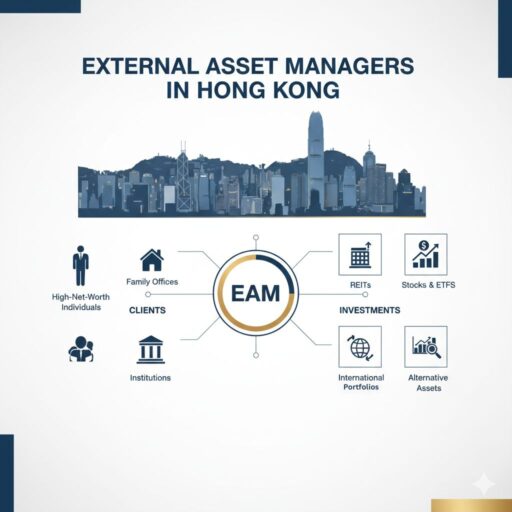
In Hong Kong, gestori patrimoniali primarily serve high-net-worth individuals, family offices, corporate clients, and institutional investors.
These clients often have diverse financial goals, including wealth preservation, capital growth, pianificazione della pensione, e succession planning.
Many seek global diversification, access to exclusive investment products, and strategies that optimize tax efficiency across jurisdictions.
Additionally, asset managers tailor their services to the unique needs of each client type, offering personalized portfolio management, risk mitigation, and investment solutions that reflect both local market conditions and international opportunities.
How to choose the right external asset manager in Hong Kong
To choose the right external asset manager in Hong Kong, clients should focus on proven experience, a strong track record, and alignment with their investment goals.
I fattori chiave da considerare sono:
1. Regulatory compliance and licensing: Ensure the manager is fully licensed and regulated, meeting all professional and legal standards.
2. Investment performance history: Review how the manager has performed across different market cycles to assess consistency and expertise.
3. Transparency in fees and reporting: Understand all costs, charges, and reporting practices to avoid surprises and ensure accountability.
4. Specialization in client types and asset classes: Confirm that the manager has experience with the specific client profile and investment products relevant to your portfolio.
5. Reputation and client references: Check reviews, testimonials, and referrals to gauge reliability, integrity, and client satisfaction.
Engaging an EAM with deep local market knowledge and robust global connections helps ensure that external assets are professionally managed, risks are mitigated, and portfolios are positioned to meet both short- and long-term objectives.
A careful selection process can significantly improve investment outcomes for high-net-worth individuals and institutional clients in Hong Kong.
Hong Kong vs Singapore for External Asset Management
Hong Kong and Singapore are Asia’s two leading hubs for external asset management, but they serve slightly different strategic purposes.
- Hong Kong positions itself as the primary gateway to Mainland China, which makes it particularly attractive for clients seeking exposure to Chinese equities, private markets, and investimenti transfrontalieri flows.
- Singapore, by contrast, is often viewed as Southeast Asia’s wealth management center, with strong appeal for family offices, regional entrepreneurs, and globally diversified investors.
- From a regulatory perspective, Hong Kong’s Securities and Futures Commission (SFC) framework is well established and closely integrated with China’s financial system.
- Meanwhile, Singapore’s Monetary Authority of Singapore (MAS) is known for its conservative and stability-focused oversight.
- Both jurisdictions are highly respected, but Singapore is frequently perceived as offering greater political neutrality and long-term stability, whereas Hong Kong offers unique access to Chinese capital markets.
- Tax treatment is competitive in both locations, though Singapore has introduced targeted incentives to attract single and multi-family offices.
- Hong Kong, meanwhile, benefits from deep capital markets, strong liquidity, and a long history as a global banking center.
For high-net-worth individuals choosing between the two, the decision often comes down to geographic strategy.
Hong Kong for China exposure and capital market depth, Singapore for Southeast Asian growth and structural stability. Both remain premier destinations for external asset management in Asia.
Conclusione
Hong Kong’s position as a leading financial center offers high-net-worth individuals and institutions access to a wide range of sophisticated investment opportunities through external asset managers.
Choosing the right manager goes beyond credentials; it requires alignment with your specific goals, risk tolerance, and the ability to provide both local expertise and global market access.
As the asset management industry grows and becomes more competitive, clients who combine professional guidance with strategic portfolio diversification are better equipped to navigate market volatility and emerging investment trends.
Ultimately, a well-chosen external asset manager can help preserve and grow wealth while adapting to the evolving financial landscape in Hong Kong and beyond.
Domande frequenti
Which is the strongest bank in Hong Kong?
Bank of China (Hong Kong) (BOCHK) has been ranked the strongest bank in Hong Kong by The Asian Banker based on criteria like capital strength, asset quality, profitability, and liquidity — an accolade it has held multiple years running.
Do asset managers beat the market?
Most asset managers do not consistently beat the market, so evaluating risk-adjusted returns and strategy is more important than chasing outperformance.
What is the best investment in Hong Kong?
Investments offering strong growth and income potential in Hong Kong include local stocks, ETFs, and REITs.
These assets give investors access to the city’s leading companies, high-yield property markets, and diversified exposure across sectors.
What are the four types of clients?
The four types of clients of external asset managers are retail investors, high-net-worth individuals (HNWIs), ultra-high-net-worth individuals (UHNWIs), and institutional clients such as corporations or pension funds.
What is considered a high wealth client?
High-wealth clients typically have investable assets exceeding HKD 10 million.
Ultra-high-net-worth clients may hold over HKD 100 million in liquid and investable assets.
Siete afflitti dall'indecisione finanziaria?

Adam è un autore riconosciuto a livello internazionale in materia finanziaria con oltre 830 milioni di visualizzazioni di risposte su Quora, un libro molto venduto su Amazon e un contributo su Forbes.