Monaco citizenship is not easily obtainable and requires significant commitment, financial resources, and time. It can primarily be secured via descent or naturalization.
There are other means, like acquiring the country’s nationality through marriage, but the residency requirements are gruesomely time-consuming.
In this guide, our talking points will include:
- How to obtain Monaco citizenship
- Monaco citizenship by birth
- Monaco citizenship by descent
- Monaco citizenship by naturalization
- Monaco citizenship criteria
Furthermore, we’ll also discuss certain aspects related to residency, and pros and cons of being a Monegasque citizen.
If you are looking to invest as an expat or high-net-worth individual, you can email me (hello@adamfayed.com) or WhatsApp (+44-7393-450-837).
This includes if you are looking for a free expat portfolio review service to optimize your investments and identify growth prospects.
Some facts might change from the time of writing. Nothing written here is financial, legal, tax, or any kind of individual advice, nor is it a solicitation to invest or a recommendation of any specific product or service.

Can you become a citizen of Monaco?
Yes, foreigners can become Monaco citizens through several legal pathways, though each requires substantial commitment and meets specific criteria.
Monaco Citizenship Benefits and Drawbacks
Key Benefits:
- Monégasque citizens enjoy no personal income tax, a cornerstone of the principality’s fiscal system. This extends to zero capital gains and wealth taxes, combined with no property tax and minimal inheritance obligations (for close family).
- The standard of living in Monaco is among the highest globally.
- Residents benefit from top-tier private healthcare, excellent schools, near-zero crime, and a pleasant Mediterranean climate.
- From a global mobility perspective, a Monegasque passport grants visa-free or visa-on-arrival access to approximately 177–179 countries. Therefore, it is ranked within the top 15 most powerful passports worldwide.
- Additionally, citizens can freely live and work in France, due to bilateral agreements.
- Finally, citizenship brings prestige, entry into an elite social circle, and political rights such as voting in local elections, making Monaco not only a tax haven but also a community of distinction.
Major Drawbacks:
- The cost of living in Monaco is staggering. Monthly rental prices often exceed €6,000 for modest apartments, with spacious units easily surpassing €10,000 per month, and purchase prices averaging €50,000 per m².
- Even with modest savings or income, day-to-day expenses remain high.
- Monaco generally requires renunciation of previous citizenship upon naturalization. Dual nationality is only allowed in the specific case of marriage to a Monégasque, allowing spouses to retain their original passports.
- Citizenship isn’t granted easily. A minimum of ten years of continuous residence after age 18 is required, although this period can be extended or waived at the Prince’s discretion.
- The real estate market is extremely tight, with limited availability and astronomical prices and rents.
- Lastly, the naturalization process is completely discretionary, with no guaranteed outcome. This means, even meeting all criteria, a citizenship application may still result in rejection by sovereign decree, often without explanation
Is it easy to get citizenship in Monaco?
Obtaining Monaco citizenship is considered one of the most difficult citizenship processes globally.
The principality maintains extremely selective requirements and has only approximately 6,000 Monégasque citizens despite having a population of 37,000 residents.
The process involves strict criteria, lengthy residency requirements, and discretionary approval by the Prince himself.
Is the Monaco passport strong?
The Monaco passport ranks 13th globally by Henley’s global passport ranking.
On the other hand, it holds the 10th passport power rank as per the Passport Index (by Arton).
As per the Nomad Passport Index, it obtained a rank of 26T with a score of 104.5.
Some sources claim that Monaco has visa-free or visa-on-arrival access to 179 countries, whereas some others claim it’s 177.
Monégasque passport holders enjoy visa-free travel to major economies including Japan, the United Kingdom, the United States, and all European Union countries.
Does Monaco allow dual citizenship?
Monaco strictly prohibits dual citizenship.
The principality does not recognize dual nationality, requiring individuals to renounce their previous citizenship when acquiring Monégasque nationality.
However, there is only one exception where spouse of a Monegasque national applying for citizenship can retain their original nationality.
How to become a citizen of Monaco
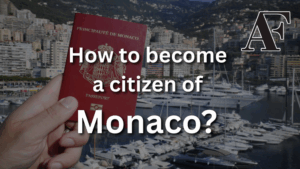
The primary options available to acquire the Monegasque nationality are naturalization and descent.
Obtaining citizenship through marriage has almost the same requirements as naturalization.
In some circumstances, citizenship can be granted at birth in Monaco.
Additionally, residency can be achieved through a significant investment, which in turn leads to citizenship.
Let’s get into the details of the different pathways to obtain citizenship in Monaco.
How to get Monaco citizenship by birth
Monaco follows the jus sanguinis principle, meaning citizenship is primarily determined by parental nationality rather than place of birth.
A child born to at least one Monégasque parent automatically acquires citizenship regardless of birth location.
Children born in Monaco to foreign parents do not automatically receive citizenship. They must pursue naturalization or other qualifying pathways later in life.
Nevertheless, any child who is born in Monaco to unknown parents automatically obtains the country’s nationality.
How to get Monaco citizenship by descent
Paternal lineage:
A child born to a Monegasque father is automatically a citizen, no additional conditions required.
Maternal lineage:
A child born to a Monegasque mother also qualifies under certain conditions:
- The mother was born Monegasque and retained citizenship at the time of birth,
(Or)
- The mother acquired Monegasque nationality through naturalization, reinstatement, or simple adoption,
(Or)
- The mother has at least one ancestral parent in her lineage who was born Monegasque
Children Born Out of Wedlock:
Children born out of wedlock are deemed citizens once their parents marry (i.e., the child is legitimized).
Anyhow, the child is recognized through maternal lineage when the father is unknown.
Citizenship Through Ancestral Declaration:
Adults (18+) may declare citizenship in cases like:
- Born in Monaco to a parent who had Monegasque ancestry, even if that parent later lost nationality.
- Individuals born before 11 July 1975, before their father became Monegasque, can also declare citizenship without residence conditions.
How to get Monaco citizenship by naturalization
Naturalization represents the most common pathway for foreigners seeking Monaco citizenship.
Applicants must fulfill stringent requirements, comprising ten years of continuous legal residence after age 18.
The process requires demonstrating genuine attachment to Monaco, French language proficiency, good moral character, and complete integration into Monégasque society.
Naturalization applications must be submitted on stamped paper directly to the Prince, who maintains absolute discretion over approval decisions.
The process involves extensive background checks, interviews, and documentation review.
Though legally possible, naturalizations are extremely rare.
In 2024, only 11 out of approximately 160 new Monegasques earned citizenship via this sovereign naturalization route. Many others obtained it via descent or marriage.
Monaco’s small citizen base of around 9,200 nationals compared to 38,000 foreign residents depicts that the process is designed to preserve its citizenry
How to get Monaco citizenship by marriage
Foreign nationals married to a Monegasque citizen can obtain Monaco nationality via declaration after 20 years of continuous marriage and residency in Monaco.
This is the case for marriages solemnized after July 1, 2022.
However, if married before July 1st, 2022, the former rule still applies, i.e., 10 years of marriage with uninterrupted cohabitation and valid marital status.
Conditions at application include:
- Spouses must still be living together (or be widowed without remarrying).
- The Monegasque partner must retain their nationality, and the foreign spouse must not have acquired nationality via a previous marriage.
- Dual nationality is permitted in this scenario, so the spouse does not need to renounce their original citizenship.
In 2024, 51 people received citizenship through marriage, underlining how rare this pathway remains
Historically (pre-2011), foreign women marrying Monegasque men automatically acquired citizenship after 5 years, though they could only vote after 10 years.
These gender-differentiated rules were abolished in 2011 in favor of gender-neutral provisions, first standardizing at 10 years until the shift to 20 years.
How to get Monaco citizenship by investment
Monaco does not offer a direct citizenship-by-investment program.
Even so, significant financial investment can facilitate residency acquisition, which may eventually lead to naturalization eligibility.
Investors must meet minimum deposit requirements of €500,000 to €1 million in Monaco banks and maintain substantial ongoing financial commitments.
The investment pathway requires initial residency through financial means, followed by the standard ten-year naturalization process.
Monaco Citizenship Process

The citizenship application process varies by pathway but generally involves extensive documentation, background verification, and formal interviews.
Applicants must demonstrate comprehensive integration into Monégasque society and maintain impeccable legal standing throughout the process.
Monaco Citizenship Requirements
Citizenship requirements vary by the pathway chosen. Given below are some general requirements for the common paths chosen.
By Marriage (Declaration)
- A foreign spouse of a Monégasque may apply by declaration after 20 years of continuous marriage and cohabitation.
- The Monegasque spouse must still hold nationality.
- Marriage must remain valid at the time of application
- In case of widowhood, the spouse must remain widowed (i.e., not remarried).
- Applicant must not have obtained nationality via a previous marriage.
- Applicant retains original nationality and dual citizenship is allowed in this scenario
By Naturalisation
- Applicant must be 18 or older.
- At least 10 consecutive years of legal residence in Monaco after turning 18 (waivable by the Prince in exceptional cases).
- Applicant should demonstrate integration into Monaco’s social, cultural, and economic life, assessed through interviews and background checks.
- Must provide police certificates from all countries of prior residence with a clean criminal record.
- Exemption from military obligations in the country of origin.
- Renunciation of foreign nationality is required except in rare cases. (e.g., marriage pathway).
- Own or rent property appropriate to financial means, which serves as proof of accommodation.
- Evidence of stable income or substantial bank deposits. Banks typically require €500k–1M for residency; similar expectations may apply for citizenship.
- Application must be made on stamped paper addressed directly to the Sovereign Prince of Monaco.
- Naturalisation is granted (or not) solely at the Sovereign Prince’s discretion; no appeal rights are offered.
By Declaration
An adult born in Monaco to a Monegasque parent (even if the parent was renamed) may declare nationality within the year following majority, provided childhood domicile in Monaco.
Adults born before 11 July 1975 to a father who acquired nationality later may declare nationality without a residency requirement.
In the case of adopted children:
- For plenary adoption, the citizenship granted at birth
- For simple adoption, the child may declare nationality as a minor
Monaco Citizenship Rules
Monaco citizenship follows strict regulatory frameworks. The primary rules regarding citizenship include:
- The jus sanguinis principle governs birth-based citizenship
- Absolute prohibition of dual citizenship with an only exception for spouses of Monegasque nationals applying for cittizenship
- Prince’s discretionary authority over naturalization decisions
- Mandatory French language competency for all applicants
- Continuous residence requirements with proof of physical presence
FAQs
Is it possible to get Monaco citizenship?
Yes, Monaco citizenship remains possible for determined individuals who meet the requirements and commit to the lengthy process.
However, paths like naturalization require substantial financial resources, extended time commitments, and successful navigation of discretionary approval systems.
Can you live in Monaco without being rich?
Yes. While Monaco is synonymous with wealth, moderate-income individuals can theoretically reside there through employment or more modest accommodations.
Nevertheless, the practical reality involves significant financial challenges due to extremely high living costs.
Most successful applicants maintain substantial wealth to meet banking requirements and afford appropriate housing.
What happens if you give birth in Monaco?
Giving birth in Monaco does not automatically confer citizenship to the child unless at least one parent holds Monégasque nationality.
Children born to foreign parents in Monaco acquire their parents’ citizenship and must pursue separate naturalization processes if they desire Monégasque citizenship later.
Is it easy to get a PR in Monaco?
No. Monaco permanent residency (Carte de Privilège) becomes available after ten years of continuous residence, but remains discretionary.
Applicants may need to demonstrate language proficiency in French, English, or Italian, and prove substantial annual presence in Monaco.
The process involves a comprehensive evaluation of integration and commitment to the country.
How can I get residency in Monaco?
Monaco residency requires meeting three fundamental criteria:
- Proof of accommodation through rental, purchase, or hosted arrangements proportionate to financial standing
- Sufficient financial resources typically requiring bank deposits of €500,000 to €1 million
- Clean criminal background with comprehensive documentation
The process begins with temporary residence permits (Carte de Résident Temporaire) valid for one year.
It is further progressed to an ordinary residence permit (Carte de Résident Ordinaire) after three years.
Conclusion
Monaco citizenship represents one of the world’s most exclusive and challenging nationality acquisitions.
The principality maintains stringent requirements designed to preserve its exclusive character while attracting individuals who demonstrate genuine long-term commitment to Monégasque society.
The process demands significant financial resources, extensive time commitments, and successful integration into the local community.
While direct citizenship-by-investment programs do not exist, substantial financial investment can facilitate residency acquisition, leading to eventual naturalization eligibility.
Success requires careful planning, professional guidance, and realistic expectations about the lengthy timeline and discretionary approval process.
The principality’s selective approach ensures that new citizens contribute meaningfully to Monaco’s unique social and economic environment.