Expat investment income strategies focus on how internationally mobile individuals generate, protect, and tax investment income while living across multiple jurisdictions.
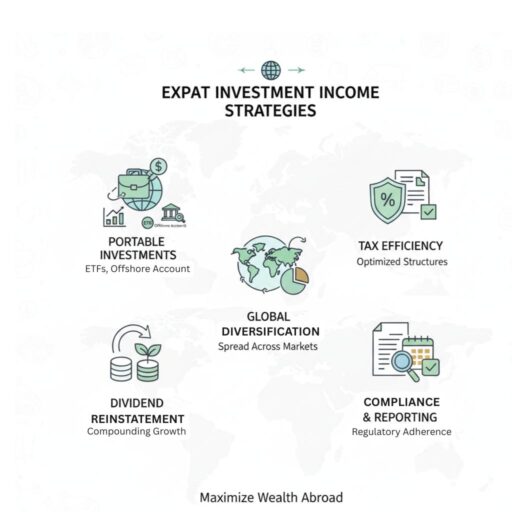
These strategies prioritize portability, tax efficiency, and global diversification to ensure wealth remains intact despite changes in residency.
Este artículo trata:
- What is a good investment for expats?
- Do I have to report my investment income?
- How to reduce tax on investment
- What happens to investments if you move to another country?
- Do you pay tax on overseas investments?
Principales conclusiones:
- Expat investment success depends as much on tax residency as on returns.
- Globally portable investments reduce disruption when relocating.
- Tax-friendly jurisdictions can significantly improve net investment income.
- Diversification across countries lowers political, currency, and regulatory risk.
Mis datos de contacto son hello@adamfayed.com y WhatsApp +44-7393-450-837 si tiene alguna pregunta.
La información contenida en este artículo es meramente orientativa. No constituye asesoramiento financiero, jurídico o fiscal, ni una recomendación o solicitud de inversión. Algunos hechos pueden haber cambiado desde el momento de su redacción.

What is the best investment for expats?
Globally diversified ETFs are the best core investment for expats, while dividend-paying equities, international real estate, and inversión extraterritorial funds work best as complementary income and diversification tools.
This structure allows expats to maintain tax efficiency, liquidity, and portability across multiple jurisdictions.
Because expats often change tax residency, investments must withstand shifts in tax rules, currencies, and reporting requirements without triggering forced sales or unnecessary complexity.
Broad-market ETFs provide geographic and sector diversification, while income-generating assets can be layered on based on risk tolerance and cash flow needs.
What is the best way to invest internationally?
The best way to invest internationally is through globally diversified, tax-efficient structures that remain accessible regardless of where you live.
Offshore brokerage accounts, internationally domiciled ETFs, and investment platforms designed for expatriates provide continuity as tax residency changes.
For mobile individuals, exit taxes and deemed-disposal rules are a critical consideration.
Some countries tax unrealized gains when you leave, which makes frequent trading and jurisdiction-specific products less suitable for expats.
Structuring investments in portable, long-term holdings can reduce the likelihood of triggering unnecessary tax events.
Brokerage access is another key constraint.
Many domestic brokers restrict accounts once clients become non-residents, potentially forcing asset transfers or liquidations.
Using internationally recognized platforms and neutral jurisdictions helps ensure uninterrupted access, consistent reporting, and smoother transitions between countries.
Currency diversification and jurisdictional neutrality further reduce concentration risk, particularly for expats earning in one currency while investing in another.
Is it better to reinvest dividends or not?
Reinvesting dividends is generally the best way for expats to grow wealth over the long term.
Reinvestment allows dividends to compound, increasing portfolio value over time and taking advantage of global market growth.
However, in jurisdictions where dividend income is taxed immediately, reinvesting may trigger annual tax liability.
In such cases, some expats may prefer to receive dividends as cash to manage tax timing or fund gastos de manutención while still maintaining a diversified portfolio.
The decision depends on balancing tax efficiency, cash flow needs, and compounding benefits.
How does investment income work?
Investment income typically comes from dividends, interest, rental income, or capital gains.
For expats, how investment income works is based heavily on where the income is sourced and where the investor is tax resident.
Some countries tax worldwide income, while others tax only locally sourced income.
Timing, withholding taxes, and double taxation treaties all influence the net income an expat ultimately receives.
Which country is best for foreign investment?
The United States, Singapore, and leading European markets are the best countries for foreign investment due to their combination of strong returns, regulatory stability, and deep capital markets.
These jurisdictions offer transparent legal systems, investor protections, and broad access to global equities, bonds, and alternative assets.
The United States provides unmatched market depth and exposure to high-growth sectors, Singapore serves as a stable Asian investment and gestión de patrimonios hub, and major European markets offer diversification across developed economies.
Tax efficiency, however, varies by investor profile and residency, making structuring as important as market selection.
What happens to my investments if I move country?
When you move country, your investments generally remain intact, but the tax treatment can change immediately.
Certain jurisdictions impose impuestos de salida, while others may reclassify assets or income once you become a tax resident.
Brokerage access can also be affected, as some platforms restrict accounts for non-residents.
This makes portability and compliance key considerations in any long-term expat investment strategy.
Do I need to pay tax on foreign investment income?
Most countries tax foreign investment income once you become a tax resident, either on a worldwide basis or through specific sourcing rules.
Jurisdictions that apply global taxation include foreign dividends, interest, and capital gains in taxable income, while territorial systems may exempt income earned outside the country.
Double taxation agreements can reduce or eliminate overlapping taxes on the same income, but reporting obligations usually remain even when no additional tax is payable.
For expats, failure to report foreign investment income is often a greater risk than the tax itself.
When to report investment income?
Expats must report all foreign and domestic investment income annually to their tax residency country, including dividends, interest, capital gains, and foreign account holdings.
Reporting deadlines, required forms, and disclosure rules vary by country, and missing or incomplete submissions can trigger audits, penalties, or interest even if no additional tax is owed.
Maintaining detailed records of income, currencies, and transactions ensures smooth compliance and supports claims for treaty benefits or exemptions.
How to minimize taxes on investment income?
To minimize taxes on investment income, expats focus on asset location, timing of realization, and jurisdiction selection, as each directly affects how and when investment income is taxed.
1. Asset location
This determines where investments are held and which tax rules apply.
For example, holding globally diversified ETFs in an offshore brokerage account rather than a high-tax onshore market can reduce withholding taxes and improve long-term tax efficiency.
2. Timing of realization
This refers to when income or capital gains are recognized.
Expats often defer realizing gains until they move to a lower-tax jurisdiction or a country that does not tax foreign capital gains, reducing or eliminating the tax burden on appreciation.
3. Jurisdiction selection
This shapes the overall tax outcome, as some countries tax worldwide income while others exempt foreign investment income.
Countries such as the UAE or Singapore apply territorial or preferential tax systems that can significantly improve net investment income for expats.
Using tax-advantaged accounts, investing in accumulation rather than distribution funds, and structuring income streams efficiently can further reduce annual tax exposure.
In many cases, strategic residency planning has a greater impact on net returns than individual investment selection.
¿Cuál es el país más fiscalmente favorable para los expatriados?
The UAE, Monaco, and several Southeast Asian countries are among the most tax-friendly countries for expats because they apply territorial taxation or exempt foreign investment income.
These jurisdictions allow expats to earn, invest, and compound income with minimal or no tax on offshore assets.
However, tax friendliness should be weighed against substance requirements, lifestyle factors, and long-term regulatory risk, as favorable tax treatment alone does not guarantee long-term suitability.
What countries are considered high risk?
Venezuela, Argentina, Zimbabwe, and Turkey are among the countries considered high risk for investment due to political instability, capital controls, weak legal enforcement, and volatile currencies.
These conditions can sharply impact asset values and make it difficult to move funds in or out of the country.
For expats, high-risk jurisdictions also complicate compliance, banking access, and exit planning, making it essential to diversify investments across more stable markets to protect capital and maintain liquidity.
Quick Guide to Smarter Investment Income
- Choose portable investments: Favor globally diversified ETFs, cuentas extraterritoriales, or internationally domiciled funds that remain accessible regardless of residency.
- Optimize for tax efficiency: Align asset location, investment type, and jurisdiction to minimize withholding taxes, exit taxes, and annual tax liability.
- Diversify across currencies and markets: Protect your income from political, currency, and market-specific risks by spreading investments globally.
- Reinvest strategically: Compounding dividends accelerates growth, but consider tax timing and cash flow needs before automatic reinvestment.
- Stay compliant with reporting: Keep detailed records of income, foreign accounts, and transactions to meet all reporting obligations and leverage treaty benefits.
- Assess country and political risk: Factor in stability, capital controls, and regulatory environments when choosing locations for income-generating investments.
- Set realistic expectations: Understand that investment income can fluctuate based on market conditions, currency movements, and your residency. Focus on long-term growth and steady compounding rather than short-term gains.
Conclusión
Expat investment income succeeds when it’s treated as a strategic, living resource, not just numbers on a statement.
Mobility, planificación fiscal, and portfolio diversification aren’t abstract concepts; they determine whether your income grows uninterrupted, compounds efficiently, and stays accessible no matter where you live.
The most effective expats think several steps ahead: aligning investments with cambios en la residencia, anticipating reporting obligations, and adjusting for currency and geopolitical risks.
By approaching income strategically, expats can turn cross-border complexity into a competitive advantage, creating a reliable, resilient foundation for long-term wealth.
Preguntas frecuentes
What if I invest $1000 a month for 5 years?
Investing $1000 a month for 5 years results in a total contribution of $60,000.
With consistent returns, compounding can significantly increase the portfolio value over time, especially when reinvested income is left untouched.
For expats, the outcome also depends on currency movements, fees, and taxes applied during the investment period.
¿Qué es la regla 10/5/3 de la inversión?
The 10/5/3 rule of investment is a simplified guideline suggesting potential annual returns of around 10% for equities, 5% for balanced portfolios, and 3% for conservative investments.
While not a guarantee, it helps investors set realistic expectations.
Expats often use this framework when allocating assets across multiple countries and risk profiles.
Are you allowed to have multiple investment accounts?
Yes, expats can hold multiple investment accounts in different countries, but each account must comply with local regulations and be reported according to your tax residency rules.
¿Le duele la indecisión financiera?

Adam es un autor reconocido internacionalmente en temas financieros, con más de 830 millones de respuestas en Quora, un libro muy vendido en Amazon y colaborador de Forbes.