19 errores que los inversores en bolsa deben evitar
Si desea invertir como expatriado o particular con un elevado patrimonio neto, que es en lo que estoy especializado, puede enviarme un correo electrónico (advice@adamfayed.com) o WhatsApp (+44-7393-450-837).
Introducción
What are the mistakes that stock investors should avoid?
You should make an effort to avoid investment errors because they can cost you money. Simply choosing the right stocks is not enough to be a successful investor. Additionally, one must avoid making simple errors that could reverse all of the prior effort.
Al debatir investing in his most recent book, “The Psychology of Money,” Morgan Housel modifies a famous Napoleonic proverb: “A good definition of an investing genius is the man or woman who can do the average thing when all those around are going crazy.”
Many investors saw what impatience can result in during the early 2020 stock market crash as they began liquidating their holdings. After the collapse, the markets quickly recovered and broke previous highs, rewarding the patient and well-prepared investors.
Let us discuss 19 mistakes that stock investors should avoid.
19 errores que los inversores en bolsa deben evitar
1. Not Making An Investment
En biggest error a novice investor can make is not investing. Unfortunately, most of us won’t be able to save enough for retirement because it’s so expensive without a lot of assistance from the stock market.
Considere setting aside $250 each month from the time you are 25 years old until you are 65 years old and ready to retire. By the time you retire, you would only have $120,000 if you kept that money in a savings account that does not earn interest. You won’t have that for very long, regrettably.
Imagine, though, that you had put that money into the stock market and allowed it to compound, so that you could earn interest on your interest. The Securities and Exchange Commission (SEC) reports that the bolsa de valores has historically returned about 10% annually.
By the time you retire, your $250 monthly contribution would have grown to more than $1.4 million. By investing in the stock market as opposed to a non-interest bearing account, you could significantly increase the same amount of money you contributed over the course of your life.
2. Absence of Investment Objectives
Lack of a proper investment goal is one of the mistakes that stock investors should avoid. To achieve these goals, you must clearly state your investment objectives and use the most effective tools.
The objective can be anything, such as putting money aside for your child’s international education, starting a fondo de pensiones, or simply hedging your USD expenses. Making sound planning decisions is crucial.

3. Investing in Stocks of Companies You Don’t Understand
One of the mistakes that stock investors should avoid is investors favoring the newest “hot” sector without having sufficient knowledge of the business or sector. You risk losing your hard-earned money if you don’t do enough research, especially if you don’t know the company’s financial stability.
On the other hand, when you thoroughly research a company and its industry, you automatically put yourself at a competitive advantage over most other investors.
You might not be aware of the complexities and nuanced aspects of the company in question if you make investments outside of your area of expertise.
This is not to say that you must be a gold miner to invest in gold mining companies or a doctor to invest in healthcare, but proper due diligence is essential; you may also want to consider hiring a asesor financiero to assist.
4. Trying to Time the Market
Trying to time the market is another error people make when trading stocks. Even seasoned investors frequently make mistakes when trying to correctly time the market because it is difficult to do.
According to a well-known study (Determinants of Portfolio Performance) on American Pension Fund Returns, approximately 94% of the portfolio’s returns come from proper asset allocation rather than market timing or stock selección.
5. Putting All Your Eggs in One Basket
When you place all of your financial future’s eggs in one basket, a single bad development could ruin your entire portfolio. By diversifying your investments, you can lower your risk and lessen the likelihood that your entire portfolio will suffer if one of them performs poorly.
You can diversify your investments by holding a mix of stocks, bonds, and inmobiliario. For instance, the bond market might do well and help you cut your losses from equity investments if the stock market crashes.
Purchasing stock in several businesses operating in the same sector is another way to diversify. Additionally, you can purchase a number of sector funds, each of which focuses on a specific industry, like technology or finance.
Your portfolio can easily be diversified with just one investment by purchasing mutual funds, index funds, or exchange traded funds (ETFs).
6. Never Just Choose Stocks; Equally Vital is Asset Allocation
Asset allocation, according to numerous studies, is the secret to a profitable cartera de inversiones.
Sin embargo, investors frequently commit the error of concentrating on selecting specific stocks rather than performing proper asset allocation. Therefore, you should aim to correct the asignación de activos first rather than selecting the newest hot stock.

7. Overconfidence in the Stock
Overestimating a stock’s potential return is another mistake investors make, and this is often the case when purchasing penny stocks. Low-cost stocks could resemble lottery tickets, enabling a $500 or $2,000 investment to grow into a modest fortune.
With penny stocks, there is a sizable risk of loss, so investors who anticipate a small, underperforming company to outperform its competitors may be let down. It’s critical to have a realistic expectation of the share price performance of the company.
Examine the stock’s historical performance and make a decision based on the financial performance of the company as well as its prior trends and gains.
While past performance is not a predictor of future outcomes, it can be a good place to start because it offers information on the volatility and trading activity of the stock.
8. Thinking of Past Performance as a Barometer for Future Performance
Relying on historical returns is one of the mistakes that stock investors should avoid. Results from the past are frequently not reliable predictors of future performance.
Long-term investors should avoid attempting to predict the market because it is not practical for them to do so. The objective should be to create a portfolio with a long-term investment horizon, with an asset’s historical performance acting only as a risk indicator.
9. Making Use of Funds You Cannot Afford to Risk
Cuando invertir dinero you can’t afford to lose, your emotions and stress levels are amplified, which can result in hasty decisions about investments.
Consider your risk tolerance when evaluating stocks, which is your willingness to lose some or all of your initial investment in exchange for higher returns.
Assess the securities or asset classes you feel comfortable investing in, such as growth stocks versus bonds, when determining your risk tolerance.
Do not invest funds that you cannot afford to lose, such as rent money or emergency funds. On the other hand, investing money that you can afford to risk will help you make much better investment decisions.
10. Waiting to Get Even
One of the mistakes that stock investors should avoid is waiting to even out. Getting even refers to holding off on trading a losing stock until it reaches its original price.
By refusing to accept a loss, you are making a “cognitive error,” according to behavioral finance, which means that you are losing twice. The first is to avoid selling the stock that is declining because it could continue to decline and lose all of its value.
Second, you are passing up the chance to spend that investment money on a more advantageous purchase. “Would I buy that stock today? “, and if the response is no, you shouldn’t keep holding eso.
11. Being Impatient
Lack of patience is one of the mistakes that stock investors should avoid. Stocks might not immediately see the gains you’re hoping for if you’re investing for the long haul.
It might take several years or several months for a company’s management team to implement a new strategy after it is announced. Too frequently, when buying stock, investors assume that the shares will act in their best interests right away.
For instance, between 2000 and 2021, the larger S&P 500 index generated annual returns of an average of 9.01%. This includes a number of years when the index experienced poor performance, including the 36.5% decline it experienced during the Great Recession in 2008.
The power of compounding is frequently what makes investing profitable. The best returns are frequently achieved by those who begin ahorrar para la jubilación when they are young because compounding takes time to truly take effect.
Long-term investing success requires 1% action and 99% patience. Many investors, however, lack that patience and wind up tweaking their portfolios on a regular basis.
You need to focus on the market’s long-term growth potential rather than the short-term volatility and worries if you want to take a disciplined approach. Market alterations are inevitable. But if you can, stick with it and continue to put in the effort.
12. Forgetting to Align One’s Investment Style with One’s Personal Goals
The adage “one size does not fit all” is helpful. To pursue an estrategia de inversión that doesn’t align with your investment objectives would be unreasonable. The goal is to identify a strategy that can respect your risk tolerance, goals, and resources.
13. Getting the Wrong Information About Stocks
Another frequent and expensive investing blunder is obtaining stock recommendations or information from the incorrect sources. There is no shortage of so-called experts willing to share their thoughts while presenting themselves as knowledgeable and always right.
Even stock analysts who work for investment firms make mistakes despite frequently having a thorough understanding of the company and the sector they cover. In other words, even if someone is qualified to express an opinion, it is possible for them to be incorrect.
If you’re looking for general asesoramiento en inversiones or direction, start by consulting government-backed sources and nonprofit organizations. To assist you in the process, you could also speak with a asesor financiero.
En no se puede predecir el futuro, not even by the most seasoned and successful investors. Consider it a warning sign if a asesor financiero promises you a specific return on your investment.
14. Using Emotions as a Guide
When you decide to make an investment, there are many biases at work. Another common investment blunder is to rely too heavily on feelings in a volatile market.
You are probably acting emotionally if you can’t wait a few days before buying or selling a stock. Because you “felt like it,” you shouldn’t hasten your investment decisions. The more emotions you leave out of the market, the better.
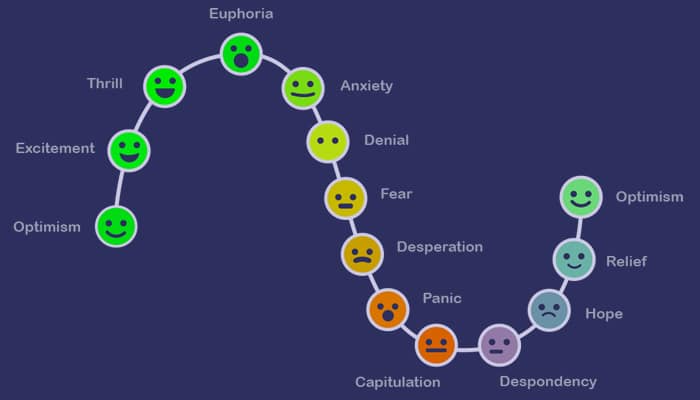
15. Taking the Crowd’s Lead
One of the mistakes that stock investors should avoid is copying what other investors are doing rather than conducting your own research, which is what following the crowd entails.
Más people don’t learn about investments until they’ve been successful. En mainstream media frequently covers price increases of two to three times in certain stocks as hot takes.
Unfortunately, the stock may already have peaked by the time the media becomes involved. The investment is probably overvalued at that point. However, media outlets like the news, the internet, and social media can drive cotizaciones bursátiles up to excessively inflated levels.
The 2021 hype surrounding the GameStop stock was one instance of this trend. The majority of the gains were already realized by the time the upsurge reached the mainstream media. Investors who entered the market too late probably lost money.
16. Having Love at First Stock
When you see your chosen stock performing well, you may decide to increase your investment in it. There is nothing wrong with that, but take care to remember your investment goals and other clases de activos.
17. The Sunk Cost Fallacy and Averaging Down
When investing, averaging down can be an expensive mistake. Investors who have already made a mistake and need to make up for it frequently use averaging down.
If they purchased the stock at $3.50 and it falls to $1.75, for instance, they might buy more shares at the lower price to hide their error.
As a result, their average share price is significantly lower as a result of their recent purchases of the stock at $3.50 and additional shares at $1.75, which makes their loss appear much smaller than it actually is.
Averaging down, however, can also be viewed as throwing good money after bad because you are adding more shares that have lost value to a losing trade and therefore, isn’t necessarily a good idea.
The so-called sunk cost fallacy is characterized by a common symptom: averaging down. When someone feels like they have already invested a lot of time, money, or energy into a particular behavior or belief, they may be reluctant to change it.
On the other hand, buying more shares after the cotización en bolsa has increased, indicating that you made a wise decision, is known as averaging up.
18. Too Much Diversity
When used properly, diversification is an excellent risk-management tool. When assets have low correlation and various risk profiles, it offers value.
For instance, you might consider including unrelated assets such as equity, bond funds, commodity ETFs, valores auríferos, etc. when diversifying a portfolio of US stocks.
Over-diversifying, though, can be counterproductive. For instance, it might not make sense to add US equity ETFs to a portfolio of diversified US stocks.
19. Not Exercising Due Diligence
When investing, it can be expensive to make a mistake and not do your research. To make sure their investments are worthwhile, venture capitalists and fondos de inversión regularly carry out due diligence.
Según la Global Impact Investing Network, organizations are more likely to avoid being caught off guard and make wise investment decisions when they have a proper due diligence strategy in place.
Individual investors should conduct thorough due diligence, particularly when purchasing shares of highly speculative and volatile penny stocks. Generally speaking, the greater your diligence, the better your investment outcomes.
You’re much less likely to be unpleasantly surprised by an event if you’ve thoroughly investigated the business, taking into account any red flags and potential risks.
Reflexiones finales
You should try to avoid making too many of these mistakes. But some of the errors we’ve talked about will be made by investors.
Fortunately, you can embrace your inner adolescent and learn from your errors. In reality, the majority of people learn more from their setbacks than their victories.
You’ll probably be in a better and more advantageous situation after gaining enough knowledge and experience. Idealistically, you want to phase out the frequent errors quickly enough to keep money for investments.
¿Le duele la indecisión financiera? ¿Quiere invertir con Adam?

Adam es un autor reconocido internacionalmente en temas financieros, con más de 830 millones de respuestas en Quora, un libro muy vendido en Amazon y colaborador de Forbes.