A second passport for Dominican Republic citizens can be obtained through top options like Dominica, Spain, and Italy, with dual citizenship generally permitted.
This makes it a practical strategy for improving visa-free travel, accessing better residency options, and securing long-term global mobility.
Este artículo trata:
- Why do people migrate from the Dominican Republic?
- What is the best second passport for Dominicans?
- ¿Cuál es el país más fácil para obtener un segundo pasaporte?
- Is the Dominican Republic passport powerful?
- Is it a good idea to have two passports?
Principales conclusiones:
- The Dominican Republic allows dual citizenship with no renunciation required.
- Caribbean programs offer the fastest second passport routes.
- European pathways can provide stronger long-term benefits for Dominicans.
- A second passport for Dominican Republic improves both travel freedom and financial flexibility.
Mis datos de contacto son hello@adamfayed.com y WhatsApp +44-7393-450-837 si tiene alguna pregunta.
Para los visados de nómada digital o de residencia que requieran ingresos, activos o inversiones cualificadas, podemos ayudarle a estructurar soluciones de inversión adecuadas que puedan ajustarse a esos requisitos, en función de sus circunstancias.
La información contenida en este artículo es meramente orientativa. No constituye asesoramiento financiero, jurídico o fiscal, ni una recomendación o solicitud de inversión. Algunos hechos pueden haber cambiado desde el momento de su redacción.

Does the Dominican Republic allow multiple citizenships?
Yes, dual or multiple citizenship is permitted in the Dominican Republic, meaning citizens can legally acquire a second passport without renouncing their Dominican nationality.
This flexibility makes it easier for Dominicans to:
- Pursue opportunities abroad
- Access better visa-free travel
- Maintain ties to their home country
Which country is best for a second passport?
The best second passport options for Dominican Republic citizens include Spain, Dominica, Saint Kitts and Nevis, Italy, Portugal, and Paraguay, based on whether the priority is speed, cost, or long-term EU access.
- Route: Residency → Citizenship (fast-track for Latin Americans)
- Key requirement: Legal residence for 2 years (reduced from 10 years)
- Inversión: No fixed amount, but proof of income, job, or residency basis required
- Calendario: 2–4 years total (including processing)
Why it stands out for Dominicans:
- One of the fastest European citizenship routes specifically available to Dominicans
- Access to full EU rights, including living and working across Europe
- Strong cultural and language alignment
- Route: Ciudadanía por inversión
- Key requirement: Clean background + approved application
- Inversión: Donation starting around $200,000 or real estate option
- Calendario: 3-6 meses
Why it stands out for Dominicans:
- One of the cheapest and fastest passports available
- No residency or travel requirements
- Visa-free access to many countries, including parts of Europe
- Route: Ciudadanía por inversión
- Key requirement: Government-approved investment + due diligence
- Inversión: Higher than Dominica (typically $250,000+)
- Calendario: 3-6 meses
Why it stands out for Dominicans:
- Longest-running and well-established CBI program
- Strong global reputation and mobility
- Faster processing options for urgent cases
- Route: Citizenship by descent (jure sanguinis)
- Key requirement: Proof of Italian ancestry (no generational limit in many cases)
- Inversión: Minimal (mainly legal/document costs)
- Calendario: 2–4 years
Why it stands out for Dominicans:
- No residency required if applying through ancestry
- Grants full EU citizenship
- One of the most accessible descent programs globally
- Route: Residency → Citizenship
- Key requirement: Legal residency + basic language integration
- Inversión: Varies (can include investment from €200,000 or passive income routes)
- Calendario: 5 years to citizenship
Why it stands out for Dominicans:
- Relatively flexible residency options
- Strong passport with EU access
- Good balance between lifestyle and mobility
- Route: Residency → Citizenship
- Key requirement: Establish residency and maintain ties to the country
- Inversión: Low financial barrier compared to other programs
- Calendario: 3+ years
Why it stands out for Dominicans:
- One of the most affordable pathways to a second passport
- Minimal stay requirements compared to Europe
- Useful stepping stone for regional mobility
¿Cuál es el segundo pasaporte más fácil de obtener?
For Dominicans, the easiest second passport to get globally is usually through citizenship by investment in countries like Dominica, Santa Lucía, o Antigua y Barbuda, or through ancestry in countries like Italy, Irlanda, and Poland.
These routes offer the least residency, fastest timelines, and simplest requirements. The easiest paths still fall into two main categories:
Caribbean programs are designed for speed and simplicity.
Countries such as Dominica, Saint Lucia, and Antigua and Barbuda offer streamlined application processes with minimal bureaucracy.
- Calendario: typically 3–6 months
- Inversión: usually around $100,000–$200,000 (donation or real estate)
- Requisitos: clean background check, approved funds, no residency
What makes this route easy is the no relocation requirement and a clear, structured process with predictable outcomes.
If you have ancestral ties, this is often the lowest-cost and least restrictive route.
Countries like Italy, Ireland, and Poland allow applicants to claim citizenship through lineage.
- Calendario: varies (often 2–4 years depending on documents)
- Coste: typically around $1,000–$5,000+, depending on legal assistance, translations, and document retrieval
- Requisitos: proof of ancestry (birth/marriage records)
The key advantage is that many applicants don’t need to live in the country, while still gaining full European Union rights.
Where do most Dominicans migrate to?
Most Dominicans migrate to the United States, followed by Spain and Puerto Rico, with the US alone hosting nearly three-quarters of all Dominican migrants worldwide.
Más recent estimates show the scale clearly:
- Around 1.3–1.4 million+ Dominicans live in the United States
- Roughly 180,000 reside in Spain
- About 50,000–70,000+ are in Puerto Rico, with higher unofficial estimates
These destinations dominate because they combine strong job markets, higher wages, and large established Dominican communities, making migration and integration significantly easier.
Why are people leaving the Dominican Republic?
People are leaving the Dominican Republic primarily for better-paying jobs, improved public services, and more stable long-term opportunities abroad, despite the country’s continued economic growth.
Even with GDP growth and rising investment, structural challenges persist, including higher living costs, income inequality, and gaps in education and institutional quality—factors that push many Dominicans to seek opportunities elsewhere.
Recent developments also highlight ongoing pressures.
For example, economic strain from rising food and energy costs is affecting lower-income households, while environmental and social tensions, such as protests over mining projects, reflect broader concerns about sustainability and local livelihoods.
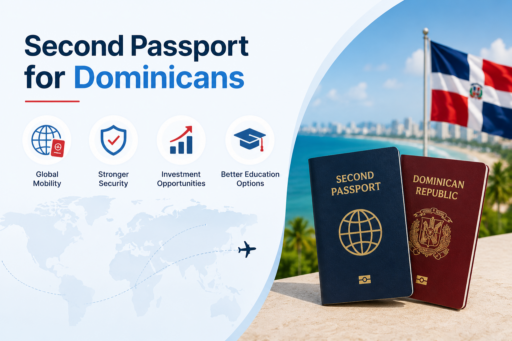
Is the Dominican Republic passport strong?
The Dominican Republic passport offers moderate strength, with visa-free or visa-on-arrival access to roughly 70–80 destinations globally, placing it in the mid-tier range for global mobility.
Below is how it ranks across major passport indices:
| Index | Ranking | Key insights |
| Índice de pasaportes de Henley | 63rd | Focuses on IATA travel data; shows limited access to US, Canada, and Schengen Area, which lowers overall rank |
| Índice de pasaportes de Arton Capital | 58th | Uses world openness score; slightly more favorable due to weighting of visa-on-arrival and eVisa access |
| Índice del Pasaporte Capitalista Nómada | 113th | Evaluates taxes, dual citizenship flexibility, and global perception, not just visa-free travel |
Is it worth it to have two passports for Dominicans?
Yes, having dual citizenship is worth it for citizens of the Dominican Republic because the benefits in travel access, financial flexibility, and long-term security often outweigh the costs and complexity of obtaining a second passport.
That said, it is not automatically beneficial for everyone.
The value depends on your income level, travel needs, tax exposure, and whether you qualify through investment, residency, or ancestry.
Key advantages:
- Increased visa-free travel and easier entry to major destinations
- Greater financial and business flexibility, especially for international banking or investment
- Backup residency or citizenship in case of political or economic instability
- Access to alternative healthcare and education systems abroad
Potential disadvantages:
- High costs for investment-based citizenship programs
- Complex tax obligations depending on countries involved
- Legal and compliance requirements in maintaining two citizenships
- Possible restrictions in countries that do not allow dual nationality
Second Passport vs Permanent Residency
For citizens of the Dominican Republic, the real decision is not just whether to get a second passport or permanent residency, but how each one changes long-term access, stability, and opportunity in real life.
Permanent residency is often the first step people take when moving abroad.
It can give you the right to live and work in a country like Spain or United States, but it usually comes with conditions: renewals, minimum stay requirements, or the risk of losing status if you leave for too long.
In practice, residency is tied to presence and compliance, not permanence. A second passport, on the other hand, changes the equation entirely.
It creates independent legal belonging, meaning your status does not depend on living in one country or maintaining a visa.
This is why citizenship programs in places like Dominica or ancestry routes in Italy are often viewed as long-term upgrades rather than just migration tools.
From a practical standpoint, the key insight is this:
- Residency is often a trial phase; useful for testing a country or building eligibility
- Citizenship is a final status; it removes uncertainty and locks in rights permanently
- Residency can be lost through inactivity, while citizenship generally cannot
- Mobility planning becomes significantly easier once a second passport is secured
Conclusión
Second citizenship for Dominicans is about long-term planning amid shifting tax rules, immigration policies, and global economic uncertainty.
One key insight is the rise of jurisdiction choice, where individuals consider where income is taxed, where assets are protected, and which legal systems ultimately shape their financial future.
This is also why working with a financial advisor in the Dominican Republic can help align citizenship decisions with broader wealth and tax planning.
Timing is another factor.
Securing a second passport earlier creates more optionality over time, whether for investment structuring, education planning, or as a contingency during economic downturns.
Second citizenship strategies are also becoming more specialized. Caribbean programs are often used for efficiency and speed, while European and ancestry routes tend to support longer-term settlement goals.
Overall, second citizenship for Dominican Republic functions as a flexible planning tool within broader financial and life strategies for individuals from the Dominican Republic.
Preguntas frecuentes
Can I have dual citizenship in the US and Dominican Republic?
Yes, you can hold dual citizenship between the United States and the Dominican Republic, as both countries legally allow multiple nationality without requiring you to renounce either citizenship
What is the passport rule for the Dominican Republic?
When traveling, you are generally expected to enter and exit the Dominican Republic using your Dominican passport, while using your second passport when it provides better visa access elsewhere.
What countries do not allow dual citizenship?
Countries such as China and India generally do not allow dual citizenship, requiring individuals to renounce their previous nationality or use alternative residency-based status instead.
What is the biggest problem in the Dominican Republic?
Economic disparity and limited access to high-paying jobs remain key issues, prompting some citizens to seek opportunities abroad or secure a second passport.
¿Le duele la indecisión financiera?

Adam es un autor reconocido internacionalmente en temas financieros, con más de 830 millones de respuestas en Quora, un libro muy vendido en Amazon y colaborador de Forbes.