To create a valid will in New Zealand, you generally need to put it in writing, sign it properly, and have it witnessed by two eligible people.
A New Zealand will can cover property, financial assets, guardianship arrangements for children, and instructions for how your estate should be handled after death.
Este artículo trata:
- Can you write a will without a lawyer in NZ?
- Is a handwritten will legal in New Zealand?
- Is probate compulsory in New Zealand?
- How much do wills cost in NZ?
- What is the cheapest way to make a simple will?
- What are the most common mistakes with a will and testament?
- What is the alternative for a will?
Principales conclusiones:
- A will needs two eligible witnesses to be valid in New Zealand.
- Probate is not always required, especially for smaller estates.
- DIY wills are possible, but mistakes can create legal problems later, especially for large estates.
- Updating your will after major life events is essential.
Mis datos de contacto son hello@adamfayed.com y WhatsApp +44-7393-450-837 si tiene alguna pregunta. También ofrecemos soluciones de estructuración a medida adaptadas a su situación.
La información contenida en este artículo es meramente orientativa, no constituye asesoramiento financiero, jurídico o fiscal y puede haber cambiado desde el momento de su redacción.

How does a will work in New Zealand?
A will in New Zealand allows an executor to apply for authority to administer a deceased person’s estate under New Zealand succession laws, including distributing assets according to the terms of the will.
In New Zealand, wills are commonly used to deal with:
- Family homes and jointly owned property
- KiwiSaver balances and personal investments
- Guardianship arrangements for children
- Funeral wishes and personal items
- Business or farming interests
After death, the executor may need to apply to the High Court for probate before banks, property transfers, or other institutions release estate assets.
Here’s what typically happens:
- An executor named in the will manages the estate
- Assets and liabilities are identified and valued
- Outstanding debts are paid
- Remaining assets are distributed to beneficiaries under the will
New Zealand also has specific laws that can affect how estates are distributed, including potential claims under the Family Protection Act and relationship property rules.
This means certain family members may challenge a will if they believe adequate provision was not made for them.
Without a valid will, the estate is distributed under New Zealand intestacy rules rather than personal instructions.
Do all wills in NZ have to go through probate?
No, not all wills in New Zealand have to go through probate, although testamentario is commonly required for estates involving significant assets or property.
Probate is the legal process where the High Court confirms that a will is valid and gives the executor authority to manage the estate.
Generally:
- Small estates may bypass probate, depending on the requirements of banks and financial institutions
- Estates involving real estate or larger financial holdings usually require probate
- If there is no will, a similar court process called letters of administration is typically needed
In New Zealand, banks and asset holders often apply their own probate thresholds, so requirements can vary between institutions.
Do I need a lawyer to make a will in NZ?
No, a lawyer is not legally required to make a valid New Zealand will, and many people create wills independently for straightforward estates.
Common ways for making a will without a lawyer include:
- DIY will kits
- Online will-writing platforms
- Public Trust will services
- Handwritten or typed wills that meet legal witnessing requirements
These options are commonly used for simple estates with straightforward asset distribution.
Legal advice is commonly recommended in New Zealand when:
- Property or multiple inversiones are involved
- There is a business, farm, or trust structure
- The family situation is complex
- There is concern about future disputes or claims against the estate
Legal and financial professionals are often involved in larger estates that include trusts, carteras de inversión, family businesses, farms, or intergenerational wealth planning.
In these situations, lawyers, accountants, and wealth managers may work together to structure the estate more efficiently.
A poorly drafted will may be challenged, interpreted differently than intended, or declared invalid under New Zealand law.
How to create a will for free in NZ?
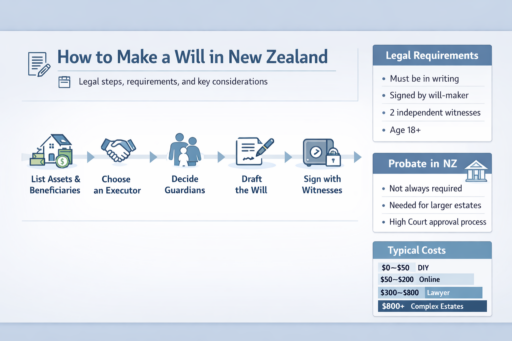
A free will in New Zealand can be created using a handwritten document, DIY will kit, or online will-writing platform, provided the will is properly signed and witnessed by two eligible people.
The process usually involves these steps:
1. List assets and decide beneficiaries: Identify key assets such as property, savings, investments, and personal belongings, then determine who will receive them.
2. Choose an executor and guardians if needed: Appoint an executor to manage the estate and name guardians if there are minor children.
3. Select how to draft the will:
The will can be prepared using:
-A DIY will template
-An online will-writing platform
-A handwritten document
-A lawyer or trustee service for more complex estates
4. Draft the will clearly and completely: Set out instructions for asset distribution, executor powers, and guardianship arrangements in clear written form.
5. Sign the will properly: The will-maker must sign the document in the presence of witnesses.
6. Have two eligible witnesses sign: At least two witnesses must observe the signing and sign the will.
7. Store the will securely: Keep the original document in a safe place and ensure the executor knows where it is kept.
How much does it cost to make a will in New Zealand?
The cost of making a will in New Zealand ranges from free DIY options to over $2,000 for complex estate planning involving lawyers, trusts, businesses, or large investment portfolios.
Typical costs include:
- DIY will kits: $0–$50
- Online will services: $50–$200
- Lawyer-drafted simple will: $300–$800
- Complex estate planning: $800–$2,000+
While DIY options are cheaper, professional drafting reduces the risk of costly legal disputes later.
What are the legal requirements for a will in NZ?
A valid will in New Zealand must be made by a person who is at least 18 years old (unless married or in a civil union), in writing, and signed in the presence of at least two witnesses who also sign the document.
These witnesses must not be beneficiaries under the will or married to beneficiaries.
The will-maker must also have testamentary capacity, meaning they understand the effect of the document and the extent of their assets at the time it is signed.
If these requirements are not followed, the will may be challenged or declared invalid.
What are the most common mistakes when creating a will?
One of the most common mistakes when writing a will in New Zealand is failing to update it after major life changes such as marriage, separation, or acquiring new assets.
Other frequent errors include not properly signing or witnessing the will, using vague language about beneficiaries or assets, forgetting to include all assets, not naming an executor or choosing an unsuitable one, and assuming verbal agreements will be honored.
These issues often arise because wills are written once and then left unchanged for many years, even as personal and financial circumstances evolve.
Even small mistakes can lead to disputes, delays in estate distribution, or parts of the estate being handled under intestacy rules instead of the will.
What is the best way to make a will in NZ?
The best way to make a will in New Zealand is to match the method to the complexity of the estate and the level of legal risk involved.
- Simple estate → online will platform or basic legal template
- Moderate complexity → lawyer-reviewed will
- Complex estate → full estate planning with a lawyer
For most people, a hybrid approach works well: drafting the will using a structured service and then having a lawyer review it for accuracy.
The key is ensuring the will is legally valid, clearly written, and regularly updated as circumstances change.
¿Cuál es la mejor alternativa al testamento?
A will in New Zealand is only one part of estate planning, and several assets can be structured to pass outside a will through legal arrangements such as trusts, joint ownership, and beneficiary designations.
Some common alternatives or complementary tools include:
- Fideicomisos: Assets are transferred into a legal structure managed by trustees for the benefit of chosen beneficiaries, which can keep them outside the estate and avoid probate in many cases
- Joint ownership: Property owned in joint tenancy automatically passes to the surviving owner upon death
- Beneficiary designations: Certain assets such as life insurance, retirement savings, and some investment accounts can be directed to named beneficiaries and pass directly without going through the estate
However, these arrangements do not fully replace a will.
A will is still needed to cover any remaining assets, appoint executors, and set guardianship instructions for minor children, ensuring the overall estate is properly coordinated.
Where should a will be stored and when should it be updated in NZ?
A will in New Zealand should be stored in a secure and accessible location, such as with a law firm, a trustee service, a bank safe custody facility, or a fireproof personal storage system at home, with clear instructions left for the executor on how to access it.
There is no single nationwide central registry for wills in New Zealand, so ensuring the executor knows exactly where the original document is kept is critical to avoid delays in estate administration.
A will should be updated whenever significant life or financial changes occur, such as marriage, separation, the birth of children, acquiring major assets, or changes in beneficiaries or executors.
Updates can be made by creating a new will that replaces the previous one or, in limited cases, by adding a legally valid codicil that modifies specific parts of the existing document.
Regular review helps ensure the will continues to reflect current intentions and reduces the risk of disputes or unintended distribution outcomes.
Conclusión
A will in New Zealand serves as the primary legal document that directs how assets are distributed under a system that otherwise follows strict intestacy rules.
Its effectiveness depends not only on correct execution at the time of signing, but on whether it continues to reflect current family circumstances, financial positions, and intended outcomes over time.
Problems often arise when expectations within families differ from what is formally written in the document, particularly where informal promises were made but not legally recorded.
This makes clarity of wording and structured decision-making at the time of drafting just as important as the legal validity of the will itself.
Preguntas frecuentes
Can I write my own will in NZ?
Yes, you can write your own will in New Zealand, as long as it meets all legal requirements such as proper signing and witnessing.
Who is best to draw up a will?
A lawyer or qualified estate planner is best for complex estates, while simple estates may be handled using reputable online will services.
What happens when a will is contested in NZ?
When a will is contested in New Zealand, the High Court reviews its validity or fairness, and parts of the will may be upheld, amended, or set aside based on the legal grounds and evidence presented.
Who pays when contesting a will in NZ?
In New Zealand, legal costs are usually paid from the estate, but the court can order one party to pay costs personally if the claim is considered weak or unreasonable.
¿Le duele la indecisión financiera?

Adam es un autor reconocido internacionalmente en temas financieros, con más de 830 millones de respuestas en Quora, un libro muy vendido en Amazon y colaborador de Forbes.