A second passport for Taiwan refers to practical citizenship pathways such as Caribbean CBI programs for speed, Turkey for investment access, or European residency routes like Portugal or Spain for long-term mobility.
These options allow Taiwanese nationals to expand visa-free travel, secure alternative residency rights, and reduce reliance on a single passport for global access.
Questo articolo tratta di:
- Can Taiwan hold two passports?
- What is the best second passport to have?
- Which country is the fastest to get a passport?
- What are the benefits of having a second citizenship for Taiwan?
- What are the disadvantages of dual nationality?
- What is the strength of Taiwan passport?
Punti di forza:
- Dual citizenship is generally allowed in Taiwan, but naturalization usually requires renunciation under the Nationality Act.
- Fastest passports are typically Caribbean CBI programs (3–6 months).
- Residency-based routes (like Portugal) take longer but offer stronger long-term value.
- The Taiwanese passport is moderately strong globally but not among the top-tier passports worldwide.
I miei recapiti sono hello@adamfayed.com e WhatsApp +44-7393-450-837 se avete domande.
Per i visti per nomadi digitali o di residenza che richiedono un reddito, un patrimonio o investimenti qualificati, possiamo aiutarvi a strutturare soluzioni di investimento adatte a soddisfare tali requisiti, a seconda delle vostre circostanze.
Le informazioni contenute in questo articolo hanno carattere puramente indicativo, non costituiscono una consulenza finanziaria, legale o fiscale e possono essere cambiate rispetto al momento in cui sono state scritte.

Does Taiwan allow multiple passports?
Yes, Taiwan generally allows dual nationality under its Nationality Act (Taiwan), meaning citizens can legally hold more than one passport without automatic loss of their Taiwanese citizenship.
However, this flexibility is not absolute.
Certain obligations such as military service requirements for eligible males, household registration rules, and administrative reporting, can still apply and affect how dual nationality is exercised.
In addition, while Taiwan permits its citizens to hold multiple passports, the rules can differ for foreigners naturalizing into Taiwan, who are often required to renounce their original citizenship unless they qualify for specific exemptions.
Which country has the most Taiwanese?
The United States has the largest Taiwanese population overseas, with around 330,000 people identifying as Taiwanese as of 2023, based on US Census and Pew Research estimates.
This makes it the primary destination for Taiwan’s diaspora, driven by long-standing education, technology, and migration links especially in states like California and New York.
Globally, there are roughly 800,000+ Taiwanese living abroad based on UN estimates , with major communities also in Canada, Australia, and Japan.
North America accounts for a significant share of the diaspora overall, reflecting stronger immigration pathways and higher education migration trends.
Why would you want two passports?
Holding a second passport for Taiwan citizens is primarily about expanding access, both in terms of travel and long-term relocation options.
While the Taiwanese passport is relatively strong, a second nationality can open additional visa-free destinations, reduce travel restrictions in certain regions, and provide more flexibility when crossing borders for business, study, or investimento.
Beyond mobility, a second passport also creates practical advantages for lifestyle and security planning.
It can provide alternative residency rights, access to different financial systems, and more options for education or healthcare abroad.
For some, it also serves as a contingency, offering a backup citizenship that can be used in case of geopolitical uncertainty or changing regional policies.
Which country is best for a second passport?
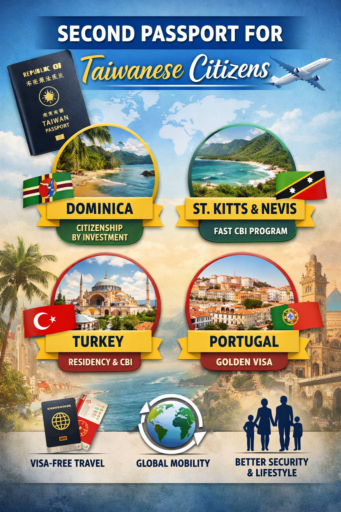
The best second passport for Taiwanese citizens typically includes Dominica, St. Kitts and Nevis, Antigua and Barbuda, Turkey, and Portugal, based on whether the priority is speed, cost, or long-term mobility.
Dominica offers one of the most affordable citizenship-by-investment (CBI) programs, with a minimum contribution of around $200,000 and processing times of 3–6 months, with no residency requirement.
It’s ideal for Taiwanese applicants seeking a fast, low-cost second passport with solid visa-free access.
St. Kitts and Nevis is one of the longest-running CBI programs, typically requiring $250,000+ investment.
Processing can be as fast as 3–6 months, and it offers strong global mobility and a well-established due diligence process, making it a premium fast-track option.
Antigua and Barbuda provides a relatively accessible entry point (around $230,000) and requires a 5-day physical stay within 5 years.
It’s a balanced option for cost and flexibility, particularly suitable for families.
Turkey offers citizenship through real estate investment starting at $400,000, with processing in about 6–12 months.
It’s attractive for Taiwanese nationals who want both a second passport and a tangible asset, along with access to regional markets between Europe and Asia.
Portugal is a long-term pathway rather than a fast one, typically requiring 5 years of legal residency before citizenship eligibility.
While slower, it provides access to the European Union, making it ideal for Taiwanese citizens prioritizing relocation, business expansion, and long-term settlement.
What is the fastest passport to get?
The fastest second passports are typically offered by Vanuatu, followed by Caribbean citizenship-by-investment programs such as Dominica and St. Kitts and Nevis, with additional faster investment routes like Turkey.
In some cases, Vanuatu can process citizenship in as little as 1–3 months, while Caribbean programs generally take around 3–6 months, and Turkey about 6–12 months, depending on due diligence and completion of investment requirements.
These programs are designed for speed and usually do not require long-term physical residence, making them attractive for applicants seeking rapid global mobility upgrades.
However, for citizens of Taiwan, there are important trade-offs.
Faster programs, especially smaller or less widely recognized ones like São Tomé e Príncipe, may come with weaker visa-free travel strength, higher uncertainty in program stability, or lower global recognition compared to established Caribbean or EU-linked pathways.
As a result, while these options prioritize speed, they may not provide the same long-term mobility, residency benefits, or international credibility as slower but more established citizenship routes.
Quali sono le sfide della doppia cittadinanza?
The main challenges of dual citizenship for Taiwanese nationals involve legal obligations, military service requirements, and conflicting rules between jurisdictions.
While holding two passports can improve mobility, it also creates situations where both countries may impose separate legal and administrative responsibilities.
These challenges often include potential tax reporting across multiple countries, mandatory military service for eligible Taiwanese males, and differing rules on whether the second country allows dual nationality or requires disclosure and renunciation.
In some cases, documentation inconsistencies or conflicting legal definitions of citizenship can also lead to complications when traveling, working, or renewing official identification.
How powerful is a Taiwanese passport?
Taiwan’s passport power is moderately strong globally, offering visa-free or visa-on-arrival access to about 130 countries, placing it in the mid-tier range of global travel passports.
Global passport rankings
| Index | Latest ranking | Note |
| Indice dei passaporti di Henley | 31st | Strong regional mobility, but below top 10 global passports |
| Indice dei passaporti di Arton Capital | 37th | Varies by methodology, generally mid-tier global standing |
| Indice del passaporto nomade capitalista | 81st | Strong travel score, weaker tax and global perception factors |
Taiwan’s passport performs well across Asia and parts of Europe and the Americas, but still requires visas or pre-approvals for certain major destinations, keeping it outside the top global tier.
Come ottenere un secondo passaporto per un altro Paese
You can get a second passport through citizenship-by-investment, long-term naturalization, ancestry, or special eligibility routes.
1. Cittadinanza per investimento – Fast-track programs in countries like Caribbean nations or Turkey.
2. Naturalizzazione through residency – Living in a country for several years (e.g., Portugal or Spain) before applying for citizenship.
3. Discendenza o ascendenza – Claiming citizenship through parents or grandparents in eligible countries.
4. Il matrimonio o special naturalization routes – Some countries offer expedited citizenship through family ties or exceptional contribution.
Multi-Passport Strategy: The Rise of Global Mobility Portfolios
A growing trend among globally mobile individuals, including citizens of Taiwan, is no longer focusing on a single best second passport but instead building a layered mobility strategy using multiple legal residencies and citizenships.
This approach is often referred to as a global mobility portfolio, where each document serves a different purpose—speed, stability, pianificazione fiscale, or long-term relocation.
This strategy often combines a fast citizenship option such as Caribbean citizenship-by-investment for immediate travel freedom, alongside a longer-term pathway like European residency in countries such as Portugal or Spain for eventual EU citizenship.
Some also add regional bases in Asia, such as Malaysia or Thailand residency, to maintain lifestyle flexibility while pursuing longer citizenship timelines elsewhere.
The key advantage of this approach is flexibility. Instead of relying on one passport to meet all needs, individuals diversify their options across different regions and legal systems.
However, it also requires higher financial commitment, careful tax planning, and ongoing reporting compliance across multiple jurisdictions, making it more suitable for high-mobility professionals, entrepreneurs, and internationally active families.
Conclusione
Planning for a second passport for Taiwan reflects a shift in how global mobility is structured rather than simply an upgrade in travel documents.
Different pathways exist to solve different constraints.
In reality, the most important distinction is not how quickly a passport can be obtained, but how it functions after issuance.
Factors such as renewability, legal stability, tax residency alignment, and integration into long-term living arrangements often matter more than initial visa-free gains.
As a result, effective strategies increasingly combine multiple steps instead of relying on a single solution.
Fast citizenship can provide immediate flexibility, while slower residency-based options build deeper and more durable access over time, creating a more resilient overall mobility profile.
Domande frequenti
Can you lose Taiwan citizenship?
Yes, citizenship from Taiwan can be lost in certain cases, such as voluntary renunciation or acquiring another nationality under conditions that require surrender of Taiwanese nationality.
However, loss is not automatic in most dual citizenship scenarios.
How hard is it to get Taiwanese citizenship?
It is considered relatively difficult.
Taiwan has strict residency requirements, language and integration expectations, and limited pathways for naturalization compared to many other countries.
Does Taiwan give citizenship to foreigners?
Yes, but it is limited.
Foreigners can obtain citizenship in Taiwan through naturalization after long-term residency, but they are generally required to renounce their original nationality under the Nationality Act (Taiwan) before approval.
Which is the toughest citizenship to get?
Alcuni dei toughest citizenships to obtain include countries like Giappone, Svizzera, e Austria.
These countries have strict residency requirements, cultural integration standards, and highly selective approval processes.
What is the #1 passport in the world?
As of recent global passport rankings, Japan, Singapore, and several European Union countries are often ranked at the top for visa-free travel access, offering entry to the highest number of destinations without prior visas.
Siete afflitti dall'indecisione finanziaria?

Adam è un autore riconosciuto a livello internazionale in materia finanziaria con oltre 830 milioni di visualizzazioni di risposte su Quora, un libro molto venduto su Amazon e un contributo su Forbes.