
+44 7393 450837
advice@adamfayed.com
Follow on

Investment vs Annuity: Which Fits Your Retirement Plan?

An annuity provides guaranteed income, while an investment focuses on growth and flexibility.

The key difference between annuities and investments is predictable, stable payouts versus the potential for higher returns and control over your money.

This article covers:

  • What is the difference between an annuity and an investment?
  • What are the advantages and disadvantages of having an annuity vs investment?
  • Are annuities or investments safe if the market crashes?

Key Takeaways:

  • Annuities provide steady income and protect against outliving savings.
  • Investments offer growth potential and flexibility but carry market risk.
  • Combining annuities with investments can balance security and growth.

My contact details are hello@adamfayed.com and WhatsApp ‪+44-7393-450-837 if you have any questions.

The information in this article is for general guidance only. It does not constitute financial, legal, or tax advice, and is not a recommendation or solicitation to invest. Some facts may have changed since the time of writing.

Discover How We Can Address Your Financial Pain Points Subscribe Free Discover Now

What is the difference between investment and annuity?

An investment grows your money in the market, while an annuity turns a lump sum into guaranteed income.

  • Investment: Allows your funds to grow with market performance, offering flexibility and potentially higher returns. You control withdrawals but bear market risk.
  • Annuity: Converts a lump sum into a steady income stream, usually monthly or annually, often for life. The provider takes on investment and longevity risk in exchange for predictability.

In short, investments prioritize growth and control, while annuities prioritize stability and guaranteed income.

Which investment is best for retirement?

The most recommendable investment for retirement is a diversified portfolio that combines stocks, bonds, and broad-based funds to balance growth, income, and risk over time, instead of relying on one asset.

This works because no single asset consistently meets all retirement needs.

Growth-oriented investments help protect purchasing power, while income-focused assets provide stability and cash flow.

Stocks and equity funds are typically included for long-term growth and inflation protection, particularly for retirees with longer time horizons or additional income sources.

Bonds and bond funds help reduce volatility and generate steadier income, making them especially useful as retirement approaches or during drawdown years.

Mutual funds and ETFs simplify diversification by spreading exposure across multiple assets, sectors, and regions without requiring active management.

REITs and real estate investments can complement a portfolio by providing income and diversification, though they are usually best used as a secondary allocation rather than a core holding.

Ultimately, the specific mix should reflect individual risk tolerance, income needs, and retirement timing, but diversification remains the foundation for most successful retirement portfolios.

Is an annuity a good choice for retirement?

An annuity can be a strong choice for retirees aiming for predictable income and protection against outliving their savings.

It is particularly suitable if you:

  • Want guaranteed monthly income for life
  • Lack other reliable income streams
  • Prefer a hands-off approach to managing market risk

However, annuities may be less flexible than other retirement strategies and often come with fees, so careful consideration of your personal situation is important.

Are annuities better than investments?

For most retirees, a combination is recommended: use an annuity for essential income and investments for growth and flexibility.

Annuities are not better than investments on their own; investments are generally better for growth, while annuities are better for assured retirement income.

  • Annuities provide steady, predictable income and reduce longevity risk.
  • Investments offer growth potential, flexibility, and the ability to leave assets to heirs.

This approach balances financial security with long-term wealth building, making retirement more stable and adaptable.

What are the advantages of investments vs annuity?
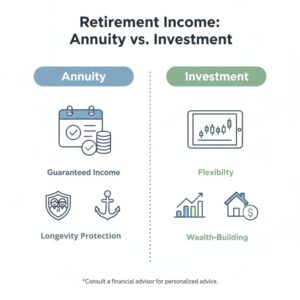
Annuity vs investment

Investments excel at wealth growth and financial flexibility, whereas annuities excel at providing reliable, consistent retirement income.

Investments offer:

  • Flexibility to access funds anytime
  • Potential for higher returns over time
  • Opportunity to grow wealth beyond guaranteed income
  • Estate planning and inheritance benefits

Annuities offer:

  • Dependable income
  • Ensuring savings last a lifetime
  • Less need to manage investments actively

What is the biggest disadvantage of an annuity vs investment?

The biggest disadvantage of an annuity is that your money is largely locked in.

 Once funds are annuitized, access is limited, and withdrawing a large sum can trigger penalties.

Investments, on the other hand, remain accessible and can be adjusted or sold as needed, but they carry market risk and do not provide guaranteed income.

What happens to annuities when the market crashes?

Annuities generally continue paying guaranteed income even if the market crashes.

Fixed and immediate annuities provide set payments regardless of market performance, while variable annuities may fluctuate but often include riders that secure a minimum income.

Overall, annuities protect essential retirement income and provide stability, though growth potential is usually lower than market-based investments.

What happens to investments when the market crashes?

Investments lose value when the market crashes, exposing your portfolio to potential losses.

Stocks, bonds, and mutual funds can drop significantly, and recovery depends on market conditions, asset allocation, and your time horizon.

Compared with annuities, investments carry higher risk but also higher growth potential once markets recover, making diversification and risk management crucial.

What investments are safe in a market crash?

During a market crash, the safest investments are those that are low-risk and less tied to market fluctuations.

Options such as US Treasury bonds and bills, high-quality corporate bonds, certificates of deposit (CDs), and money market funds tend to preserve capital and provide predictable returns.

These investments act as a stabilizing component in a portfolio, helping retirees protect their savings while weathering market volatility.

Conclusion

Retirement planning is as much about strategy as it is about money.

Annuities act as a safety net, ensuring basic needs are covered, while investments serve as a growth engine, helping your wealth keep pace with inflation and lifestyle goals.

Balancing the two allows retirees to protect essential income while still capturing opportunities for financial growth, giving both security and flexibility in a changing economic landscape.

Consulting a financial advisor can help you tailor this balance to your unique situation, ensuring your retirement plan meets your goals and mitigates risks effectively.

FAQs

What are the safest investments for seniors?

The safest investments for seniors are low-risk, income-focused options that preserve capital, such as US Treasury bonds and bills, high-quality corporate bonds, certificates of deposit (CDs), and money market funds.

These choices prioritize predictable returns and protection of principal over high growth.

How much does a $100,000 annuity pay per month?

A $100,000 lifetime annuity often pays roughly $400 to $600 per month, based on age at purchase, interest rates, and payout options such as single-life or joint-life coverage.

Why avoid annuities in retirement?

Retirees may avoid annuities because they limit access to a lump sum, come with fees and commissions that reduce returns, may lose purchasing power due to inflation, and offer less investment flexibility compared with market-based options.

Pained by financial indecision?

Adam Fayed Contact CTA3

Adam is an internationally recognised author on financial matters with over 830million answer views on Quora, a widely sold book on Amazon, and a contributor on Forbes.


Leave a Reply

Your email address will not be published. Required fields are marked *

This URL is merely a website and not a regulated entity, so shouldn’t be considered as directly related to any companies (including regulated ones) that Adam Fayed might be a part of.

This Website is not directed at and should not be accessed by any person in any jurisdiction – including the United States of America, the United Kingdom, the United Arab Emirates and the Hong Kong SAR – where (by reason of that person’s nationality, residence or otherwise) the publication or availability of this Website and/or its contents, materials and information available on or through this Website (together, the “Materials“) is prohibited.

Adam Fayed makes no representation that the contents of this Website is appropriate for use in all locations, or that the products or services discussed on this Website are available or appropriate for sale or use in all jurisdictions or countries, or by all types of investors. It is your responsibility to be aware of and to observe all applicable laws and regulations of any relevant jurisdiction.

The Website and the Material are intended to provide information solely to professional and sophisticated investors who are familiar with and capable of evaluating the merits and risks associated with financial products and services of the kind described herein and no other persons should access, act on it or rely on it. Nothing on this Website is intended to constitute (i) investment advice or any form of solicitation or recommendation or an offer, or solicitation of an offer, to purchase or sell any financial product or service, (ii) investment, legal, business or tax advice or an offer to provide any such advice, or (iii) a basis for making any investment decision. The Materials are provided for information purposes only and do not take into account any user’s individual circumstances.

The services described on the Website are intended solely for clients who have approached Adam Fayed on their own initiative and not as a result of any direct or indirect marketing or solicitation. Any engagement with clients is undertaken strictly on a reverse solicitation basis, meaning that the client initiated contact with Adam Fayed without any prior solicitation.

*Many of these assets are being managed by entities where Adam Fayed has personal shareholdings but whereby he is not providing personal advice.

This website is maintained for personal branding purposes and is intended solely to share the personal views, experiences, as well as personal and professional journey of Adam Fayed.

Personal Capacity
All views, opinions, statements, insights, or declarations expressed on this website are made by Adam Fayed in a strictly personal capacity. They do not represent, reflect, or imply any official position, opinion, or endorsement of any organization, employer, client, or institution with which Adam Fayed is or has been affiliated. Nothing on this website should be construed as being made on behalf of, or with the authorization of, any such entity.

Endorsements, Affiliations or Service Offerings
Certain pages of this website may contain general information that could assist you in determining whether you might be eligible to engage the professional services of Adam Fayed or of any entity in which Adam Fayed is employed, holds a position (including as director, officer, employee or consultant), has a shareholding or financial interest, or with which Adam Fayed is otherwise professionally affiliated. However, any such services—whether offered by Adam Fayed in a professional capacity or by any affiliated entity—will be provided entirely separately from this website and will be subject to distinct terms, conditions, and formal engagement processes. Nothing on this website constitutes an offer to provide professional services, nor should it be interpreted as forming a client relationship of any kind. Any reference to third parties, services, or products does not imply endorsement or partnership unless explicitly stated.

*Many of these assets are being managed by entities where Adam Fayed has personal shareholdings but whereby he is not providing personal advice.

I confirm that I don’t currently reside in the United States, Puerto Rico, the United Arab Emirates, Iran, Cuba or any heavily-sanctioned countries.

If you live in the UK, please confirm that you meet one of the following conditions:

1. High-net-worth

I make this statement so that I can receive promotional communications which are exempt

from the restriction on promotion of non-readily realisable securities.

The exemption relates to certified high net worth investors and I declare that I qualify as such because at least one of the following applies to me:

I had, throughout the financial year immediately preceding the date below, an annual income

to the value of £100,000 or more. Annual income for these purposes does not include money

withdrawn from my pension savings (except where the withdrawals are used directly for

income in retirement).

I held, throughout the financial year immediately preceding the date below, net assets to the

value of £250,000 or more. Net assets for these purposes do not include the property which is my primary residence or any money raised through a loan secured on that property. Or any rights of mine under a qualifying contract or insurance within the meaning of the Financial Services and Markets Act 2000 (Regulated Activities) order 2001;

  1. c) or Any benefits (in the form of pensions or otherwise) which are payable on the

termination of my service or on my death or retirement and to which I am (or my

dependents are), or may be entitled.

2. Self certified investor

I declare that I am a self-certified sophisticated investor for the purposes of the

restriction on promotion of non-readily realisable securities. I understand that this

means:

i. I can receive promotional communications made by a person who is authorised by

the Financial Conduct Authority which relate to investment activity in non-readily

realisable securities;

ii. The investments to which the promotions will relate may expose me to a significant

risk of losing all of the property invested.

I am a self-certified sophisticated investor because at least one of the following applies:

a. I am a member of a network or syndicate of business angels and have been so for

at least the last six months prior to the date below;

b. I have made more than one investment in an unlisted company in the two years

prior to the date below;

c. I am working, or have worked in the two years prior to the date below, in a

professional capacity in the private equity sector, or in the provision of finance for

small and medium enterprises;

d. I am currently, or have been in the two years prior to the date below, a director of a company with an annual turnover of at least £1 million.

Adam Fayed is not UK-based, nor FCA or MiFID authorised.

Adam Fayed uses cookies to enhance your browsing experience, deliver personalized content based on your preferences, and help us better understand how our website is used. By continuing to browse adamfayed.com, you consent to our use of cookies.

If you do not consent, you’ll be redirected away from this site as we rely on cookies for core functionality.

Learn more in our Privacy Policy & Terms & Conditions.

SUBSCRIBE TO ADAM FAYED JOIN COUNTLESS HIGH NET WORTH SUBSCRIBERS

SUBSCRIBE TO ADAM FAYED JOIN COUNTLESS HIGH NET WORTH SUBSCRIBERS

Gain free access to Adam’s two expat books.

Gain free access to Adam’s two expat books.

Get more strategies every week on how to be more productive with your finances.
