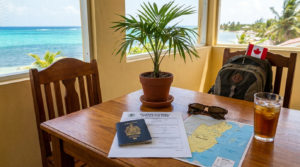
Canadians move to Belize by entering visa-free, extending their stay monthly, and later applying for permanent residency or a retirement residency program.
Belize’s English-speaking system, flexible immigration rules, and accessible property ownership laws make relocation achievable without prior visa approval.
For Canadians planning to make this move, it’s also important to consider Canada’s exit tax on certain assets—we can help you manage this efficiently.
This article covers:
- How to legally reside in Belize
- What do Canadians need to enter Belize?
- Can I get permanent residency in Belize?
- How much does the QRP cost in Belize?
- How much does it cost to become a permanent resident of Belize?
- What are the advantages and disadvantages of living in Belize?
Key Takeaways:
- Canadians can enter Belize without a visa and extend their stay monthly.
- Permanent residency is available after 12 months of legal presence.
- Retirees may qualify through the Qualified Retired Persons program.
- Foreigners can own property outright in Belize.
My contact details are hello@adamfayed.com and WhatsApp +44-7393-450-837 if you have any questions.
The information in this article is for general guidance only. It does not constitute financial, legal, or tax advice, and is not a recommendation or solicitation to invest. Some facts may have changed since the time of writing.

How does a Canadian move to Belize?
A Canadian typically moves to Belize by relocating first under visitor status, securing housing, and then transitioning to long-term legal residence once eligibility requirements are met.
Most Canadians arrive without prearranged visas, establish day-to-day life, and later choose between permanent residency or the Qualified Retired Persons (QRP) program based on age and income.
Belize’s immigration system allows this gradual approach, enabling Canadians to move first and formalize their status afterward without complex pre-approval requirements.
What are the requirements to move to Belize?
Canadians can move to Belize by entering with a valid passport and meeting immigration and residency requirements for short- or long-term stays.
At a minimum, Canadians need:
- A valid Canadian passport with at least six months’ validity
- Proof of onward travel or sufficient financial means
- Compliance with Belize immigration entry rules
For long-term residence, additional requirements include:
- A clean criminal background check
- Medical clearance
- Proof of income or financial self-sufficiency
- Continuous legal stay in Belize to qualify for residency
How much does it cost to get residency in Belize?
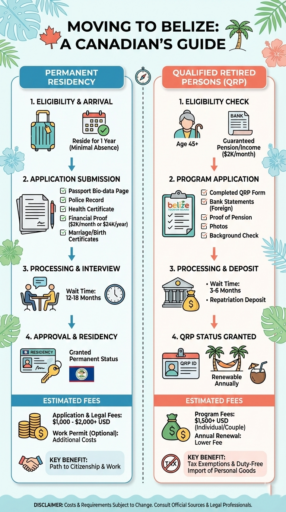
Obtaining residency in Belize typically costs around US $1,500 for permanent residency for Canadians and about US $1,350–$1,400 for the QRP program, including application and card fees, not counting supporting documents or optional legal assistance.
Permanent Residency (PR) costs for Canadians:
- Government residency fee: BZ $3,000 (~US $1,500), paid upon approval
- Document preparation: Police clearances, medical exams, and translations (~US $100–$300)
- Optional legal or processing assistance: US $500–$1,500 depending on services
Qualified Retired Persons (QRP) program costs:
- Application fee: US $150, non-refundable
- Program fee (main applicant): US $1,000
- QRP ID card fee: US $200
- Dependent fee: US $750 per dependent (if applicable)
- Annual card renewal: US $25
Additional considerations: Travel expenses, temporary accommodation, and any professional assistance may add to upfront costs.
While fees for both PR and QRP are generally modest compared with many countries, applicants should budget carefully for document preparation, legal support, and ongoing maintenance to remain compliant with Belize’s residency requirements.
How to apply for residency in Belize?
To apply for residency in Belize, a Canadian must legally reside in the country for at least 12 consecutive months before submitting a permanent residency application.
Step-by-step process for permanent residency in Belize:
1. Enter Belize legally: Arrive with a valid Canadian passport and comply with Belize’s visitor entry requirements.
2. Establish continuous residence: Live in Belize for 12 consecutive months and limit absences to no more than 14 days in total.
3. Maintain valid immigration status: Renew visitor permits monthly at the Belize Immigration Department during the qualifying period.
4. Prepare required documentation: Gather passport copies, a police clearance from Canada, and a medical examination.
5. Demonstrate financial stability: Provide proof of income or sufficient financial resources to support yourself in Belize.
6. Submit the residency application: File the completed application with supporting documents and pay the required government fees.
Alternatively, Canadians aged 45 and older may apply under the Qualified Retired Persons (QRP) program.
What is the QRP program in Belize and how to apply?
The Qualified Retired Persons (QRP) program in Belize is a residency program designed for retirees aged 45 and older who have a steady income from foreign sources.
It allows Canadians and other foreigners to live in Belize long term without the strict continuous presence requirement that permanent residency demands.
Participants enjoy benefits such as exemption from Belize taxes on foreign income and duty-free importation of personal goods and vehicles.
How Canadians can apply for the QRP program:
- Check eligibility: Ensure you are at least 45 years old and have a minimum monthly income of US $2,000 from pensions, annuities, or other foreign retirement funds.
- Gather documentation: Prepare passport copies, proof of age, proof of income, and a police clearance certificate.
- Submit the QRP application: File your application with the Belize Tourism Board or authorized QRP office along with supporting documents and application fees.
- Await approval: Once approved, you receive QRP status, which allows residency in Belize and access to program benefits.
- Maintain QRP status: Renew annually and comply with any reporting or documentation requirements to retain program privileges.
The QRP program is particularly attractive to Canadians because it simplifies long-term living in Belize while providing tax and import incentives, making it a popular alternative to permanent residency for retirees.
How long can a Canadian citizen stay in Belize?
A Canadian citizen can stay in Belize for up to 30 days upon entry, with the option to renew monthly while remaining in the country.
Extensions are handled through the Belize Immigration Department and generally involve a fee.
Many Canadians remain in Belize for extended periods by renewing their tourist status until they qualify for permanent residency or choose a formal residency program.
What are the benefits of moving to Belize?
One of the main benefits of moving to Belize is its English-speaking environment, which makes daily life and integration easier for Canadians.
Other advantages include:
- Lower cost of living compared to Canada
- Warm climate year-round
- No capital gains tax
- Simple property ownership rules for foreigners
- Established Canadian and international expat communities
Belize also offers proximity to North America while maintaining a relaxed Caribbean-Central American lifestyle.
What is the downside of living in Belize?
One of the main downsides of living in Belize is its limited healthcare infrastructure compared to Canada, which can affect access to medical services.
Other challenges include:
- Bureaucratic delays in government processes
- Higher import costs for foreign goods
- Infrastructure limitations in rural areas
- Fewer employment opportunities for foreign nationals
While lifestyle advantages are significant, many Canadians rely on private healthcare and maintain financial ties abroad.
Where do most Canadians live in Belize?
Most Canadians in Belize live in Ambergris Caye, a well‑established expat and beach community with plenty of amenities and social opportunities.
Other common choices include:
- Caye Caulker: Smaller, more laid‑back island known for its go-slow lifestyle and lower cost.
- Placencia: A southern peninsula with quiet beaches, growing expat presence, and relaxed island‑meets‑mainland living.
- San Ignacio (Cayo District): Inland town surrounded by jungle, rivers, and Mayan sites — popular with adventure‑oriented expats.
- Corozal Town: Northern Belize near the Mexican border with affordable housing and a calm community atmosphere.
- Hopkins Village: A coastal Garifuna village with a growing expat scene, cultural immersion, and beachfront living.
- Punta Gorda (Toledo District): Southern Belize town valued for nature‑focused living, low property costs, and a slower pace.
These places offer diverse lifestyles, from vibrant island life to quieter coastal or inland communities, giving Canadians a range of options depending on whether they prefer social expat hubs, beach living, cultural immersion, or rural tranquility.
What is the easiest country for Canadians to immigrate to?
Belize is often considered one of the easier options for Canadians due to visa-free entry and accessible residency programs. Other countries frequently ranked as easy for Canadians include:
- Portugal – Offers accessible residency visas like the D7 and Golden Visa with pathways to permanent residency and EU mobility.
- Australia – Popular for skilled workers and those with job offers through established immigration streams.
- New Zealand – Welcomes skilled migrants and has relatively transparent pathways to long‑term residency.
- Mexico – Proximity to Canada, established expat networks, and retiree visa options make it a common choice.
- Germany – Offers work‑related routes like the EU Blue Card for in‑demand professions.
- Spain – Non‑Lucrative visas and lifestyle appeal attract many Canadians seeking residency.
- France – Residency through income or investment and cultural ties make it attractive for some.
- Croatia and Thailand – Often cited in visa guides as relatively straightforward options for retirees and remote workers.
Conclusion
Relocating to Belize invites Canadians to rethink what home can mean, blending freedom, simplicity, and opportunity in unexpected ways.
Moving here challenges you to engage with a different rhythm of life, embrace local culture, and build connections across communities.
For many, the true value of living in Belize lies in the small, everyday experiences: the pace of island life, the natural surroundings, and the chance to cultivate a life defined more by choice than convention.
In that sense, moving to Belize is less about a destination and more about creating a lifestyle on your own terms.
One that can be as adventurous, social, or reflective as you wish.
FAQs
Is Belize easy to immigrate to?
Yes, Belize is relatively easy to immigrate to for Canadians.
The ability to enter without a visa, extend stays monthly, and qualify for residency after one year makes the process more accessible than many other countries.
Can a Canadian buy a house in Belize?
A Canadian can buy a house in Belize with the same property rights as a local citizen.
Foreigners can own land outright, including beachfront property, without requiring a local partner.
Property purchases are commonly made in cash, as local mortgage financing for foreigners is limited.
Can I live in Belize for $1000 a month?
It is possible to live in Belize for $1000 a month in rural or inland areas with modest housing and lifestyle choices.
Coastal and island locations typically require a higher monthly budget, especially when factoring in rent, utilities, and imported goods.
What language do they speak in Belize City?
The primary language spoken in Belize City is English, which is the official language of Belize.
Belizean Creole (Kriol) is also widely spoken, along with Spanish in some communities.
Pained by financial indecision?

Adam is an internationally recognised author on financial matters with over 830million answer views on Quora, a widely sold book on Amazon, and a contributor on Forbes.