GIFT City vs Dubai is ultimately a comparison between an India-linked international financial center and a globally diversified offshore investment hub.
For investors, the right choice hinges on geographic exposure, tax structure, regulatory comfort, and the type of assets they want to access.
This article covers:
- What are GIFT City investments?
- What are the best investments in Dubai?
- What are the benefits of investing in GIFT City and Dubai?
- What is the tax treatment in Dubai?
- What are the tax benefits of the GIFT City?
Key Takeaways:
- GIFT City suits India-focused investors and NRIs seeking regulated, tax-efficient exposure.
- Dubai provides global diversification, mature markets, and highly liquid investment options.
- Tax outcomes in both hubs rely on investment structure, not just location.
- Savvy investors often use GIFT City and Dubai together to balance growth and diversification.
My contact details are hello@adamfayed.com and WhatsApp +44-7393-450-837 if you have any questions.
The information in this article is for general guidance only. It does not constitute financial, legal, or tax advice, and is not a recommendation or solicitation to invest. Some facts may have changed since the time of writing.

GIFT City vs Dubai at a Glance
GIFT City operates as India’s first International Financial Services Centre (IFSC), designed to channel global capital into India through a regulated, onshore framework.
Dubai, by contrast, is a mature global financial hub with decades of experience attracting international investors, family offices, and multinational institutions.
GIFT City and Dubai are increasingly compared as investment destinations, but they serve different strategic purposes.
From an investment point of view, the comparison isn’t exactly about which city is objectively better and more about alignment with investor goals.
GIFT City is tightly linked to India’s growth story, while Dubai offers broad global diversification and offshore flexibility.
| Factor | GIFT City | Dubai |
| Jurisdiction Type | Onshore International Financial Services Centre (IFSC) within India | Offshore/global financial hub with multiple free zones (DIFC, ADGM) |
| Primary Objective | Channel global capital into India and facilitate India-focused investments | Serve as a platform for globally diversified capital and cross-border investing |
| Regulatory Environment | Unified Indian regulatory framework under IFSCA, evolving but globally aligned | Mature, internationally recognised regulatory environment with established investor protections |
| Investor Profiles | NRIs, India-focused institutional investors, fund managers targeting Indian growth | UHNWIs, family offices, global institutional investors seeking diversified portfolios |
| Currency Environment | Primarily USD and other foreign currencies within IFSC framework, INR-linked investments possible | Multi-currency, fully convertible for global transactions |
| Tax Incentives | 100 % corporate tax holiday for 10 out of 15 years for eligible entities, reduced withholding taxes, exemptions on certain capital gains | No personal income tax; corporate tax 0 % on profits up to AED 375,000, 9 % above that; free-zone entities often 0 % corporate tax |
| Market Focus | India-centric assets, IFSC-listed global securities, India-linked funds | Global equities, bonds, private equity, real estate, sukuk, structured products |
| Liquidity & Market Depth | Developing market; growing but limited compared to Dubai | Deep and highly liquid markets with broad international participation |
| Best For | Investors seeking India exposure with regulatory clarity and tax efficiency | Investors prioritizing global diversification, mature infrastructure, and offshore flexibility |
What are the best investment opportunities right now?
The best investment opportunities right now in GIFT City are India-linked funds and IFSC-listed global securities, while Dubai offers broader access to global equities, private markets, and real assets.
In GIFT City, opportunities are closely tied to India’s expanding economy and capital markets, with investors increasingly using India-focused funds, alternative investment structures, and IFSC exchanges that benefit from regulatory clarity and targeted tax incentives.
In Dubai, investment opportunities span a wide range of global asset classes.
Investors commonly use Dubai as a base to deploy capital into international equities, private equity, venture capital, real estate, sukuk, and structured products through well-established offshore vehicles.
Across both jurisdictions, investment options continue to evolve as regulations mature, global capital flows shift, and investor demand changes.
Ultimately, the best opportunity depends on whether an investor is prioritizing India-focused growth or globally diversified exposure.
GIFT City
GIFT City is positioned as a gateway for international investors looking to access Indian markets efficiently.
Operating under the International Financial Services Centres Authority (IFSCA), it offers a unified regulatory framework that combines banking, capital markets, insurance, and fund management.
From an investment perspective, GIFT City is particularly attractive for:
- Alternative Investment Funds (AIFs) with India-linked strategies
- Portfolio Management Services (PMS) for global and domestic assets
- Offshore-style fund structures within an onshore Indian framework
- Listings of global equities, bonds, and derivatives on IFSC exchanges
The ecosystem is still developing, but momentum is strong, especially among NRI investors, institutions, and fund managers seeking a regulated alternative to traditional offshore centers.
DUBAI
Dubai has long established itself as a global investment hub, supported by sophisticated financial infrastructure and multiple free zones such as DIFC and ADGM.
It serves as a base for investors deploying capital across the Middle East, Europe, Africa, and Asia.
Key investment strengths of Dubai include:
- Access to global equity and bond markets
- Private equity and venture capital ecosystems
- Real estate investment platforms and REITs
- Shariah-compliant investment products such as sukuk
- Flexible structuring through SPVs and holding companies
Dubai’s appeal lies in its scale, liquidity, and global connectivity, making it particularly attractive for UHNWIs and family offices seeking international diversification.
Is it worth investing in GIFT City or DUBAI?
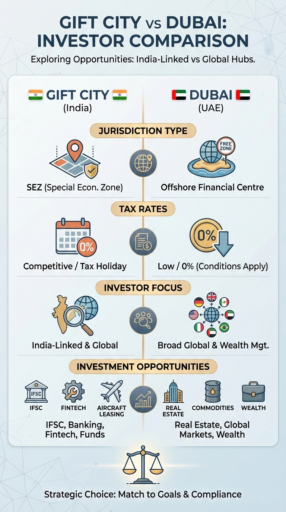
Yes, both GIFT City and Dubai are worth investing in, with GIFT City designed to channel global capital into India’s growth and Dubai built to serve as a platform for globally diversified investing.
GIFT City is well suited for investors seeking exposure to India’s long-term economic expansion within a globally aligned regulatory framework, particularly NRIs and institutions pursuing India-centric strategies with potential tax efficiencies.
Dubai, by contrast, appeals to investors focused on broad international diversification, mature financial markets, and access to a wide range of global asset classes.
Its long-established investment ecosystem offers scale, liquidity, and operational stability.
Rather than choosing one over the other, many sophisticated investors use GIFT City and Dubai as complementary platforms within a diversified investment strategy.
What are the risks of investing in Dubai and GIFT City?
The main risks of investing in GIFT City relate to its evolving regulatory framework and India-centric market exposure, while Dubai’s risks are tied to global market cycles and regulatory change.
In GIFT City, key risks include regulatory evolution as the IFSC framework continues to mature, relatively limited market depth and liquidity compared to older financial hubs, and concentration risk from a strong focus on Indian assets.
In Dubai, investors should consider exposure to global market volatility, potential regulatory and tax adjustments as international standards evolve, and cyclical risks in sectors such as real estate.
Neither jurisdiction is inherently high-risk, but each presents different forms of exposure that investors must assess carefully within the context of their overall investment strategy.
What is the tax rate for investments in GIFT City and Dubai?
In GIFT City, eligible entities can enjoy a 100 % corporate tax holiday for any 10 years out of the first 15 years of operation, with a fallback minimum tax rate of 9 % on book profits when the holiday isn’t claimed.
Dividend income paid to non‑resident investors is typically subject to a concessional withholding tax of around 10 %, and many investment transactions within IFSC exchanges are exempt from capital gains tax or transaction taxes such as STT and GST.
In Dubai (UAE), there is no personal income tax and capital gains for individuals are generally tax‑free; corporate tax is 0 % on profits up to AED 375,000 and 9 % on profits above that threshold, with qualifying free‑zone entities often able to retain a 0 % rate on qualifying income.
Effective tax outcomes vary by structure, asset type, and residency status, so investors should plan with professional advice to maximize efficiency.
Conclusion
From an investment perspective, GIFT City vs Dubai is not a zero-sum comparison.
GIFT City represents India’s push to retain and attract international capital within a regulated domestic framework, while Dubai remains a globally diversified investment hub with unmatched reach.
For investors, the more important question is not which hub will win, but how regulatory direction, capital controls, and geopolitical alignment shape long-term flexibility.
As global scrutiny of offshore structures increases and regional growth stories diverge, investors who understand the strategic role of each center, and use them deliberately, are better placed to adapt as the investment landscape evolves.
FAQs
How rich is Dubai compared to other cities?
Dubai ranks among the richest cities globally, currently placing around 18th in the world for the number of high-net-worth individuals, with about 81,200 resident millionaires and over 200 ultra-wealthy centi-millionaires.
This positions it ahead of many established global cities in wealth concentration and underscores its rapid ascent as a major hub for global capital and affluent residents.
Why is Dubai considered a global city?
Dubai is considered a global city due to its strategic location, international connectivity, diverse population, advanced infrastructure, and role as a financial and commercial hub linking multiple regions.
Is GIFT City India’s emerging rival to Dubai and Singapore?
GIFT City is often described as India’s emerging alternative to established financial hubs like Dubai and Singapore.
While it is not yet a direct rival in scale, it is strategically positioned to serve India-focused international capital.
Is it better to invest in India or Dubai?
Investing in India is better for investors looking for long-term growth from an expanding domestic economy, while Dubai is better for those prioritizing global diversification and access to mature financial markets.
Each serves a distinct investment objective, with India offering growth-driven opportunities and Dubai providing stability and international reach.
Can we buy land in GIFT City?
No, investors generally cannot buy land outright in GIFT City.
Land is owned and allocated by authorities, and most exposure is obtained through long-term leases or investment vehicles rather than direct ownership.
Pained by financial indecision?

Adam is an internationally recognised author on financial matters with over 830million answer views on Quora, a widely sold book on Amazon, and a contributor on Forbes.