A financial advisor for expats in Gabon helps foreign professionals manage income, savings, and investments within the country’s resource-driven economy and cross-border financial rules.
Expats working or living in Gabon often require specialized guidance to handle currency stability, local costs, and long-term planning across jurisdictions.
This article covers:
- What is the economic activity of Gabon?
- Why should you hire a financial advisor in Gabon?
- How much does it cost to use a financial adviser?
- What are the advantages of a financial advisor?
- What are the disadvantages of being a financial advisor?
- How to choose the right financial advisor as an expat in Gabon?
Key Takeaways:
- Gabon’s economy offers relative stability but remains resource-dependent.
- Expats face added complexity from cross-border taxes and assets.
- Financial advisor fees vary widely based on services and structure.
- Advisor quality depends on credentials, transparency, and expat experience.
My contact details are hello@adamfayed.com and WhatsApp +44-7393-450-837 if you have any questions.
The information in this article is for general guidance only. It does not constitute financial, legal, or tax advice, and is not a recommendation or solicitation to invest. Some facts may have changed since the time of writing.

What is the economic situation in Gabon?
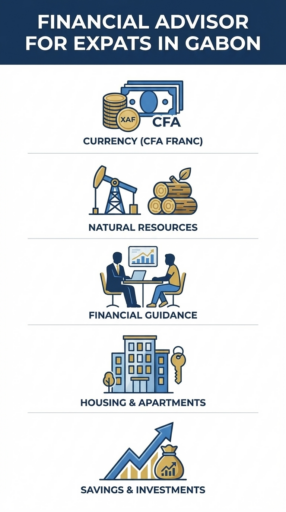
Gabon’s economy is classified as an upper-middle-income economy with a relatively high GDP per capita compared to most sub-Saharan African countries, around $8,200–$8,800 nominal per person in 2024–2025.
The country’s wealth is heavily tied to natural resources, particularly oil production.
Oil and petroleum products make up a major share (around 80%) of exports and contribute significantly to government revenue and GDP.
In addition to oil, manganese, timber, and forestry products also play important roles in Gabon’s economy:
- Manganese is one of the world’s largest producers, supporting exports and mining activity.
- Timber contributes through forestry and wood product sectors.
Despite this resource wealth, Gabon remains vulnerable to global commodity price swings, especially in oil.
Lower oil revenues and rising public spending have challenged fiscal balances and increased public debt levels in recent years.W
The use of the Central African CFA franc (XAF), pegged to the euro, contributes to relative monetary stability versus many African currencies, but does not insulate the economy from external price shocks.
For expatriates, this translates to a stable but commodity-linked financial system, where careful planning for income, savings, currency exposure, and long-term investments is particularly important.
Why would one need a financial advisor in Gabon?
A financial advisor in Gabon can help expats navigate financial systems that may differ significantly from those in their home countries.
Common reasons expats seek financial advice include:
- Managing cross-border assets and income
- Understanding local banking and investment options
- Planning for retirement while working abroad
- Structuring savings in multiple currencies
- Ensuring tax efficiency across jurisdictions
Local regulations, limited investment products, and international tax considerations make professional guidance particularly valuable for foreign nationals unfamiliar with Central African financial frameworks.
What are the 3 C’s of selecting a financial advisor?
The 3 C’s of selecting a financial advisor are competence, credentials, and compatibility, which together help expats evaluate both technical expertise and personal fit.
These provide a practical framework for choosing a financial advisor in Gabon:
- Competence: Verify qualifications, certifications, and experience with expat clients
- Credentials: Look for internationally recognized financial designations
- Compatibility: Ensure the advisor understands your financial goals and communicates clearly
Selecting an advisor based on these principles helps reduce risk and improves long-term financial outcomes.
What qualities make a good financial advisor?
A good financial advisor is defined by ethical standards, practical experience, and how they manage ongoing client relationships, not just by formal credentials.
For expats in Gabon, a strong advisor typically demonstrates:
- Strong knowledge of international finance and taxation
- Clear and transparent fee disclosure
- Fiduciary responsibility to act in the client’s best interest
- Cultural awareness and experience working with foreign nationals
- Consistent communication and a long-term planning focus
These qualities are especially important when managing assets across multiple countries.
What is the average cost of having a financial advisor?
The average cost of having a financial advisor in Gabon typically ranges from 0.5% to 1.5% of assets under management per year, based on the advisor’s structure and services offered.
Common pricing models include:
- Percentage of assets under management (AUM): Typically around 0.5% to 1.5% annually
- Flat annual or project-based fees: Often used for financial planning or one-time consultations
- Commission-based fees: Earned from selling financial products
For expats with international portfolios, advisors may charge higher fees due to the complexity of multi-jurisdictional financial planning.
Transparency in fee structures is essential to avoid conflicts of interest.
What are the pros and cons of a financial advisor?
The main advantage of using a financial advisor is access to professional, structured guidance, while the primary drawback is the cost and variability in advisor quality.
Pros:
- Professional guidance tailored to expat circumstances
- Time savings and reduced financial stress
- Expertise in tax planning, investments, and wealth preservation
- Objective financial decision-making
Cons:
- Advisory fees can reduce net returns
- Quality varies widely between advisors
- Potential conflicts of interest in commission-based models
Weighing these pros and cons helps expats determine whether professional advice aligns with their financial needs and goals.
More often, the positives outweigh the negatives, particularly for high-net-worth individuals and those who manage multiple income streams and plan for future generations.
Choosing Between Local vs International Advisors
A local advisor typically manages Gabon’s resource-driven economy, regulations, and banking matters. An expat or international advisor generally oversees multi-country portfolios, international taxes, and long-term wealth planning.
Choosing the right advisor depends on how much your financial life interacts with Gabon versus offshore markets.
- Local Gabonese Advisors
- Deep knowledge of banking, tax rules, and regulatory compliance specific to Gabon
- Familiarity with resource-sector investments, local permits, and market constraints
- Ideal for handling daily cash flow, local payments, and operational financial matters
- Can help mitigate risks tied to commodity price volatility and Gabon-specific economic shifts
- International/Expat-Focused Advisors
- Expertise in multi-country taxation, currency management, and global investment portfolios
- Can help integrate assets across jurisdictions and plan for retirement, estate planning, or high-net-worth needs
- Useful for diversifying outside Gabon’s resource-dependent market and protecting wealth from local economic fluctuations
Key Recommendation: When possible, choose an advisor with both Gabon-specific knowledge and offshore/expat expertise.
This ensures you can handle local regulations, manage domestic investments, and optimize global strategies without needing multiple advisors.
Conclusion
Navigating personal finances as an expat in Gabon requires not just understanding local rules but also ongoing attention, adaptability, and proactive decision-making.
While no single strategy fits every situation, working with a qualified financial advisor can help you balance opportunities and risks, maintain financial discipline, and confidently plan for both short-term needs and long-term goals.
Ultimately, success hinges on combining professional guidance with your own informed judgment.
FAQs
Is paying 1% to a financial advisor worth it?
Paying 1% may be worth it if the advisor provides comprehensive planning, tax efficiency, and disciplined investment management that outweighs the cost.
For expats with complex financial situations, the value often lies in avoiding costly mistakes.
What is the 80 20 rule for financial advisors?
The 80/20 rule suggests that roughly 80% of results come from 20% of financial decisions.
In practice, this means that asset allocation, tax planning, and long-term strategy typically have a greater impact than frequent trading or minor adjustments.
Why is Gabon wealthy?
Gabon’s wealth primarily comes from oil exports, natural resources, and a relatively small population.
This combination results in higher per-capita income compared to many neighboring countries, despite income inequality.
How much is house rent in Gabon?
The average monthly rent for a 1-bedroom apartment in Libreville is around 500,000 XAF (≈$830 USD).
Prices can vary depending on the neighborhood and property quality, with smaller apartments starting near 220,000 XAF and larger or premium units exceeding 1,000,000 XAF.
Pained by financial indecision?

Adam is an internationally recognised author on financial matters with over 830million answer views on Quora, a widely sold book on Amazon, and a contributor on Forbes.