The best financial advisors for expats in 2026 are professionals and firms with proven experience, regulatory awareness, and the ability to manage investments, tax coordination, and long‑term planning across multiple countries.
Transparency notes: This list includes Adam Fayed because of sustained reader interest in expat-focused advisory models. The list is not a ranking and reflects relevance, not preference or endorsement over others.
The advisors and firms below were selected based on:
- Demonstrated experience with expats and international clients
- Cross‑border regulatory and licensing awareness
- Ability to coordinate investments, tax strategy, and structuring
- Track record, reputation, and service relevance (not firm size alone)
This is not a definitive ranking but a practical shortlist of credible options expats could consider.
This article covers:
- Top expat financial advisors
- Are small financial advisory firms good?
- Real financial advisor cost per year
- Financial advisor and wealth manager difference
Key Takeaways:
- The best expat advisors specialize in international investing and planning, not domestic-only portfolios.
- Large global banks offer scale and brand recognition but often require high minimums.
- Fees usually range from 0.5% to 2.5% AUM, depending on service scope and complexity.
- Choosing the right advisor matters more than choosing a famous name.
My contact details are hello@adamfayed.com and WhatsApp +44-7393-450-837 if you have any questions.
The information in this article is for general guidance only. It does not constitute financial, legal, or tax advice, and is not a recommendation or solicitation to invest. Some facts may have changed since the time of writing.
Best Advisors for Expats
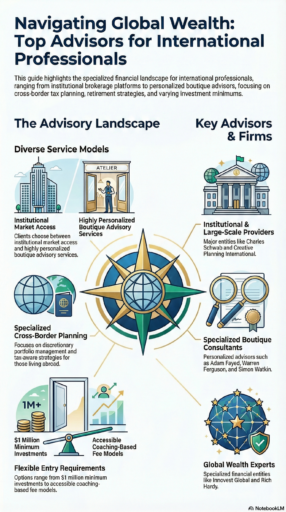
The top financial advisors for expats aren’t always general domestic advisors. They include internationally focused firms and expat specialists such as Creative Planning International and Adam Fayed, alongside offshore-focused asset managers.
Expats may also work with boutique advisors focused on specific jurisdictions, larger international firms offering discretionary portfolio management, or education-led planners who emphasize long-term decision-making over product sales.
The strongest financial advisors for expats generally fall into three groups:
- specialist expat advisory firms with deep nationality‑specific expertise
- large global investment managers offering disciplined portfolio management for high‑net‑worth clients
- independent, platform‑agnostic advisors who structure offshore investments across multiple jurisdictions
There is no single best advisor for everyone — the right choice is determined by nationality, residency, asset size, and complexity.
These firms are presented as comparative options for expats, not a formal ranking.
1. Charles Schwab International
Charles Schwab International is frequently cited in mainstream finance rankings for low-cost investing and broad market access.
It is a common choice for internationally mobile professionals who prefer a self-directed or lightly advised approach.
Services: International brokerage accounts, model portfolios, optional advisory services, global market access.
Fees & minimums: No formal minimums for brokerage; typically six-figure minimums depending on the advisory program; low underlying fund and platform costs.
2. Fisher Investments International
Fisher Investments focuses on discretionary portfolio management for high‑net‑worth international clients using a centralized investment process.
The firm has a strong equity bias and limited customization at smaller account sizes.
Services: Global equity and fixed‑income portfolio management, discretionary investment mandates.
Fees & minimums: Tiered AUM fees that generally decline with size; minimum investment is usually around USD 500,000 or higher.
3. Schroders Wealth Management
Schroders Wealth Management is the private wealth arm of Schroders, a globally recognized asset manager often referenced in institutional and high-net-worth rankings.
It caters to internationally diversified families and professionals seeking a more traditional discretionary approach.
Services: Discretionary portfolio management, multi-asset investing, international wealth structuring, estate planning coordination.
Fees & minimums: Usually around 0.8%–1.5% of AUM; minimums often start at USD 1 million+ depending on jurisdiction.
4. Creative Planning International
Creative Planning is the international arm of a major US advisory firm, frequently referenced in mainstream finance media for multi-jurisdiction planning expertise.
They’re primarily for US-linked planning needs.
Services: Investment management, US tax‑aware planning, coordination with CPAs and estate attorneys.
Fees & minimums: Approximately 0.25%–1.2% AUM; minimums often start around USD 500,000.
5. Adam Fayed
Adam Fayed focuses on offshore investment education and portfolio structuring for expats and HNWIs, working alongside regulated advisors and internationally recognized investment platforms.
Services: Offshore investment structuring, cross‑border portfolio design, coordination across jurisdictions.
Fees & minimums: 0.5% per annum; review from USD 1,500; eligibility for standard services from $50,000 or $500 a month, or from $200,000 for HNWIs.
6. Rich Hardy (FOCUS)
Rich Hardy is an expat wealth specialist known for retirement planning and investment structuring for globally mobile professionals, particularly in Asia and the Middle East.
He is frequently referenced within the expat advisory community rather than mass-market rankings.
Services: Retirement planningfor expats, long-term portfolio structuring, income planning across jurisdictions.
Fees & minimums: Varies by engagement; typically advisory-led rather than platform-driven.
7. Simon Watkin Financial Planner
Simon Watkin is a well-known independent financial planner focused on British and international expats, with an emphasis on transparent advice and long-term planning discipline.
He is often recognized for educational content and regulatory clarity rather than product distribution.
Services: Expat financial planning, retirement and pension advice, investment strategy.
Fees & minimums: Planning-led fee structures; varies depending on scope and complexity.
8. Innovest Global Wealth
Innovest positions itself as a global wealth advisory firm serving internationally mobile clients seeking cross-border investment and planning solutions.
The firm emphasizes holistic planning over single-product strategies.
Services: Global wealth planning, investment advisory, cross-border structuring.
Fees & minimums: Varies by jurisdiction and service scope; usually advisory and AUM-based.
9. Mercer Wealth / Mercer Advisors (International)
Mercer is a global consulting and investment advisory firm frequently cited by Forbes and other institutional rankings for retirement planning, investment consulting, and fiduciary oversight.
Its wealth and advisory arms serve professionals living abroad and high-net-worth clients seeking structured, long-term strategies rather than sales-driven solutions.
Services: Retirement and pension planning, discretionary portfolio management, institutional-grade asset allocation, multi-country planning coordination.
Fees & minimums: Higher minimums than retail expat advisers; charges AUM-based fees in a tiered range: $1,200 for investment-only, $6,000 for planning + investments, $15,000 for full-service wealth management, and $75,000 for HNWIs.
10. Specialist Boutique Expat Advisors
Many of the strongest outcomes for expats come from smaller boutique firms focused on one nationality or region.
Services: Highly tailored cross‑border planning, jurisdiction‑specific advice.
Fees & minimums: Often higher percentage fees but lower minimums; strong fit for complex, real‑world expat cases.
Are small financial advisory firms worth considering?
Yes. While large firms dominate rankings due to assets under management and brand recognition, many expats also receive better outcomes from smaller, specialist advisory firms.
Advantages of smaller firms:
- Advisors with real international experience
- Flexible structures, not rigid institutional models
For these reasons, boutique firms are included alongside, not beneath, global institutions.
What Is the Typical Fee for a Financial Advisor?
Most expat‑focused advisors charge 0.5% to 2.5% per year of assets under management (AUM).
- Large banks: lower percentages, higher minimums
- Boutique firms: higher percentages, more customization
- Some advisors offer flat‑fee or project‑based pricing
How to Choose the Right Advisor as an Expat
Start by verifying that an advisor is properly regulated for multijurisdictional work, then assess whether they can deliver clear, coordinated advice across tax, legal, and investment needs over time.
The right advisor for an expat is defined less by brand name and more by their ability to handle such matters.
• Confirm expat experience: Look for a proven track record working with cross-border and internationally based clients.
• Verify regulation and licensing: Ensure the advisor and platforms used are appropriately licensed for your situation.
• Understand how they’re paid: Fees and commissions should be transparent and easy to explain.
• Assess coordination ability: The advisor should integrate tax, legal, and investment considerations—not treat them in isolation.
• Test the working relationship: Communication style and long-term fit matter as much as technical skill.
Financial Advisor vs Wealth Manager
A financial advisor focuses on specific planning or investment tasks. A wealth manager oversees your entire financial structure on an ongoing basis.
Expats with complex, multi‑country exposure typically benefit more from wealth management.
Many expats confuse financial advisors with wealth managers. The distinction matters because your choice influences scope, fees, and outcomes.
Financial Advisor:
- Focuses on specific financial or investment needs, e.g., retirement planning, investments, or insurance
- Practically, an advisor manages only your portfolio
- Relationship can be transactional or project-based
- Fees may be flat-fee, hourly, or AUM for limited services
- Suitable for individuals with straightforward financial situations or single-country exposure
Wealth Manager:
- Provides holistic financial oversight, integrating investments, tax exposure, residency issues, estate planning, and multi-jurisdiction strategy
- Relationship is ongoing and strategic, often spanning years or decades
- Fees usually 0.5%–2.5% AUM depending on complexity and services
- Best for expats with multi-country accounts, cross-border tax planning, complex estates, or substantial assets
Choosing the correct type ensures that expat clients receive comprehensive support for their complex financial lives rather than piecemeal advice that may leave gaps or create inefficiencies.
However, note that the line that distinguishes an advisor’s role from a wealth manager’s is often blurred.
Many firms call themselves wealth managers but operate like product-driven advisors. Others are registered as advisors yet deliver true wealth-management services.
Titles are not regulated consistently, so the label alone might be unreliable.
The difference is real in function, so expats should judge firms by scope of responsibility and integration, not by whether advisor or wealth manager appears on the website.
FAQs
How to tell if a financial advisor is good?
A good financial advisor can clearly explain why each recommendation exists, how it fits your situation, and what the total costs and risks are.
For expats, quality advisors demonstrate real experience with international clients, regulatory awareness across jurisdictions, and a willingness to coordinate with tax or legal professionals rather than working in isolation.
What are common advisor red flags?
Red flags include product-first conversations, pressure to act quickly, vague explanations of fees, and an inability to explain how your residency or nationality affects taxes and investments.
Expats should be especially cautious of advisors who rely heavily on complex insurance-wrapped products or claim one-size-fits-all offshore solutions.
What not to do when selecting a financial advisor?
Do not choose an advisor based on brand name alone, promised returns, or familiarity with your home country only.
Expats should also avoid advisors who cannot explain how your plan adapts if you move again or who discourage second opinions or independent verification.
What financial advisors don’t want you to know?
Many advisors do not proactively disclose that fees compound over time, that cheaper alternatives may exist, or that some recommendations pay them higher commissions than others.
Expats should always ask how the advisor is paid, whether alternatives were considered, and what happens to fees if performance is poor.
When to dump your financial advisor?
You should leave an advisor if they stop communicating clearly, avoid questions about fees or performance, push products without explanation, or fail to adjust your plan after major life or residency changes.
For expats, ignoring tax residency changes or multi-country risks is a strong signal the relationship is no longer serving your interests.
Pained by financial indecision?

Adam is an internationally recognised author on financial matters with over 830million answer views on Quora, a widely sold book on Amazon, and a contributor on Forbes.