Bitcoin citizenship countries include jurisdictions like El Salvador, where legally obtained cryptocurrency or crypto-derived wealth can be used to qualify for residency or citizenship programs.
In most other jurisdictions, cryptocurrency holdings must be converted into fiat currency and pass standard source-of-funds, AML, and compliance checks before being accepted for residency or citizenship applications.
This article covers:
- What is the main purpose of Bitcoin?
- What countries accept bitcoin?
- Does El Salvador offer citizenship to Bitcoin holders?
- Which country is most crypto-friendly?
- What are the legal implications of cryptocurrency?
Key Takeaways:
- Bitcoin does not grant citizenship directly, but crypto wealth can qualify for programs like El Salvador’s Freedom Visa.
- Countries such as Portugal and Malta accept Bitcoin-derived funds after strict due diligence.
- Crypto visas in Estonia and the UAE offer residency pathways, not immediate citizenship.
- Legal compliance and proof of source of funds are essential.
My contact details are hello@adamfayed.com and WhatsApp +44-7393-450-837 if you have any questions.
For digital nomad or residence visas that require income, assets, or qualifying investments, we can help structure suitable investment solutions that may align with those requirements, depending on your circumstances.
The information in this article is for general guidance only. It does not constitute financial, legal, or tax advice, and is not a recommendation or solicitation to invest. Some facts may have changed since the time of writing.

What is the purpose of Bitcoin?
Bitcoin was created to serve as a decentralized, peer‑to‑peer form of digital money that operates without reliance on banks or governments.
Its core purposes include enabling borderless payments, offering an alternative store of value, and providing financial sovereignty to individuals.
Because Bitcoin transactions can be conducted globally, it has become particularly attractive to entrepreneurs, digital nomads, and investors seeking mobility and diversification.
In which countries is Bitcoin legal?
Countries such as the United States, Canada, the United Kingdom, most of the European Union, Japan, Singapore, and Australia allow Bitcoin ownership, trading, and taxation under regulated frameworks.
Bitcoin is legal or tolerated in most developed and emerging economies.
In these jurisdictions, Bitcoin is generally classified as property, a digital asset, or a financial instrument rather than legal tender.
Legality is critical because only legally obtained and compliant crypto funds can be used for immigration, residency, or citizenship purposes.
What is a Bitcoin passport?
Bitcoin passport is a popular term used to describe residency or citizenship options that become accessible through Bitcoin-generated wealth.
However, a BTC passport is not an official travel document.
In most countries, this means holding Bitcoin, converting it into fiat currency through compliant exchanges, and using those funds to qualify for residency-by-investment or citizenship-by-investment programs.
The term reflects the idea that Bitcoin can indirectly unlock global mobility, not that it replaces a government-issued passport.
Countries With Bitcoin Citizenship
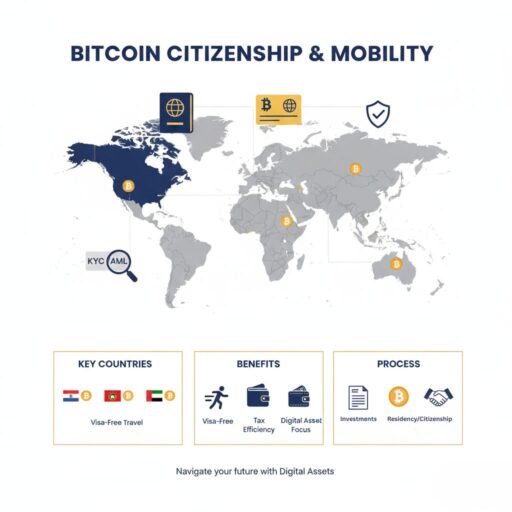
While no country grants citizenship simply for holding Bitcoin, several jurisdictions allow cryptocurrency-derived wealth, once properly documented and converted into fiat currency if required, to qualify under established residency or citizenship-by-investment schemes.
These pathways generally fall into four categories.
Government-Structured Crypto Investment Framework
El Salvador
El Salvador has created the Freedom Visa / Freedom Passport program, a government-backed migration and investment framework that formally accommodates cryptocurrency.
Qualifying investors can use Bitcoin (BTC) or USD Tether (USDT) within a structured investment process.
Program details:
- Grants citizenship and a Salvadoran passport upon successful application.
- Annual quota: approximately 1,000 applicants.
- Minimum contribution: US $1,000,000, payable in Bitcoin or USDT.
- Requires full due diligence, anti-money laundering (AML), and compliance checks.
- Citizenship is granted through the program once all requirements are met, rather than through general naturalization rules.
This makes El Salvador the only country with a direct, crypto-friendly citizenship-by-investment program at the government level.
Citizenship by Investment Programs Accepting Crypto-Derived Funds (Post-Conversion)
Countries like Turkey, Vanuatu, and Dominica do not accept Bitcoin directly as payment.
However, they may allow legally obtained cryptocurrency wealth to be used as the source of investment funds, provided:
- The crypto is converted into fiat currency
- Funds pass through regulated financial institutions
- Full transaction and wallet history is disclosed
- Enhanced due diligence and AML checks are satisfied
🇹🇷 Turkey: Citizenship via property (≥ $400,000) or other investments (≥ $500,000). Crypto can be converted to meet thresholds; process takes ~8–12 months.
🇻🇺 Vanuatu: Donation to Development Support Program (~$130,000). Crypto can be used through licensed agents; approval in ~2–3 months.
🇦🇬 Antigua and Barbuda: Minimum donation $100,000 or real estate $200–300k. Crypto must be converted to fiat; processing ~3–6 months.
🇩🇲 Dominica:Donation $200,000 or approved real estate. Crypto-derived funds accepted post-conversion; citizenship in ~3–6 months.
🇱🇨 Saint Lucia: Donation $100,000 or real estate $300,000. Crypto must be documented and converted; timeline ~3–6 months.
🇰🇳 Saint Kitts and Nevis: Donation $250,000 or real estate $325,000. Crypto can demonstrate net worth but must be converted; citizenship ~4–6 months.
Residency or Naturalization Pathways Accepting Crypto-Derived Wealth
Portugal and Malta offer residency or structured naturalization routes where crypto-originated funds may be accepted after proper documentation and conversion.
🇵🇹 Portugal
Portugal allows foreigners to obtain residency through crypto-derived investments via its Golden Visa or D7 programs.
High-net-worth individuals can leverage cryptocurrency wealth by investing in CMVM-registered Bitcoin-linked or diversified funds.
Key points:
- Investment minimum – €500,000 in eligible funds, with at least 60% invested in Portuguese companies.
- Holding period – Minimum 5 years.
- Residency pathway – Permanent residency and eventual citizenship via naturalisation after legal residence requirements.
- Regulation & compliance – Funds must be regulated by the Portuguese Securities Market Supervisory Authority (CMVM), and crypto funds must be fully documented and legally sourced.
Portugal’s Golden Visa offers a regulated, crypto-friendly path to European residency, combining investment diversification with potential long-term citizenship.
🇲🇹 Malta
Malta does not offer direct citizenship for cryptocurrency, but crypto investors can use the Malta Permanent Residence Programme (MPRP) to obtain permanent residence.
Key points:
- Residency, not citizenship – Citizenship is possible later via standard naturalization.
- Government contribution – €50,000 in two stages; €7,500 per dependent parent/grandparent.
- Property – Rent €10,000–€12,000/year or purchase €300,000–€350,000; maintain for 5 years.
- Donation – €2,000 to a registered local NGO.
- Financial assets – €500,000 (with €150,000 in regulated assets) or €650,000 (with €75,000). Crypto must be converted to compliant fiat/assets.
Crypto wealth can fund the MPRP, granting Schengen-area residency, tax benefits for non-domiciled residents, and family inclusion, while citizenship is a later step via naturalization.
Crypto-Friendly Business and Innovation Jurisdictions
Estonia, the UAE, and Singapore support blockchain and digital asset entrepreneurship.
Residency is typically granted through:
- Business formation
- Startup innovation programs
- Investment in regulated enterprises
Ownership of cryptocurrency alone does not qualify an applicant.
🇪🇪 Estonia: Startup and digital entrepreneur visas; strong digital governance infrastructure.
🇦🇪 United Arab Emirates: Free-zone structures and investor visas for blockchain founders and digital asset businesses.
🇸🇬 Singapore: Entrepreneur and fintech visa pathways tied to regulated business activity.
Key Distinction
Across all jurisdictions:
- Cryptocurrency is treated as an asset class, not as a sovereign substitute for fiat currency in immigration programs.
- Governments prioritize transparency, compliance, and lawful source of funds.
- Enhanced due diligence is standard where digital assets are involved.
The practical pathway typically involves:
- Documented crypto acquisition
- Regulated exchange conversion
- Banked fiat investment
- Full AML/KYC review
What are the legal and regulatory implications of cryptocurrency?
Regulations typically include taxation of gains, reporting obligations, licensing requirements for exchanges, and adherence to know-your-customer (KYC) and anti-money laundering (AML) laws.
Cryptocurrency is regulated differently in each country, and legal compliance is required for ownership, trading, and using crypto in financial or immigration matters.
For immigration and citizenship purposes, the key implication is transparency: governments prioritize traceable, compliant, and legally sourced funds when evaluating applications tied to cryptocurrency wealth.
What regulatory protections does crypto have?
In regulated markets, protections may include licensed exchanges, consumer safeguards, custody rules, and legal recognition of digital assets.
However, cryptocurrencies generally do not enjoy the same protections as bank deposits or government-backed currencies.
Applicants using crypto wealth for citizenship or residency must therefore rely on proper compliance, professional structuring, and reputable intermediaries to ensure their funds are accepted and legally recognized.
Comparing Crypto-Based and Traditional Citizenship/Residency Pathways
When using crypto wealth for residency or citizenship, the key difference from traditional pathways lies in how the funds are sourced, verified, and invested.
Traditional programs rely on cash, bank savings, real estate, or business income in fiat currency.
Crypto-based programs require full documentation of wallet history, lawful acquisition, and often conversion into fiat before being applied to qualifying investments.
Processing times can also differ.
Some crypto-focused programs, such as El Salvador’s Freedom Visa, can be faster due to the liquidity of crypto assets, though enhanced due diligence may lengthen verification.
Traditional investment routes generally follow predictable timelines with well-established procedures.
Geographically, crypto wealth provides greater flexibility, as funds are borderless and can be invested in multiple jurisdictions, whereas traditional investments are usually tied to specific local economies or assets.
Crypto-based pathways also allow access to innovation hubs like Estonia, the UAE, and Singapore, which encourage blockchain entrepreneurship which is an opportunity often unavailable in traditional programs.
Regulatory and tax considerations are more complex with crypto.
Missteps in reporting or compliance can jeopardize residency or citizenship applications, whereas traditional investments operate under more predictable frameworks.
Additionally, crypto’s volatility introduces both risk and opportunity: it can impact the amount of capital qualifying for investment thresholds but also allows for rapid liquidity and strategic allocation.
Ultimately, crypto-based pathways offer borderless mobility, access to innovative economies, and potential speed, but demand careful documentation, regulatory compliance, and professional guidance.
Traditional pathways remain more stable and predictable, though less flexible and innovation-oriented.
Conclusion
Crypto wealth is redefining the boundaries of global mobility, offering a dynamic alternative to traditional investment-based residency and citizenship routes.
Its value lies not in the currency itself, but in the strategic application of legally sourced, traceable funds to access opportunities that were once limited to conventional investments.
As jurisdictions continue to experiment with crypto-friendly policies, those who combine regulatory compliance, meticulous documentation, and entrepreneurial foresight will be best positioned to turn digital assets into real-world mobility, influence, and long-term strategic advantage.
In this evolving landscape, Bitcoin is less a payment method and more a tool for unlocking flexibility and innovation in global citizenship planning.
FAQs
What countries use Bitcoin as a national currency?
El Salvador and the Central African Republic recognize Bitcoin as legal tender. In all other countries, it is treated as a digital asset or property, not official currency.
Can you cash out Bitcoin for real money?
Yes. Bitcoin can be converted into fiat currency through regulated cryptocurrency exchanges, brokers, and certain financial institutions, subject to identity verification and local regulations.
Which country has banned Bitcoin?
Countries like China, Bangladesh, and Algeria have banned Bitcoin, prohibiting trading, mining, and exchange operations.
Enforcement and scope vary by country.
What are the signs of a Bitcoin scammer?
Common signs of a Bitcoin scammer include guaranteed returns, pressure to act quickly, requests for private keys, lack of verifiable identity, and promises of risk-free profits.
Legitimate Bitcoin transactions never require sharing private wallet credentials.
Pained by financial indecision?

Adam is an internationally recognised author on financial matters with over 830million answer views on Quora, a widely sold book on Amazon, and a contributor on Forbes.