Bulgaria officially launched its Digital Nomad Visa, a dedicated long-stay residence permit for remote workers earning income from abroad.
The visa is valid for one year and can be renewed once, providing non-EU/EEA/Swiss nationals with a legal way to live in Bulgaria while working remotely.
This article covers:
- What is a digital nomad residence permit?
- What is the minimum salary for Bulgarian digital nomad visa?
- Bulgaria digital nomad visa application
- How much is a residence permit in Bulgaria?
- Bulgaria tax for digital nomads
- Who has the best digital nomad visa, Bulgaria or Portugal?
Key Takeaways:
- Bulgaria digital nomad residence permit is valid for one year, with one extension.
- The country combines low taxes, modest bureaucracy, and relatively cheap costs.
- Bulgaria suits expats focused on long-term residency, not short-term hype.
My contact details are hello@adamfayed.com and WhatsApp +44-7393-450-837 if you have any questions.
The information in this article is for general guidance only. It does not constitute financial, legal, or tax advice, and is not a recommendation or solicitation to invest. Some facts may have changed since the time of writing.

What is the new digital nomad visa in Bulgaria?
Bulgaria officially kicked off its Digital Nomad Visa in December 2025, a residence permit that allows non-EU nationals to live in Bulgaria while working remotely for foreign employers or clients.
The offering, commonly referred to as a Digital Nomad Residence Permit, comes after Bulgaria amended its foreigners and residence legislation to formally define digital nomads as a legal category.
Rather than launching a marketing-driven scheme, the country embedded digital nomads into its existing immigration framework, to create a legally grounded residence permit with clear eligibility, tax implications, and renewal rules.
That distinction is subtle but important.
Who qualifies for a digital nomad visa?
Applicants to the Bulgaria Digital Nomad Residence Permit must be employed by non-EU companies, operating foreign businesses, or freelancing for overseas clients with a proven work history.
Family members (spouse/dependents) may be eligible for reunification under certain conditions.
The program targets established remote professionals, not short-term location-independent travelers.
This excludes:
- Casual gig workers
- Tourism-style nomads
- Those intending to pivot into local employment
In other words, Bulgaria is not chasing volume. It is filtering for financially independent, low-burden residents who integrate without competing in the local labor market.
That design choice aligns closely with how Bulgaria has historically approached corporate tax policy, that is, attract stable external capital without distorting domestic systems.
How do you qualify for digital nomad in Bulgaria?
Applicants must demonstrate sufficient financial means, such as annual income of at least 50x the Bulgarian monthly minimum wage for the previous calendar year.
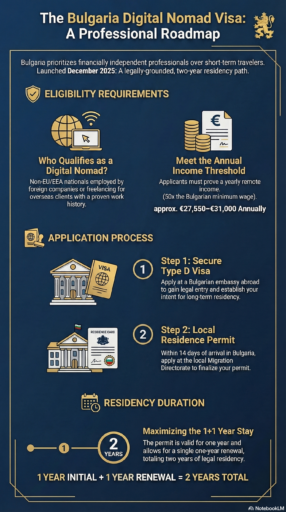
As of 2025, this threshold is roughly €27,550–€31,000 per year (income earned from remote work abroad).
You must maintain your income level and employment/freelance status throughout your residence.
Documentation
Bulgaria digital nomad visa requirements generally include:
- Valid passport (with at least 6 months’ validity).
- Proof of remote work (employment or contract documentation).
- Proof of income can include bank statements, pay slips, contracts, or invoices.
- Proof of accommodation in Bulgaria (rental agreement, hotel booking, or property deed).
- Clean criminal record certificate from your place of residence.
- Health insurance valid in Bulgaria (and typically Schengen/EU-wide) covering medical emergencies/hospitalization.
- Translations and apostilles for relevant foreign documents as required.
How to apply for a Bulgaria digital nomad visa?
The standard process for Bulgaria’s digital nomad visa involves getting a long-stay visa, then applying for the residence permit.
1. Obtain a long-stay (Type D) visa from a Bulgarian embassy/consulate — this allows entry and residence establishment in Bulgaria.
2. Within 14 days of arrival, apply for the digital nomad residence permit at the local Migration Directorate.
How much is the visa fee for Bulgaria?
The digital nomad visa for Bulgaria is issued as a long-stay Type D visa, followed by a residence permit after arrival. The Type D visa application fee is around €100–€120, payable at a Bulgarian consulate.
Once approved and in Bulgaria, applicants must also pay a residence permit issuance fee, which usually costs at least €150.
Total government fees for the Bulgarian digital nomad visa process generally fall between €250 and €320.
This excludes additional costs such as document translations, legalization, apostilles, or mandatory health insurance, which vary by applicant and location.
How long does a digital nomad visa last and what does it imply?
The Bulgaria digital visa grants one year of residence, renewable once, for a total of up to two years.
Two years is long enough to matter, but not long enough to create automatic settlement expectations.
Many EU digital nomad visas quietly act as backdoor residency pathways. Bulgaria’s does not.
Instead, it functions as a residency bridge: a structured period during which remote workers can assess tax residency, lifestyle fit, and longer-term legal options without being locked into them.
This could be preferable for experienced expats.
What are the taxes for digital nomads in Bulgaria and common misconceptions?
Holding Bulgaria’s Digital Nomad Visa does not automatically make you a tax resident, as the country does not operate a digital-nomad-specific tax regime.
Instead, standard tax residency rules apply, and long stays may still trigger tax residency.
Generally, tax residency arises after spending more than 183 days in the country within a year.
Once tax resident, individuals are subject to a flat 10% personal income tax on worldwide income in Bulgaria, as per PwC. This is one of the lowest statutory rates in the EU.
The misinterpretation is assuming the visa itself is a tax shelter. It is not. What it offers are predictable thresholds, simple rates, and relatively low compliance friction compared to Western Europe.
For globally mobile professionals, that simplicity could matter more than headline incentives.
What is the purpose of Bulgaria’s Digital Nomad Visa — and why did it arrive now?
Bulgaria’s Digital Nomad Visa joins the growing list of European countries offering legal residence to remote workers with foreign income. On paper, it looks like another EU nomad visa.
In practice, it reflects a quieter but more structural shift in how second-tier EU states are positioning themselves in the global competition for mobile professionals.
Most early digital nomad visas in Europe were reactive, created quickly in response to pandemic-era remote work.
Bulgaria’s arrived later, after observing where other programs struggled: abuse, tax ambiguity, political backlash, and administrative overload.
It is a policy move grounded in immigration law, economic signaling, and long-term talent retention.
Beyond domestic policy, Bulgaria’s nomad visa positions the country as a strategic EU foothold for globally mobile professionals.
By offering a structured, legally grounded residence permit without excessive bureaucracy, it creates an alternative to crowded Western European programs.
For remote workers, this means a low-risk entry point into the EU, offering affordable living, clear legal rules, and a straightforward permit—advantages often missing from more complex or oversubscribed European nomad visas.
What are the disadvantages of a digital nomad visa?
The main disadvantages of the digital nomad residency in Bulgaria are limited stay duration, no special tax treatment, and strict rules on who you can work for.
- No digital-nomad-specific tax regime; standard Bulgarian tax rules apply
- Long stays may trigger Bulgarian tax residency
- One-year permit with only one renewal under the same category
- No direct path to permanent residency or citizenship
- You cannot work for Bulgarian employers or local clients
- High documentation and compliance requirements
- Ongoing income and insurance thresholds must be maintained
What makes Bulgaria’s Digital Nomad Visa stand out compared to other EU options?
Bulgaria’s visa is structured by law with clear criteria, lower living costs, and access to EU travel via Schengen membership.
Unlike some EU digital nomad schemes that evolved through administrative proclamations or face frequent changes, Bulgaria’s approach is grounded in legal amendments to the immigration code.
Key distinguishing elements include:
- Clarity and predictability: The legislative basis reduces ambiguity about eligibility and rights.
- EU access: Bulgaria’s recent accession to the Schengen Area enhances travel freedom across Europe.
- Affordability: Bulgaria’s cost of living and operational expenses remain significantly lower than in Western Europe.
- Flexibility: The visa accommodates employees, business owners, and freelancers without rigid job title requirements.
This contrasts with more saturated digital nomad permits in countries like Portugal, where evolving minimum income rules and demand pressures have created more complex eligibility landscapes.
Bulgaria vs Portugal: A Practical Digital Nomad Comparison
Bulgaria’s visa is a more recent, structured, and policy-defined remote work residence permit; Portugal’s is established, broader, and tied to longer-term EU residency possibilities.
Portugal is often the benchmark for EU digital nomad visas, albeit that visibility comes with trade-offs.
Portugal’s digital nomad visa is explicitly designed, widely marketed, and popular. As a result, it now faces rising minimum income thresholds, increased scrutiny, and growing political pressure.
Processing times are longer, compliance requirements are tighter, and competition among applicants is intense.
Bulgaria, by contrast, operates quietly. It does not market a lifestyle visa, and it does not attract mass inflows of remote workers. This has preserved:
- Lower income thresholds in practice
- Faster processing in many cases
- Greater regulatory flexibility
From a tax perspective, Portugal’s regime is more complex, with special schemes, transition rules, and reform risk. Bulgaria’s flat tax system is simpler and easier to model long-term.
Lifestyle is where Portugal dominates. It offers coastal cities, global nomad hubs, and strong international infrastructure.
For strategic expats who value legal certainty and an EU foothold over lifestyle hype, Bulgaria’s visa can be a quiet alternative to mainstream nomad destinations.
| Feature | Bulgaria | Portugal |
| Launch year | 2025 | 2022 |
| Income threshold | ~€27,500–€31,000/year | €3,680/month (~€44,160/year) |
| Marketing | Low / quiet | Aggressively marketed |
| EU access | Schengen via Bulgaria (recently acceded) | Established |
| Tax regime | Standard personal tax rules; no nomad‑specific regime | Standard Portuguese tax rules (No NHR for new applicants) |
| Permit duration | 1 year, renewable once (up to 2 years) | Initially 1 year, renewable up to 5 years total |
| Path to long‑term residency | No direct path through nomad visa alone | Possible. Continued renewals can lead to long‑term residency & citizenship after ~5 years |
FAQs
How long can a foreigner stay in Bulgaria?
Foreigners may stay in Bulgaria up to 90 days within any 180-day period without a residence permit.
Longer stays require a long-stay visa and an approved residence permit.
Is Bulgaria part of the Schengen Area?
No. Bulgaria is an EU member but not part of Schengen, which means residence rights are valid in Bulgaria while still allowing travel within the EU under standard Schengen rules.
How many types of visas are there in Bulgaria?
Bulgaria generally issues three main visa categories:
• Type A – Airport transit visa
• Type C – Short-stay (Schengen) visa
• Type D – Long-stay national visa
What is a Type D visa in Bulgaria?
A Type D visa is a long-stay national visa issued by Bulgaria for stays longer than 90 days, typically as a pathway to temporary or long-term residence.
It is required for purposes such as employment, business activity, study, family reunification, or residence under newer frameworks like digital nomad or investment-linked permits.
The Type D visa is usually the first step before applying for a Bulgarian residence permit.
What is a C visa for Bulgaria?
A Type C visa is a short-stay Schengen visa allowing travel in Bulgaria and other Schengen states for up to 90 days within a 180-day period.
It is designed for tourism, business trips, conferences, or short visits and does not lead to residency or long-term stay rights in Bulgaria.
Is Bulgaria a good long-term option for digital nomads?
Yes, particularly for those seeking affordability, legal EU residence, and long-term stability rather than short-term lifestyle branding.
What happens if I overstay in Bulgaria?
Overstaying in Bulgaria can lead to fines and possible entry bans.
It may also negatively affect future visa or residence applications not just in Bulgaria but within the Schengen Area.
Can I get residency in Bulgaria if I buy a house?
No. Buying property in Bulgaria does not grant residency.
Residence rights must be obtained through a separate legal basis, such as employment, business activity, family reunification, or an approved residence permit category.
Is Bulgaria a strong passport?
The Bulgarian passport is considered moderately strong. As an EU passport, it provides freedom of movement and residence across the European Union, along with visa-free or visa-on-arrival access to many countries worldwide.
While it does not rank at the very top globally, its EU mobility rights make it particularly valuable for individuals seeking long-term geographic flexibility rather than short-term travel perks alone.
Pained by financial indecision?

Adam is an internationally recognised author on financial matters with over 830million answer views on Quora, a widely sold book on Amazon, and a contributor on Forbes.