
+44 7393 450837
advice@adamfayed.com
Follow on

Taxes in Spain vs Portugal: How They Compare for Expats and Retirees

Portugal generally has lower taxes and living costs for retirees and expats, while Spain can be more expensive for high earners.

Property taxes, retirement income taxation, and daily expenses also differ significantly between the two countries.

This article covers:

  • Is Portugal or Spain better for retirement?
  • Is income tax higher in Spain or Portugal?
  • What is the consumption tax in Portugal?
  • What is the consumption tax in Spain?

Key Takeaways:

  • Portugal often offers lower overall taxes for retirees and expats.
  • Spain’s cost of living is higher in major cities but competitive in smaller towns.
  • Property taxes are generally cheaper in Portugal.
  • Portugal is safer and more expat-friendly, while Spain has a larger, more diverse economy.

My contact details are hello@adamfayed.com and WhatsApp ‪+44-7393-450-837 if you have any questions.

The information in this article is not tax advice and may have changed since the time of writing. I can connect you with expert tax support for your specific situation.

Discover How We Can Address Your Financial Pain Points Subscribe Free Discover Now

Does Spain or Portugal Have Higher Taxes?

Spain generally imposes higher overall taxes than Portugal, including income tax and social security contributions, though exact rates vary by region.

  • Portugal: The top personal income tax rate is around 48%. Social security contributions are lower than in Spain, generally around 11% for employees and 23.75% for employers.
  • Spain: The top personal income tax can reach 47% depending on the region. Social security contributions are higher, typically around 6.35% for employees and up to 30% for employers, depending on salary level. Certain regions, like Madrid, offer slightly lower income tax rates, but social security is largely consistent nationwide.

Overall, for high earners, Spain’s combined tax and social security burden is usually higher, while Portugal provides a relatively lighter total tax load for most residents.

Is it Cheaper to Live in Spain or Portugal?

On average, living in Portugal is slightly cheaper than in Spain, including daily expenses, utilities, and overall consumption patterns, though costs vary by city and lifestyle.

  • Portugal: Daily expenses, groceries, and utilities are generally lower than in Spain. Household consumption rates are moderate, and VAT (IVA) is 23% standard, 13% intermediate, and 6% reduced on essential goods and services. Lisbon and Porto are more expensive than smaller towns, but healthcare, transportation, and dining out remain relatively affordable.
  • Spain: Larger cities like Madrid and Barcelona are costly, while smaller cities and southern regions such as Andalusia are cheaper. VAT (IVA) is slightly lower than Portugal at 21% standard, 10% reduced, and 4% super-reduced for essentials. Household consumption rates for utilities, services, and everyday goods are slightly higher than in Portugal, especially in urban areas.

Is it Better to Retire in Spain or Portugal?

Portugal is generally the more affordable country to retire in compared to Spain, due to lower overall living costs and a lighter combined tax burden for most retirees.

  • Portugal: Pension and social security income is taxed at moderate rates based on residency status, and healthcare contributions are generally lower than in Spain. Public healthcare is high-quality and mostly free or low-cost for residents, while private health insurance is affordable. Daily living costs including groceries, utilities, and transportation are also lower than in Spain.
  • Spain: Pension income from abroad is taxed under Spain’s progressive personal income tax (IRPF), with rates ranging from 19% up to 47% depending on total income. Social security contributions are slightly higher than in Portugal. Public healthcare is excellent but may involve co-pays for certain services, and private insurance is generally more expensive than in Portugal. Urban areas like Madrid and Barcelona have higher living costs, including utilities and everyday expenses.

For retirees prioritizing low pension and social security taxes combined with affordable healthcare and living costs, Portugal often provides the better option, while Spain may appeal for those seeking larger cities and more extensive infrastructure.

Are Property Taxes High in Portugal vs Spain?
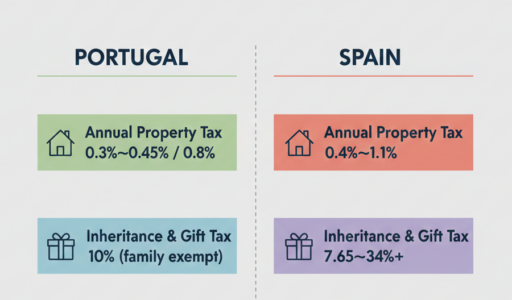
Taxes in Portugal vs Spain

Portugal typically imposes lower property and related taxes than Spain, making it more affordable for homeowners and retirees.

  • Portugal: Portugal’s annual property tax IMI generally ranges from 0.3%–0.45% for urban properties and 0.8% for rural land (set by municipalities), property purchases are subject to IMT transfer tax up to 7.5% depending on value and use, and while Portugal has no traditional inheritance tax, stamp duty of 10% applies to inheritances and gifts outside close family (with a 0.8% rate on real estate transfers).
  • Spain: Annual property tax (IBI) ranges from 0.4% to 1.1%, depending on the municipality. Wealth tax may apply for high-value properties. Inheritance and gift taxes in Spain vary by region and relationship to the beneficiary, with rates ranging from 7.65% to over 34% in some autonomous communities.

Tax Efficiency vs Lifestyle: Choosing Between Portugal and Spain

Taxes are an important factor, but they should be considered alongside lifestyle and long-term living preferences.

Portugal offers generally lower taxes, simpler inheritance rules, and predictable property costs, making it appealing for retirees and expats seeking financial clarity.

Spain, however, provides larger cities, more extensive infrastructure, and greater cultural and regional diversity, which can enhance quality of life despite higher tax exposure.

Ultimately, the choice between the two countries is a matter of financial optimization versus lifestyle priorities.

The best decision aligns tax efficiency with safety, healthcare, climate, and daily living preferences.

Conclusion

The key distinction between Portugal and Spain for expats and retirees lies in taxation structure and predictability.

Portugal offers lower overall tax exposure, straightforward property rules, and simpler inheritance treatment, making financial planning clearer and more stable.

Spain’s progressive income tax, regional wealth taxes, and varied property-related rules can increase complexity, requiring careful attention to optimize your total tax burden.

For anyone relocating or retiring, understanding these differences is essential to make informed decisions that protect both income and assets.

FAQs

Who has a better economy, Spain or Portugal?

Spain has a larger economy, higher GDP, and more diverse industries.

Portugal’s economy is smaller but growing steadily, particularly in tech and tourism.

Is Portugal warmer than Spain?

Spain is generally warmer, especially in the south (Andalusia) and islands (Canary, Balearic).

Portugal’s southern region, the Algarve, enjoys mild winters and warm summers.

What is safer, Portugal or Spain?

Portugal consistently ranks safer than Spain, appearing near the top of the Global Peace Index with lower overall crime rates.

Spain is generally safe, though petty crime is higher in major cities like Madrid and Barcelona.

Is property cheaper in Spain or Portugal?

Property prices vary widely, but Portugal’s smaller towns and inland areas are usually cheaper, while Spain’s southern regions and smaller cities can be comparable.

Lisbon and Porto are among the most expensive areas in Portugal.

Pained by financial indecision?

Adam Fayed Contact CTA3

Adam is an internationally recognised author on financial matters with over 830million answer views on Quora, a widely sold book on Amazon, and a contributor on Forbes.


Leave a Reply

Your email address will not be published. Required fields are marked *

This URL is merely a website and not a regulated entity, so shouldn’t be considered as directly related to any companies (including regulated ones) that Adam Fayed might be a part of.

This Website is not directed at and should not be accessed by any person in any jurisdiction – including the United States of America, the United Kingdom, the United Arab Emirates and the Hong Kong SAR – where (by reason of that person’s nationality, residence or otherwise) the publication or availability of this Website and/or its contents, materials and information available on or through this Website (together, the “Materials“) is prohibited.

Adam Fayed makes no representation that the contents of this Website is appropriate for use in all locations, or that the products or services discussed on this Website are available or appropriate for sale or use in all jurisdictions or countries, or by all types of investors. It is your responsibility to be aware of and to observe all applicable laws and regulations of any relevant jurisdiction.

The Website and the Material are intended to provide information solely to professional and sophisticated investors who are familiar with and capable of evaluating the merits and risks associated with financial products and services of the kind described herein and no other persons should access, act on it or rely on it. Nothing on this Website is intended to constitute (i) investment advice or any form of solicitation or recommendation or an offer, or solicitation of an offer, to purchase or sell any financial product or service, (ii) investment, legal, business or tax advice or an offer to provide any such advice, or (iii) a basis for making any investment decision. The Materials are provided for information purposes only and do not take into account any user’s individual circumstances.

The services described on the Website are intended solely for clients who have approached Adam Fayed on their own initiative and not as a result of any direct or indirect marketing or solicitation. Any engagement with clients is undertaken strictly on a reverse solicitation basis, meaning that the client initiated contact with Adam Fayed without any prior solicitation.

*Many of these assets are being managed by entities where Adam Fayed has personal shareholdings but whereby he is not providing personal advice.

This website is maintained for personal branding purposes and is intended solely to share the personal views, experiences, as well as personal and professional journey of Adam Fayed.

Personal Capacity
All views, opinions, statements, insights, or declarations expressed on this website are made by Adam Fayed in a strictly personal capacity. They do not represent, reflect, or imply any official position, opinion, or endorsement of any organization, employer, client, or institution with which Adam Fayed is or has been affiliated. Nothing on this website should be construed as being made on behalf of, or with the authorization of, any such entity.

Endorsements, Affiliations or Service Offerings
Certain pages of this website may contain general information that could assist you in determining whether you might be eligible to engage the professional services of Adam Fayed or of any entity in which Adam Fayed is employed, holds a position (including as director, officer, employee or consultant), has a shareholding or financial interest, or with which Adam Fayed is otherwise professionally affiliated. However, any such services—whether offered by Adam Fayed in a professional capacity or by any affiliated entity—will be provided entirely separately from this website and will be subject to distinct terms, conditions, and formal engagement processes. Nothing on this website constitutes an offer to provide professional services, nor should it be interpreted as forming a client relationship of any kind. Any reference to third parties, services, or products does not imply endorsement or partnership unless explicitly stated.

*Many of these assets are being managed by entities where Adam Fayed has personal shareholdings but whereby he is not providing personal advice.

I confirm that I don’t currently reside in the United States, Puerto Rico, the United Arab Emirates, Iran, Cuba or any heavily-sanctioned countries.

If you live in the UK, please confirm that you meet one of the following conditions:

1. High-net-worth

I make this statement so that I can receive promotional communications which are exempt

from the restriction on promotion of non-readily realisable securities.

The exemption relates to certified high net worth investors and I declare that I qualify as such because at least one of the following applies to me:

I had, throughout the financial year immediately preceding the date below, an annual income

to the value of £100,000 or more. Annual income for these purposes does not include money

withdrawn from my pension savings (except where the withdrawals are used directly for

income in retirement).

I held, throughout the financial year immediately preceding the date below, net assets to the

value of £250,000 or more. Net assets for these purposes do not include the property which is my primary residence or any money raised through a loan secured on that property. Or any rights of mine under a qualifying contract or insurance within the meaning of the Financial Services and Markets Act 2000 (Regulated Activities) order 2001;

  1. c) or Any benefits (in the form of pensions or otherwise) which are payable on the

termination of my service or on my death or retirement and to which I am (or my

dependents are), or may be entitled.

2. Self certified investor

I declare that I am a self-certified sophisticated investor for the purposes of the

restriction on promotion of non-readily realisable securities. I understand that this

means:

i. I can receive promotional communications made by a person who is authorised by

the Financial Conduct Authority which relate to investment activity in non-readily

realisable securities;

ii. The investments to which the promotions will relate may expose me to a significant

risk of losing all of the property invested.

I am a self-certified sophisticated investor because at least one of the following applies:

a. I am a member of a network or syndicate of business angels and have been so for

at least the last six months prior to the date below;

b. I have made more than one investment in an unlisted company in the two years

prior to the date below;

c. I am working, or have worked in the two years prior to the date below, in a

professional capacity in the private equity sector, or in the provision of finance for

small and medium enterprises;

d. I am currently, or have been in the two years prior to the date below, a director of a company with an annual turnover of at least £1 million.

Adam Fayed is not UK-based, nor FCA or MiFID authorised.

Adam Fayed uses cookies to enhance your browsing experience, deliver personalized content based on your preferences, and help us better understand how our website is used. By continuing to browse adamfayed.com, you consent to our use of cookies.

If you do not consent, you’ll be redirected away from this site as we rely on cookies for core functionality.

Learn more in our Privacy Policy & Terms & Conditions.

SUBSCRIBE TO ADAM FAYED JOIN COUNTLESS HIGH NET WORTH SUBSCRIBERS

SUBSCRIBE TO ADAM FAYED JOIN COUNTLESS HIGH NET WORTH SUBSCRIBERS

Gain free access to Adam’s two expat books.

Gain free access to Adam’s two expat books.

Get more strategies every week on how to be more productive with your finances.
