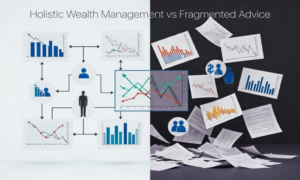
Most investors rely on siloed financial advice—separate advisors for investments, tax, estate, or insurance. Holistic wealth management, in contrast, integrates all aspects of a client’s financial life.
The difference is not just convenience. Evidence shows coordinated planning reduces risk, improves returns, and ensures long-term financial resilience.
Key Takeaways:
- Holistic wealth management integrates all financial areas, creating synergy.
- Siloed advice may produce hidden costs, fragmented planning, and unmanaged risk.
- Coordinated strategies improve returns, reduce fees, and align with life targets.
- Even moderately complex portfolios benefit from a unified advisory framework.
My contact details are hello@adamfayed.com and WhatsApp +44-7393-450-837 if you have any questions.
The information in this article is for general guidance only. It does not constitute financial, legal, or tax advice, and is not a recommendation or solicitation to invest. Some facts may have changed since the time of writing.

What is holistic wealth management?
Holistic wealth management is a comprehensive approach that aligns investments, tax planning, estate strategy, and insurance under one coordinated plan.
Rather than treating each financial decision in isolation, holistic advisors:
- Consider the interplay between taxes, investments, and liabilities
- Integrate risk management, insurance, and estate planning into portfolio strategy
- Tailor recommendations to life goals, risk tolerance, and long-term objectives
The goal is synergy, not separate optimization.
Who needs holistic wealth management?
High-net-worth individuals, families with complex finances, and clients with multiple wealth components benefit most from holistic wealth management.
Typical beneficiaries include:
- Entrepreneurs or business owners with varying income streams
- Families managing intergenerational wealth
- Expats or multi-jurisdictional clients navigating taxes, investments, and estate planning
- Anyone seeking coordinated long-term financial strategies rather than ad hoc advice
How holistic and isolated approaches differ
Holistic wealth management integrates all financial decisions, while siloed advice isolates each component.
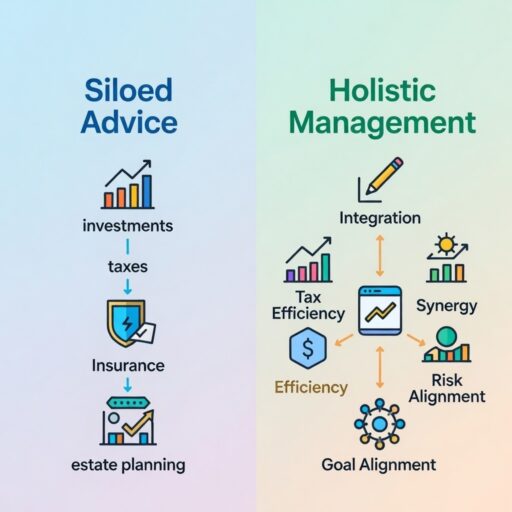
Siloed advice is reactive and focuses on discrete problems such as picking a fund, selecting life insurance, or filing taxes without seeing the connections.
Holistic management is proactive and anticipates interactions between assets, liabilities, and personal objectives while seeking synergies rather than incremental fixes.
For example, a siloed advisor might recommend a high-performing equity fund, unaware that it triggers taxable events that undermine overall portfolio returns.
Meanwhile, a holistic advisor sees the tax consequence, insurance gaps, and estate implications before recommending the investment.
| Feature | Holistic Wealth Management | Siloed Financial Advice |
| Integration | All financial areas coordinated | Each area separate |
| Tax Efficiency | Optimized across portfolio | Often missed |
| Risk Management | Aligned across assets & insurance | Assessed in isolation |
| Goal Alignment | Strategies support life goals | Focus on individual objectives |
| Decision-Making | Centralized advisory team | Multiple advisors, fragmented |
| Outcome | Predictable growth, reduced duplication | Inefficiencies, potential gaps |
Why does siloed advice fall short?
Because siloed advice treats parts in isolation, it fails to manage the whole system that produces client outcomes.
It breaks down not because individual recommendations are wrong, but because no one is responsible for how all decisions work together.
When advice is delivered in pieces, clients are left coordinating between specialists, reconciling conflicting guidance, and absorbing the consequences if strategies clash.
This fragmentation often leads to inconsistent decision-making, where actions taken in one area quietly undermine progress in another.
Without a single point of accountability, risks can accumulate unnoticed, costs can compound, and timing errors can occur simply because no advisor has visibility over the full picture.
Over time, this lack of coordination increases complexity rather than reducing it. Clients may feel they are doing everything right yet still experience higher fees, unnecessary risk exposure, and lower after-tax or after-cost outcomes.
The advice solves isolated issues, but the overall plan never fully comes together.
Siloed advice shifts the burden of integration onto the client. Holistic planning exists to remove that burden and ensure every decision supports a coherent, long-term strategy.
How holistic wealth management improves outcomes
Holistic wealth management improves long-term performance by coordinating strategy, reducing risk, and aligning with life goals.
- Integrated tax planning: Minimizes leakage and boosts net returns.
- Strategic asset allocation: Accounts for all liabilities, including insurance and real estate.
- Goal alignment: Ensures investment strategies support retirement, education, and legacy objectives.
- Efficiency and simplicity: One team coordinating multiple aspects reduces stress, duplication, and oversight errors.
What are the practical steps to adopt a holistic approach?
Identify a single trusted advisor or team, consolidate financial information, and define unified goals.
1. Map all financial elements: Investments, tax exposure, insurance coverage, estate structures, and liabilities.
2. Select a holistic advisor or firm: One with the authority and capability to coordinate across disciplines.
3. Set unified objectives: Retirement timelines, education funding, legacy goals, and risk tolerance.
4. Review and adapt regularly: Adjust strategies as life events, tax rules, or market conditions change.
The Hidden Cost of Fragmented Decision-Making
Fragmented financial advice creates costs that extend beyond visible fees. These costs quietly erode returns, increase stress, and amplify risk in ways most clients do not immediately recognize.
Rather than focusing only on account balances or headline charges, holistic wealth management evaluates the cumulative effects of missed coordination over time.
These effects often appear in three areas.
- Opportunity cost from disjointed decisions.
Actions taken in isolation can reduce overall wealth even when they appear reasonable on their own. For example, raising liquidity through asset sales may unintentionally increase tax exposure or conflict with long-term estate objectives. - Behavioral friction.
Receiving guidance from multiple advisors increases cognitive load. Conflicting recommendations can lead to decision fatigue, hesitation, or poorly timed actions, all of which weaken outcomes. - Compounding inefficiencies.
Small misalignments such as duplicated insurance, uncoordinated tax planning, or inconsistent investment positioning accumulate over years. What seems negligible in isolation can materially widen the gap between potential and actual results.
The true value of holistic wealth management lies in preventing invisible wealth erosion rather than simply executing transactions.
Clients often underestimate these hidden costs until they are identified and quantified through a comprehensive review.
Are holistic strategies better for all investors?
Not necessarily. Holistic strategies add the most value when complexity exists. For simpler situations, they may offer limited incremental benefit.
Investors with multiple income sources, cross-border exposure, business interests, or long-term legacy goals benefit because coordination materially affects outcomes.
In these cases, integration reduces blind spots, improves sequencing, and prevents costly conflicts between decisions.
For investors with straightforward finances, such as a single income, limited assets, and no tax or estate complexity, a fully holistic framework may be unnecessary.
Basic investment management or goal-based planning can be sufficient, and the added structure of holistic oversight may not justify the cost or effort.
The key distinction is not wealth level but complexity. As soon as decisions in one area influence outcomes in another, such as taxes affecting investments or liquidity affecting risk, a holistic approach becomes increasingly valuable.
Practically speaking, the best strategy is proportional. Investors should adopt as much integration as their financial situation requires, and no more than that.
Holistic planning is a tool, not a default, and its effectiveness depends on how interconnected the investor’s financial life truly is.
FAQs
What are the best strategies for managing multi-generational wealth?
Successful multi-generational wealth management combines strong governance, clear succession planning, and education of heirs.
Effective strategies typically include well-structured trusts or foundations, defined family roles, transparent communication, and regular reviews to adapt structures as laws, assets, and family dynamics evolve.
What are the latest trends in wealth management?
Key wealth management trends include greater regulatory transparency, increased tech use for reporting and monitoring, a shift toward unified advisory models, and growing attention to digital assets and alternative investments.
Wealth management is also becoming more global, with a stronger emphasis on cross-border coordination and reporting compliance.
Does holistic wealth management cost more?
It can involve higher upfront fees, especially if multiple advisors are coordinated under one framework.
However, the benefits—like potential tax savings, risk reduction, better investment alignment, and streamlined decision-making—often outweigh the cost.
Think of it as paying once for coordinated insight rather than many times for fragmented advice.
How often should a financial plan be reviewed?
Review plans at least once a year, or sooner if there are major life changes, market shifts, or tax law updates.
Regular review ensures your strategy remains aligned, compliant, and optimized for growth, risk management, and lifestyle goals.
Will wealth management be replaced by AI?
AI is transforming wealth management, but it is unlikely to replace it entirely.
Technology excels at data analysis, reporting, and automation, while human advisors remain essential for judgment, strategic structuring, behavioral guidance, and navigating complex family and cross-border issues.
The future is a hybrid model, not full replacement.
Pained by financial indecision?

Adam is an internationally recognised author on financial matters with over 830million answer views on Quora, a widely sold book on Amazon, and a contributor on Forbes.