After 10 years, your Supplementary Retirement Scheme (SRS) account continues to grow and you are allowed to make withdrawals, but timing, penalties, and taxes affect how much you actually get.
Understanding what happens to SRS after this milestone is crucial for maximizing your retirement savings.
This article covers:
- What are the withdrawal rules for SRS?
- Who can contribute to SRS?
- Is it worth to put money in SRS?
- What are tax-efficient withdrawal strategies?
Key Takeaways:
- SRS in Singapore can continue to grow after 10 years; withdrawals are optional.
- Early withdrawals before retirement age incur penalties and taxes.
- SRS works best when you contribute at peak income and withdraw at retirement.
- SRS offers flexibility and investment options not available through CPF.
My contact details are hello@adamfayed.com and WhatsApp +44-7393-450-837 if you have any questions.
The information in this article is for general guidance only. It does not constitute financial, legal, or tax advice, and is not a recommendation or solicitation to invest. Some facts may have changed since the time of writing.

How Does SRS Work in Singapore?
The Supplementary Retirement Scheme (SRS) is a voluntary retirement savings account that helps individuals grow their wealth while enjoying tax benefits.
Both Singaporeans and foreigners can contribute to SRS, with contributions eligible for tax relief, reducing your taxable income for the year.
Funds in your SRS account can be invested in a variety of products, including fixed deposits, bonds, unit trusts, ETFs, and stocks, allowing your money to grow over time.
This combination of tax savings and investment flexibility makes SRS a powerful tool for long-term retirement planning.
What Happens to an SRS Account After 10 Years?
After 10 years, your SRS account continues to grow, and you can manage your investments and withdrawals, though early withdrawals incur additional costs.
- Your investments earn returns and your funds benefit from continued tax-deferred growth.
- You can leave your money in the account to grow further.
- Early withdrawals are allowed, but withdrawals before the retirement age of 62 have penalties and taxes.
The 10-year mark is simply a planning milestone, not a requirement to withdraw funds.
Can I Withdraw SRS After 10 Years?
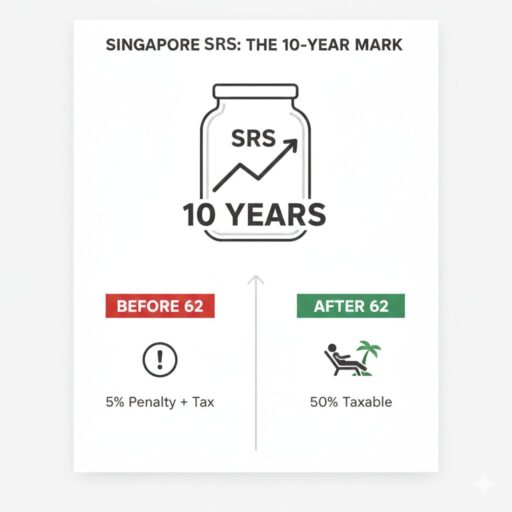
You can withdraw your SRS funds after 10 years, but withdrawals made before reaching the statutory retirement age of 62 will incur a 5% penalty plus income tax on the withdrawn amount.
Simply reaching 10 years does not make withdrawals penalty-free.
- At or after retirement age (62): Withdrawals are 50% taxable and 50% tax-free, and you can spread withdrawals over multiple years to manage your tax liability.
The 10-year mark is a planning milestone rather than an automatic trigger for penalty-free withdrawals.
Timing your withdrawals strategically after retirement age is key to maximizing the benefits of your SRS account.
How to Maximize SRS Withdrawal?
You maximize SRS withdrawals by planning strategically, investing wisely, and timing your withdrawals after retirement.
1. Delay withdrawals: Wait until the statutory retirement age to reduce income tax and avoid early withdrawal penalty, which can significantly affect your net savings.
2. Invest wisely: Choose a diversified portfolio of stocks, bonds, ETFs, and unit trusts to grow your funds while managing market risk over the long term.
3. Monitor contributions: Stay within annual contribution limits to fully leverage tax relief and ensure your SRS account continues to grow efficiently.
What Are the Benefits of SRS?
SRS provides tax relief while helping your retirement savings grow over time, making it a useful tool for long-term financial planning.
- Tax relief – Contributions are deductible from your taxable income in the year you make them, reducing your current tax bill and freeing up cash for investments.
- Investment flexibility – Unlike CPF, SRS funds can be invested in a wide range of instruments such as stocks, ETFs, bonds, and unit trusts, allowing you to tailor your portfolio according to your risk tolerance and goals.
- Tax-deferred growth – Investments within SRS grow without being taxed until withdrawal, which helps compound your wealth faster over the long term.
- Supplementary retirement income – SRS acts as an additional source of income in retirement, complementing CPF savings and other personal funds, giving you more financial security.
What Are the Risks of Investing in SRS?
One key risk of investing through SRS is market risk, as the value of investments like stocks or ETFs can fluctuate.
Beyond that, there are other factors to consider:
- Liquidity risk – Withdrawing funds before the statutory retirement age of 62 triggers a 5% penalty plus income tax, limiting access to your money when you might need it.
- Inflation risk – Conservative investments may not keep pace with inflation, reducing the real value of your savings over time.
- Investment choice risk – Poor selection or lack of diversification can impact returns, so careful planning and monitoring are essential.
- Market risk – Investments such as stocks, ETFs, and unit trusts can rise or fall in value, affecting your returns.
What’s the Difference Between CPF and SRS?
The main difference is that CPF is mandatory while SRS is voluntary, giving SRS contributors more flexibility and tax-saving opportunities.
| Feature | CPF | SRS |
| Mandatory/Voluntary | Mandatory | Voluntary |
| Tax Benefits | Limited | Contributions reduce taxable income |
| Investment Options | CPF-approved funds only | Stocks, ETFs, bonds, unit trusts |
| Withdrawal Age | 55-65 (depends on scheme) | 62 (statutory retirement age) |
While CPF is compulsory for Singaporeans and permanent residents, SRS is optional but offers more flexibility and tax-saving potential.
SRS vs Investing Outside SRS
Choosing between investing through SRS and investing outside SRS comes down to tax efficiency versus flexibility.
Tax Treatment
SRS investing offers upfront tax relief on contributions and tax-deferred growth, with only 50% of withdrawals taxable after age 62.
This makes SRS attractive for high-income earners looking to reduce their current tax bill.
Investing outside SRS, on the other hand, does not provide contribution tax relief.
However, Singapore does not tax capital gains, and most investment income is either tax-free or lightly taxed, depending on the asset type.
This means long-term investors may still enjoy efficient growth without locking up their funds.
Liquidity and Access
SRS funds are restricted. Certain withdrawals incur penalty plus income tax.
Investments outside SRS are fully liquid. You can sell and access your funds anytime without penalties, making this route more flexible for those who may need capital before retirement.
Investment Flexibility
Both routes allow access to stocks, ETFs, bonds, and unit trusts.
However, SRS investments must be held within approved products and institutions, while investing outside SRS provides complete freedom across global platforms and asset classes.
When SRS Makes More Sense
SRS may be more suitable if:
- You are in a higher tax bracket.
- You are confident you won’t need the funds before retirement.
- You want structured retirement planning with tax optimization.
When Investing Outside SRS May Be Better
Investing outside SRS may be preferable if:
- You value liquidity and early access.
- You are in a low tax bracket where SRS tax relief offers limited benefit.
- You want complete control without withdrawal restrictions.
Conclusion
SRS is not just a tax-saving scheme; it’s a versatile tool for building a stronger, more flexible retirement plan.
Its real potential comes from strategic contributions, diversified investments, and well-timed withdrawals, rather than simply reaching milestones like 10 years.
When used thoughtfully, SRS can complement CPF savings, provide tax-efficient growth, and serve as a buffer against market or inflation risks.
Ultimately, the strength of SRS lies in the control it gives you over your retirement journey, turning long-term planning into tangible financial confidence.
FAQs
How Much is the SRS Allowance in Singapore?
The maximum SRS contribution for 2026 is S$15,300 for Singaporeans and PRs and S$35,700 for foreigners, as per the IRAS.
Contributions are eligible for tax relief in the respective fiscal year.
Where Can I Park My SRS Money?
You can invest SRS funds in fixed deposits, bonds and government securities, unit trusts, ETFs, and stocks listed on approved exchanges.
Can SRS Be Transferred to CPF?
No, SRS funds cannot be transferred to CPF. They remain separate accounts and serve as supplementary retirement savings.
Is SRS Only for Singaporeans?
No, SRS is open to both Singaporeans and foreigners. However, contribution limits differ, with foreigners allowed higher caps.
Can Foreigners Use SRS?
Yes, foreigners working or living in Singapore can contribute to SRS and enjoy tax reliefs on contributions, making it an attractive retirement planning tool.
Pained by financial indecision?

Adam is an internationally recognised author on financial matters with over 830million answer views on Quora, a widely sold book on Amazon, and a contributor on Forbes.