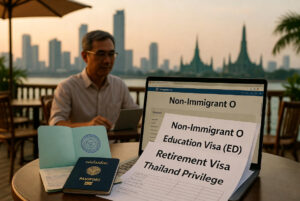
Thailand is often described as one of the easiest countries in Asia to live in legally. With multiple long-stay visa options, flexible extensions, and relatively low entry barriers, remaining in the country is rarely the challenge.
The real constraint appears later, when expats and investors attempt to convert ease of stay into long-term security, permanence, or strategic leverage.
Thailand welcomes presence, but it carefully limits attachment.
Key Takeaways:
- Thailand prioritizes access over permanence
- Visa ease comes with a clear ceiling
- Long-term leverage requires parallel planning
- Thailand works best strategically, not exclusively
My contact details are hello@adamfayed.com and WhatsApp +44-7393-450-837 if you have any questions.
For digital nomad or residence visas that require income, assets, or qualifying investments, we can help structure suitable investment solutions that may align with those requirements, depending on your circumstances.
The information in this article is for general guidance only. It does not constitute financial, legal, or tax advice, and is not a recommendation or solicitation to invest. Some facts may have changed since the time of writing.

Why Are Thailand Visas Considered Easy to Obtain?
Thailand visas are considered easy to get because the system prioritizes access at entry and defers stricter scrutiny until later stages.
Thailand’s immigration framework is built around multiple, parallel visa categories—tourist, education, retirement, remote work, and elite-style programs—rather than a single restrictive pathway.
This spreads demand and lowers initial barriers.
Initial applications typically involve light documentation and limited financial or integration requirements.
Renewals and extensions are also flexible, allowing foreigners to remain long term without committing upfront to permanent residence or citizenship.
Unlike countries that front-load compliance checks, language tests, or long-term tax alignment, Thailand allows entry first and applies selectivity later.
The result is continuity of stay without immediate permanence, which makes Thai visas feel accessible, predictable, and comparatively easy to secure.
Easiest Thai Visas to Get
The easiest Thai visas to obtain are the Tourist Visa (TR) and Visa Exempt Extensions, Non-Immigrant ED (Education) Visa, Non-Immigrant O / O-A Retirement Visas, and the Thailand Privilege (Elite) Visa.
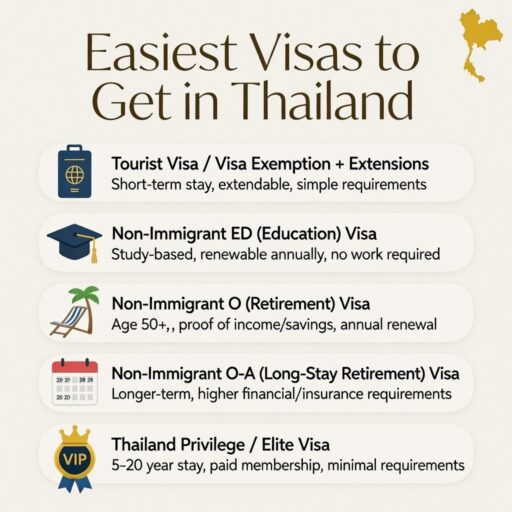
- Tourist Visa (TR) and Visa Exemption + Extensions
Short-stay visas that can be extended inside Thailand. While not designed for settlement, they are widely used for medium-term stays due to simple requirements and repeatability. - Non-Immigrant ED (Education) Visa
Issued to foreigners enrolled in approved language schools or academic programs. Allows residence for the duration of study, typically renewable annually, with no employment requirement. - Non-Immigrant O (Retirement) Visa
Available to applicants aged 50+. Requires proof of income or savings but no work, investment, or integration criteria. Renewable annually. - Non-Immigrant O-A (Long-Stay Retirement) Visa
A longer-duration retirement visa issued outside Thailand, with higher financial and insurance requirements, but still relatively straightforward compared to residence programs elsewhere. - Thailand Privilege Visa (formerly Thai Elite Visa)
A paid long-stay residence program offering 5-, 10-, or 20-year stays in exchange for a membership fee. No income, employment, or language requirements.
How These Visas Function
These visas operate as parallel tracks not as steps toward permanent residence. Applicants select a category based on purpose without moving through increasingly restrictive stages.
- Tourist and long-stay visas are built around flexibility. They allow short-term entry with extensions and repeat renewals, prioritizing ease of access over long-term rights.
- Education visas permit extended residence through enrollment in approved programs. They allow legal stay for multiple years but do not grant access to the local labor market.
- Retirement visas are structured around age and financial stability. Eligibility is based on meeting income or savings thresholds rather than employment, investment, or integration criteria.
- Elite and privilege programs exchange upfront fees for residence certainty. They prioritize convenience, predictable renewals, and administrative ease rather than economic participation.
Why Thailand Allows Long Stays Without Citizenship
Thailand offers long-term visas that are easy to enter and renew, but these don’t automatically lead to permanent residence or citizenship.
Continuity is granted, yet rights escalation is limited. Work authorization, for example, is tied to a specific employer and rarely transferable, while permanent residency is quota-based and slow.
Citizenship remains discretionary and is rarely awarded.
The system favors residents who are economically passive, administratively compliant, and legally non-assertive.
Those expecting visas to automatically compound into full rights may only encounter restrictions after several years.
This subtle balance explains why Thailand feels accessible but remains restrictive in terms of permanence.
Easy Visas and What Investors Should Know
Thailand’s visa flexibility is attractive for lifestyle reasons, but it does not guarantee investment freedom or cross-border financial control.
Some practical constraints:
- Banking and lending often require documentation beyond visa compliance.
- Ownership of companies, trusts, or holding structures may need multi-jurisdictional planning.
- Foreign income continues to be subject to Thai and home-country tax rules regardless of visa type.
In short, ease of entry is not the same as strategic control. Investors must plan proactively to convert presence into legal, financial, and structural advantage.
Why Thailand’s Visa System Differs from Residency-First Countries
Thailand’s visas are simple to maintain but hard to escalate. Unlike countries that reward initial effort with stronger rights over time, Thailand keeps access easy while limiting pathways to permanence.
It works well for:
- Lifestyle-driven expats
- Retirees
- Remote earners with offshore income
It is less suitable for:
- Investors seeking residency-based tax optimization
- Families planning long-term settlement
- Professionals needing predictable legal escalation
The system provides comfort without convergence, offering flexibility but not permanent legal leverage.
How Thailand Compares to Harder Residency Jurisdictions
Compared to countries like Portugal or Spain, Thailand trades permanence and integration for speed, predictability, and flexibility.
Unlike European or North American residency programs, where visas often act as a stepwise ladder toward permanent residency or citizenship, Thai visas are designed to maintain residence without escalating rights.
Key distinctions:
- Progression vs. stability: In countries like Portugal, Spain, or Canada, the visa process starts strict but builds toward rights—long-term residence, work freedom, and eventually citizenship. Thailand flips this: entry is simple, renewals are predictable, but progression toward permanence is limited.
- Integration requirements: Harder residency jurisdictions often require language proficiency, civic knowledge, or continuous residence. Thailand generally imposes none of these, favoring a stay that is administratively compliant but socially hands-off.
- Economic leverage: In structured residency systems, long-term legal status often enables investment, property ownership, and tax planning. Thailand grants continuity but does not inherently unlock legal or financial levers tied to residence.
- Policy philosophy: European programs integrate migrants into society over time. Thailand, by contrast, manages foreigners as temporary residents, ensuring state discretion while allowing lifestyle or retirement-driven mobility.
Overall, Thailand offers predictable, repeatable stays for lifestyle, retirement, or remote work, but it deliberately limits legal escalation, differentiating it from jurisdictions that link initial effort to long-term rights.
| Dimension / Feature | Thailand | Europe / North America |
| Approach | ⚡ Quick & Predictable | 🏛 Structured & Progressive |
| Rights Escalation | ↔ Stable | 🔄 Stepwise → Long-Term / Citizenship |
| Integration | 🈚 Optional | 📘 Required |
| Lifestyle Fit | 🏖 Flexible / Temporary | 🏠 Settlement-Focused |
| Complexity | 🔹 Low | 🔹 High |
| Fast Entry | ✅ | ❌ |
| Path to Citizenship | ❌ | ✅ |
| Investment / Tax Leverage | ⚠ | ✅ |
| Flexible Stay | ✅ | ⚠ |
Bottom Line
Thailand’s visas provide fast, flexible, and predictable long-term stays, making them ideal for lifestyle-focused expats, retirees, and remote workers.
However, they rarely lead automatically to permanent residency or citizenship, and do not inherently unlock investment, banking, or tax advantages.
Success in Thailand depends on planning around flexibility rather than permanence, using these visas as a low-friction base rather than a pathway to long-term legal or financial leverage.
FAQs
Is Thailand easy to live in long term?
Yes. Thailand allows long-term residence through renewable visas, including tourist extensions, education, retirement, and elite programs.
Most options rely on periodic renewal rather than providing permanent residence or citizenship.
Is it easy to get citizenship in Thailand?
No. Citizenship is discretionary and rarely granted. Even long-term residents must meet strict residency, language, and legal criteria, and approvals can take many years.
How long do you have to live in Thailand to apply for citizenship?
Applicants typically need at least 5 years of continuous permanent residency before being eligible.
Other requirements include language proficiency, proof of income, and government approval.
Can I get a 1 year visa in Thailand?
Yes. Certain visas, such as the Non-Immigrant O-A (Long-Stay Retirement) Visa or the Elite Visa, allow stays of 1 year or longer, with renewals or multi-year options available depending on the category.
Does Thailand have an investor visa?
Thailand does not have a traditional investor visa like some countries, but the Thailand Elite Visa and some business-based Non-Immigrant B visas allow long-term residence for fee-paying or business-owning foreigners.
Investment alone does not automatically grant permanent residency.
Can I get residency in Thailand if I buy a house?
No. Buying property in Thailand does not grant a residency permit. You still need a visa category (retirement, education, business, or elite) to legally reside long-term.
What are common reasons for visa denial?
Common reasons include:
• Incomplete or inaccurate documentation
• Insufficient income, savings, or financial proof
• Failure to meet age or program-specific criteria
• Previous visa violations or overstays
Can I apply again immediately if my visa is rejected?
Some visa categories allow immediate reapplication, while others may require a waiting period or additional documentation.
It’s important to review the rejection reason before reapplying.
Which countries give visas easily?
Countries with flexible or lifestyle-focused visas include Thailand, Indonesia (Bali), Malaysia, Croatia, and the UAE.
Ease typically refers to low documentation requirements, renewable visas, and predictable processing, not guaranteed paths to permanent residence or citizenship.
Pained by financial indecision?

Adam is an internationally recognised author on financial matters with over 830million answer views on Quora, a widely sold book on Amazon, and a contributor on Forbes.