The best crypto tax-free countries in Europe include Germany and Switzerland, both of which allow 0% capital gains tax on crypto under specific conditions such as long-term holding or private investor status.
Other strong contenders like Portugal and Malta also offer highly favorable regimes depending on residency and trading activity.
This article covers:
- What type of tax do you pay on crypto?
- Which EU country is crypto-friendly?
- Which EU country has the best tax system for crypto?
- What is the MiCA regulation for crypto?
Key Takeaways:
- Some European countries offer 0% crypto capital gains tax, but only under specific holding or residency rules.
- Tax treatment differs between private investors and professional traders.
- The European Union regulates crypto markets through MiCA, but taxation remains national.
- Long-term holding strategies and strategic relocation are often the most effective legal tax optimization approaches.
My contact details are hello@adamfayed.com and WhatsApp +44-7393-450-837 if you have any questions.
The information in this article is not tax advice and may have changed since the time of writing. I can connect you with expert tax support for your specific situation.

What taxes do you pay for crypto?
Crypto is generally subject to capital gains tax, income tax, and in some jurisdictions, wealth tax, based on how it is acquired, held, and disposed of.
Globally, crypto taxation usually falls into three main categories:
1. Capital Gains Tax (CGT)
Applies when you dispose of crypto such as selling it for fiat, swapping tokens, or using it to purchase goods or services. The taxable amount is generally the profit between acquisition cost and sale value.
2. Income Tax
Applies when crypto is earned rather than invested, including through mining, staking rewards, airdrops, or when received as salary or business income.
3. Wealth Tax (in limited countries)
A small number of jurisdictions impose annual tax on net assets, which may include crypto holdings if classified as part of taxable wealth.
For example:
- In Germany, long-term holders can sell crypto tax-free after one year.
- In Portugal, long-term gains may qualify for favorable treatment depending on structure and holding period.
- In Switzerland, private investors typically pay no capital gains tax, but wealth tax may apply at the cantonal level.
The critical distinction worldwide is whether crypto is treated as a private investment asset or as business income, as that classification determines the type and rate of tax applied.
Is crypto accepted in Europe?
Yes, crypto is widely accepted across Europe both legally and commercially.
Most European countries allow:
- Buying and selling crypto on regulated exchanges
- Holding crypto as a private asset
- Crypto payments in certain retail and service sectors
Countries like Switzerland and Estonia have positioned themselves as crypto-friendly hubs.
Switzerland’s Crypto Valley in Zug is particularly well known for blockchain innovation.
However, acceptance does not mean uniform tax treatment. Each country maintains its own tax framework.
Which European country is crypto tax free?
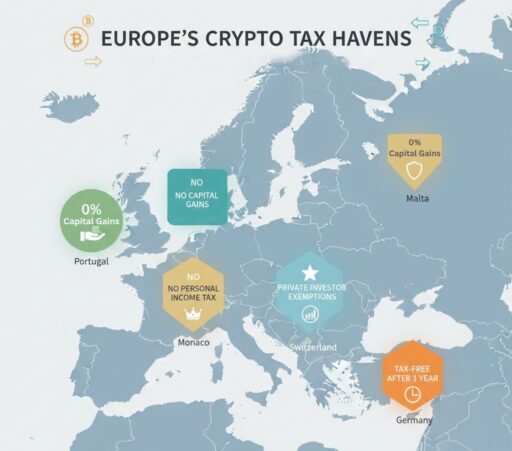
Several jurisdictions such as Germany and Portugal offer 0% capital gains tax on crypto under specific conditions, including minimum holding periods, private investor status, or qualifying residency.
However, there is no European country that is 100% tax-free for all crypto activities in all scenarios, including trading, mining, staking, business income, and both short-term and long-term holdings.
The most favorable regimes include:
Germany
- 0% capital gains tax if crypto is held for more than 12 months
- Short-term gains taxed at personal income tax rates
- Staking, mining, or business activity may alter treatment
Portugal
- 0% capital gains tax on crypto held more than 365 days (for individuals, non-business activity)
- 28% flat tax on short-term gains (held less than 365 days)
- Professional or business trading may be taxed at progressive rates up to ~48%
Malta
- 0% capital gains tax on long-term crypto held as a capital asset
- Trading activity classified as business income taxed at up to 35%
- Corporate crypto activity subject to 35% headline corporate tax (with potential refund mechanisms)
Switzerland
- 0% capital gains tax for private investors
- Professional traders taxed at progressive income tax rates (roughly 20%–45% depending on canton)
- Annual wealth tax applies at approximately 0.1%–1% depending on canton
Monaco
- 0% personal income tax and no capital gains tax for most residents
- Corporate income tax of 25% if significant revenue is generated outside Monaco
- Strict residency requirements, including property and financial thresholds
Estonia
- Profits can be effectively tax-free until distributed, making it attractive for crypto startups, exchanges, or professional trading companies
- Corporate profits are taxed only when distributed (20%)
- Strong digital infrastructure and licensing clarity
- Not a tax-free option for private individual investors
The best crypto tax-free outcome is based on residency status, holding period, trading frequency, and whether you qualify as a private investor rather than a professional trader.
| Country | Investor Type | Best Use Case / Strength |
| Germany | Private Investor | Long-term HODL |
| Portugal | Individual / Expat | Residency-based tax efficiency |
| Malta | Mixed / Business | Long-term capital gains & structured planning |
| Switzerland | Private Investor | Private holdings with wealth tax planning |
| Monaco | HNW Resident | No personal capital gains tax |
| Estonia | Corporate / Startup | Retained profits taxed only on distribution |
Which EU country has the best crypto tax?
In the EU, Germany, Portugal, and Estonia offer the most favorable crypto tax frameworks for different investor types and business structures.
For long-term holders: Germany
Germany is particularly attractive for individuals because crypto held longer than 12 months can be sold at 0% capital gains tax if classified as private wealth.
This makes it highly efficient for buy-and-hold investors rather than frequent traders.
For lifestyle and relocation flexibility: Portugal
Portugal is attractive for individuals because long-term crypto holdings can be exempt from capital gains tax.
Short-term or professional trading remains taxable, but the country’s favorable residency rules make it a popular choice for relocation-based tax planning.
For structured crypto businesses: Estonia
Estonia stands out for its corporate tax model, where profits are taxed only upon distribution (currently 20%) rather than when retained.
Combined with strong digital infrastructure and licensing clarity, this makes it attractive for crypto startups and exchanges operating within the EU.
Which country is best for crypto trading in Europe?
Switzerland, Germany, and Malta are among the top destinations for crypto trading in Europe, specifically for active or professional trading rather than long-term holding, staking, or mining.
Top contenders:
- Switzerland – Strong regulatory framework under FINMA, reliable banking access, and a mature crypto ecosystem; particularly suited for institutional or high-volume trading.
- Germany – Clear tax rules for traders and robust financial infrastructure make it practical for professional trading activities.
- Malta – Early adoption of crypto legislation and a well-defined licensing regime support trading businesses and startups.
Crypto trading involves frequent buying, selling, or exchanging of assets, which presents different regulatory and infrastructure needs compared with other crypto activities.
For active traders, key considerations go beyond tax:
- Regulatory clarity
- Exchange licensing framework
- Banking access
- Capital markets depth
Which country has the most crypto investors in Europe?
The United Kingdom, Germany, and Switzerland lead Europe in crypto adoption, measured by both total number of users and the share of adults owning crypto.
Largest crypto populations (absolute users)
- United Kingdom: ~19% of adults (~12.7 million people) hold crypto.
- Germany: ~12% of adults (~10 million people) hold crypto.
- France: Adoption is slightly lower, but still millions of holders, making it one of Europe’s largest markets.
High adoption rates (per-capita / relative adoption)
- Switzerland: ~21% of adults own crypto, one of the highest rates in Europe.
- Netherlands: ~40–45% of adults have engaged with crypto, showing strong density despite smaller population than Germany or the UK.
- Belgium: ~20–21% of adults hold crypto.
- Ukraine: ~25% of financially active adults hold crypto, ranking it among the top countries globally in per-capita adoption.
- Other Eastern European nations such as Moldova and Georgia also show strong relative adoption, highlighting grassroots engagement in smaller populations.
Large economies like the UK, Germany, and France dominate in total number of crypto investors, shaping market scale.
Smaller or mid-sized countries like Switzerland, the Netherlands, Belgium, and Ukraine stand out in adoption rate per capita, reflecting how concentrated crypto participation is relative to population.
What is the EU regulation for crypto?
The key regulatory framework is MiCA (Markets in Crypto-Assets Regulation) under the European Union.
MiCA aims to:
- Standardize crypto regulation across EU member states
- Introduce licensing requirements for crypto service providers
- Enhance consumer protection
- Increase transparency for stablecoins
MiCA does not harmonize tax laws. Taxation remains under national jurisdiction.
This means regulatory clarity is increasing, but tax competition between countries continues.
Is there any way to avoid paying taxes on crypto?
Yes. It is possible to legally minimize crypto taxes in Europe by using strategies that optimize holding periods, residency, and the classification of trading activity.
- Hold long-term: Keep crypto for periods that qualify for capital gains exemptions in your country.
- Relocate strategically: Move to jurisdictions with favorable crypto tax rules to benefit from residency-based exemptions.
- Classify correctly: Structure trading as a private investment rather than a business to avoid professional trader taxation.
- Time disposals carefully: Sell or exchange crypto at optimal points to reduce taxable gains.
Tax evasion is illegal.
Strategic tax planning within legal frameworks is common, especially among high-net-worth investors relocating to favorable jurisdictions.
Other Tax-Free Crypto Countries Outside Europe
The UAE, Singapore, Cayman Islands, and Bahamas offer minimal or zero crypto taxes beyond Europe.
- United Arab Emirates (Dubai, Abu Dhabi) – 0% personal income and capital gains tax; increasingly attractive for crypto professionals and businesses.
- Singapore – No capital gains tax for individuals; business income may be taxed. Strong regulatory clarity and exchange infrastructure.
- Cayman Islands – No income, capital gains, or wealth taxes; popular for crypto funds and startups.
- Bahamas – No personal income or capital gains tax; established as a financial center with developing digital asset laws.
Key insights:
- These jurisdictions are especially relevant for high-net-worth individuals, crypto entrepreneurs, and businesses.
- Legal residency, corporate structuring, and compliance with local licensing rules are crucial to realize tax-free benefits.
- Comparing Europe with these regions helps investors evaluate trade-offs between market access, lifestyle, regulation, and taxation.
Conclusion
Europe offers a nuanced landscape for crypto investors. While no country is universally tax-free, strategic choices around holding periods, residency, and investor classification can drastically reduce tax exposure.
The interplay between regulatory clarity, infrastructure, and tax incentives determines whether long-term holding, active trading, or running a crypto business makes a country the most suitable choice.
Investors should approach Europe with a multi-dimensional strategy.
Consider not only the headline tax rates but also residency rules, reporting obligations, and market accessibility.
Countries like Germany, Switzerland, Portugal, and Malta illustrate that favorable outcomes are rarely automatic; they require planning, alignment with local rules, and awareness of how different crypto activities are classified.
Ultimately, Europe rewards informed and strategic crypto participation, and the right location can turn tax optimization and regulatory compliance into a competitive advantage.
FAQs
How much tax do you have to pay on your crypto?
Rates can range from 0% for long-term holdings in favorable jurisdictions to over 40% in high-income countries.
The amount of tax you pay on crypto varies by country, holding period, and whether it is treated as capital gains or income.
What country has the least crypto restrictions?
Switzerland, Portugal, and Malta are among the European countries with the least crypto restrictions, offering a combination of regulatory clarity and favorable tax treatment.
Which EU countries have no wealth tax?
Several EU countries without wealth tax include Germany, Portugal, Belgium, and Austria.
Meanwhile, wealth tax countries include Spain, which levies a progressive wealth tax up to 3.5 %.
Pained by financial indecision?

Adam is an internationally recognised author on financial matters with over 830million answer views on Quora, a widely sold book on Amazon, and a contributor on Forbes.