Colombia now levies a wealth tax on individuals whose net assets exceed 40,000 Unidad de Valor Tributario (UVT) or about 2 billion Colombian pesos, with progressive rates from 0.5% to up to 5% for the very wealthy under the 2026 emergency tax regime.
The Colombia wealth tax primarily applies to resident individuals and is designed to expand the taxpayer base by lowering the threshold and increasing rates for high-asset holders.
This article covers:
- How much is the wealth tax in Colombia?
- Which assets are tax-free in Colombia?
- What assets are taxable in Colombia?
- Who is liable to pay tax?
- What are strategies to reduce taxes?
Key Takeaways:
- The 2026 Colombian wealth tax stems from an economic emergency decree that expanded its scope.
- The levy applies to residents with net assets above 40,000 UVT, with rates up to 5%.
- The policy targets extreme wealth concentration in Colombia.
- Using pension vehicles and other exemptions can reduce taxable exposure.
My contact details are hello@adamfayed.com and WhatsApp +44-7393-450-837 if you have any questions.
The information in this article is not tax advice and may have changed since the time of writing. I can connect you with expert tax support for your specific situation.

What is the wealth tax in Colombia 2026?
The Colombia wealth tax rates in 2026 apply to individuals with net assets worth over 40,000 Unidad de Valor Tributario (UVT), which is roughly 2 billion pesos. Progressive rates start at 0.5% and rise up to 5% for very large fortunes.
These rules were introduced under an economic emergency decree issued in late 2025, significantly lowering the previous threshold and increasing the top marginal rate.
The tax is assessed annually on net wealth held as of January 1, 2026, and applies primarily to resident individuals.
Residents must report their worldwide assets and pay according to the progressive brackets, meaning higher levels of wealth face higher marginal rates.
The stated objective of Colombia’s wealth tax is to raise revenue for the national budget while expanding the taxpayer base and increasing contributions from high-net-worth individuals.
What Colombian assets can be taxed?
The Colombian wealth tax applies to different assets, including real estate, bank accounts, investments such as stocks and bonds, equity in businesses, and high-value personal property like luxury vehicles, yachts, and planes.
These taxable assets are valued at their fair market value as of the reference date (typically January 1) for the 2026 tax year.
The tax base is calculated on net wealth total assets minus allowable liabilities, meaning debts can reduce the taxable amount.
Financial instruments, tangible property, and equity stakes are all included in determining whether an individual exceeds the threshold and owes tax.
What assets are not taxed in Colombia?
The Colombia tax on wealth excludes personal-use household goods, furniture, and standard non-luxury vehicles from the taxable base.
It is calculated on net wealth, meaning liabilities and debts are deducted from total assets before applying the tax.
The ordinary statutory framework also allows an exemption for part of the value of a taxpayer’s principal residence (up to a specified tax value unit cap), which reduces taxable equity.
Non-residents are taxed only on Colombian-located assets, while residents must generally include worldwide assets in their net wealth calculation.
Who pays taxes in Colombia?
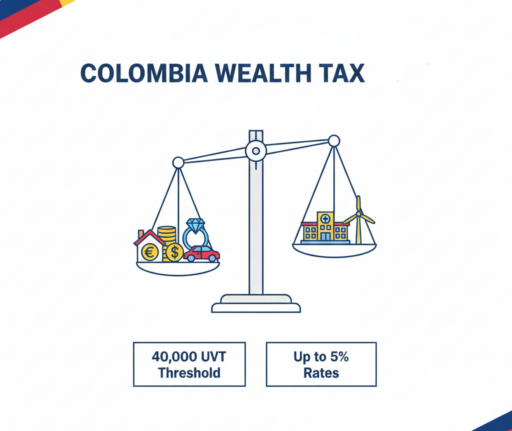
Wealth tax in Colombia primarily applies to residents with net assets exceeding 40,000 tax value unit and are taxed on both domestic and foreign assets.
Non-residents are generally not subject to the tax unless they own significant assets located within the country.
Residency is determined by physical presence, economic ties, and long-term intention to stay in the country.
Individuals meeting these criteria with net wealth above the threshold must report and pay the wealth tax annually.
Is there any tax exemption in Colombia?
Yes, Colombia’s tax on wealth allows certain exemptions to reduce the taxable base for eligible individuals and assets.
Exemptions include individuals with net assets below the minimum threshold, assets invested in qualifying productive activities such as businesses or infrastructure projects, and donations made to government-recognized charitable foundations.
These measures encourage investment and philanthropy while keeping the focus of the tax on high-net-worth individuals.
What are the tax planning strategies?
One common strategy for the wealth tax in Colombia is holding assets in exempt vehicles like pension funds to reduce taxable net wealth.
Other approaches include:
- Investing in businesses that qualify for tax incentives
- Using trusts or foundations for estate and wealth management
- Timely valuation of assets to minimize exposure
Professional guidance is recommended, as misreporting assets can lead to substantial penalties.
Why is there so much wealth inequality in Colombia?
Colombia’s wealth inequality is driven by historical concentration of assets, limited social mobility, and economic policies that have favored the wealthy.
As a result, the richest 10 % of the population hold around 71 % of the nation’s total wealth, and the top 1 % owns nearly 38 %, as per WID.
The country also has a very high income inequality, with a Gini coefficient of 53–54, one of the highest in Latin America.
Several structural factors reinforce these disparities.
- Land and natural resources remain concentrated among a small elite, limiting access to productive assets for the majority.
- Large segments of the population have restricted access to quality education, healthcare, and formal jobs, forcing many into low-income or informal work.
- Tax policies historically relied on indirect taxes that disproportionately affect lower-income households while providing limited wealth redistribution.
These conditions make the wealth tax an important tool to help address long-standing economic and social gaps.
Why is it better to tax the rich?
Taxing the rich can curb excessive wealth concentration, preventing a small elite from dominating economic and political influence.
Other key reasons include:
- Incentivizing the wealthy to invest in productive activities rather than accumulating unproductive assets like luxury goods, real estate speculation, or offshore holdings
- Strengthening fiscal capacity to fund social safety nets that enhance human capital, which benefits the economy in the long term
- Promoting intergenerational fairness by reducing the gap between inherited wealth and opportunities for the broader population
- Enhancing social cohesion and political stability by addressing perceptions of unfairness in the economic system
What are the negative effects of taxing the rich?
Taxing the rich can lead to capital flight, lower investment, and higher compliance costs if not carefully designed.
Potential downsides include:
- Wealthy individuals relocating assets or themselves to lower-tax jurisdictions, reducing the domestic tax base
- Lower levels of private investment in businesses, innovation, or capital markets if excessive taxation reduces incentives
- Higher administrative and compliance costs for both taxpayers and the government to accurately assess and enforce the tax
- The possibility of discouraging entrepreneurship or risk-taking if marginal rates are perceived as overly punitive
Policymakers must carefully calibrate rates and exemptions to balance revenue generation, equity, and long-term economic growth.
Colombia Wealth Tax Compared to Other Countries
Colombia’s wealth tax is moderate compared to the world’s highest-tax countries but aggressive within Latin America.
The emergency decree lowered the threshold and increased top rates, expanding the number of residents subject to the tax.
By contrast, Chile does not impose a net wealth tax on individuals. There is no active personal wealth tax in Chile under current law, although past proposals have considered one.
In Europe, only a few countries maintain individual wealth taxes:
- Spain levies a progressive net wealth tax on residents’ worldwide assets, with regional rates often between about 0.2 % and 3.5 %.
- Norway imposes a net wealth tax of about 1 % to 1.1 % on net assets above a modest threshold.
- Switzerland has cantonal wealth taxes (no federal one) that typically range from 0.1 % to around 1 %, depending on the canton.
Most other advanced economies including Germany, Sweden, and the UK have abolished or do not currently levy a broad individual wealth tax, choosing instead to rely on income, property, or capital gains taxes.
This comparison shows that Colombia’s current approach under the emergency regime is relatively aggressive by international standards, especially in terms of its top marginal rates, and reflects a broader global debate over how (and whether) to tax private wealth effectively and equitably.
| Country | Wealth Tax? | Approximate Top Rate |
| Colombia | Yes | Up to 5% |
| Chile | No | N/A |
| Spain | Yes | ~3.5% |
| Norway | Yes | ~1–1.1% |
| Switzerland | Yes (cantonal) | ~0.1–1% |
| Germany | No | N/A |
| Sweden | No | N/A |
| United Kingdom | No | N/A |
Conclusion
The 2026 Colombia wealth tax, introduced under an emergency decree, demonstrates the government’s urgent approach to expanding revenue and addressing extreme wealth concentration.
While the measure targets fairness and social equity, its temporary and exceptional nature highlights the challenges of balancing rapid fiscal interventions with economic stability.
Residents with substantial assets must navigate the rules carefully, using strategic planning to remain compliant and optimize outcomes.
Beyond immediate revenue, the decree underscores a broader lesson for policymakers: wealth taxation can be a powerful tool for social cohesion, but its effectiveness depends on thoughtful design, clear rules, and attention to behavioral and economic consequences.
FAQs
How much money is considered wealthy in Colombia?
For 2026, individuals with net assets above 2 billion Colombian pesos are considered wealthy for wealth tax purposes.
Which country pays 60% tax?
Some countries have top personal income tax rates near 60 %, including Denmark and Côte d’Ivoire, when national and local taxes are combined.
Is Colombia a high tax country?
No, Colombia’s overall tax rates are moderate. The wealth tax applies only to high-net-worth individuals, and general income tax rates are lower than those in high-tax countries.
Pained by financial indecision?

Adam is an internationally recognised author on financial matters with over 830million answer views on Quora, a widely sold book on Amazon, and a contributor on Forbes.