If you own Canadian property while living abroad, you may still owe Canadian taxes on rental income, capital gains, or both.
Your exact tax overseas are determined by whether the property generates income, whether you sell it, and your Canadian tax residency status.
This article covers:
- How does property tax in Canada work?
- Do Canadians have to pay taxes outside of Canada?
- What countries does Canada have tax treaties with?
- What happens if I don’t pay property taxes in Canada?
Key Takeaways:
- Non-residents pay 25% withholding tax on gross rental income unless they file under Section 216.
- Selling Canadian real estate triggers capital gains tax in Canada, even if you live abroad.
- Property taxes must be paid regardless of residency status.
- Filing correctly can significantly reduce tax and prevent CRA penalties.
My contact details are hello@adamfayed.com and WhatsApp +44-7393-450-837 if you have any questions.
The information in this article is not tax advice and may have changed since the time of writing. I can connect you with expert tax support for your specific situation.

What are property taxes in Canada?
Property taxes in Canada are annual charges set by municipal governments to fund local services such as schools, roads, waste management, and emergency services.
The amount each property owner pays is based on the assessed value of the property and the municipal tax rate, which varies by province, city, and neighborhood.
Local governments may also adjust rates annually based on budget needs or property value changes.
These taxes are a fundamental part of owning property in Canada and are collected regardless of whether the property is used personally, for business, or as a rental.
What is considered taxable Canadian property?
Taxable Canadian property generally refers to Canadian real estate and certain assets that derive their value from Canadian real estate.
Under Canadian tax law, taxable Canadian property (TCP) generally includes:
- Real estate located in Canada
- Rental properties in Canada
- Shares of private Canadian corporations that derive value from Canadian real estate
- Certain partnership or trust interests tied to Canadian real estate
If you are a non-resident and dispose of taxable Canadian property, you are typically subject to Canadian tax on any capital gains.
Who pays Canadian property taxes?
Property taxes in Canada are paid by the registered property owner, regardless of where they live.
These taxes are municipal (not federal) and are payable to the local government where the property is located.
Even if you live abroad, you must continue paying annual property taxes. Failure to pay can result in penalties or a tax lien on the property.
Property taxes are separate from income tax on rental income or capital gains tax on sale.
Do I have to file taxes in Canada if I don’t live there?
Yes. If you earn income from Canadian property or sell it, you must file a Canadian tax return even if you live abroad.
If you are a non-resident of Canada:
- You generally do not file a regular Canadian income tax return unless you have Canadian-source income.
- If you earn rental income from Canadian property, you must report it.
- If you sell Canadian real estate, you must file to report the capital gain.
Simply owning property does not automatically require filing, but earning income or selling it usually does.
What is Section 216 withholding?
Section 216 of Canada’s Income Tax Act allows non-resident property owners to elect to be taxed on net rental income instead of gross income.
By filing a Section 216 return:
- You report rental income and deductible expenses
- Tax is calculated on net profit
- You may receive a refund if too much tax was withheld
This election is commonly used by non-resident landlords to reduce their overall Canadian tax burden.
What is the rental withholding tax in Canada?
Non-residents earning rental income from Canadian property are subject to a 25% withholding tax on gross rental income.
This amount must be withheld and remitted to the Canada Revenue Agency, usually by:
- The tenant, or
- A property manager acting as your agent
This withholding applies before expenses are deducted, which means tax is calculated on total rent collected, not profit.
What happens if I live abroad and don’t file taxes?
If you are required to file Canadian taxes on rental income or a property sale and fail to do so, you can face penalties, interest, and serious complications with the Canada Revenue Agency.
If you are required to file and do not:
- Penalties and interest may accumulate
- The CRA may assess tax based on estimates
- You could face compliance issues when selling the property
- Clearance certificates may be delayed
If you later sell the property, unresolved filing issues can complicate the transaction.
How can I legally reduce my taxes in Canada?
Non-residents can lower Canadian taxes by deducting rental expenses, filing a Section 216 return, or using tax treaty benefits before selling or renting their property.
- Filing a Section 216 return
- Deducting allowable rental expenses (mortgage interest, repairs, management fees, insurance, property taxes)
- Claiming depreciation (Capital Cost Allowance), though this affects capital gains later
- Using tax treaty provisions
- Structuring ownership appropriately
Proper planning before selling can also reduce withholding and improve cash flow.
Can I deduct property taxes from my income tax in Canada?
Yes. Property taxes are deductible from income tax if such property generates rental income, because they are considered an allowable expense.
This reduces the amount of taxable income and, in turn, lowers the taxes owed on rental earnings. However, property taxes cannot be deducted against employment or other non-rental income.
For properties used for personal purposes, such as vacation homes, property taxes are generally not deductible for income tax purposes.
Properly tracking and claiming these expenses is important for non-residents to ensure they do not pay more tax than required.
Which countries does Canada have tax treaties with?
Canada has signed over 90 tax treaties according to the Government of Canada, including with countries such as the United States and the United Kingdom, to prevent double taxation on income, including rental income from Canadian property.
Canadian Tax Treaty Countries include:
- United States
- United Kingdom
- Australia
- Germany
- France
- Japan
- China
- India
- Brazil
- Mexico
- South Korea
- Netherlands
- Switzerland
- Philippines
- South Africa
Tax treaties may:
- Reduce withholding tax rates
- Provide foreign tax credits
- Clarify residency rules
If you live in a treaty country, you may avoid being taxed twice on the same rental income.
Canadian Residents vs. Non-Residents: Tax Implications for Property Owners
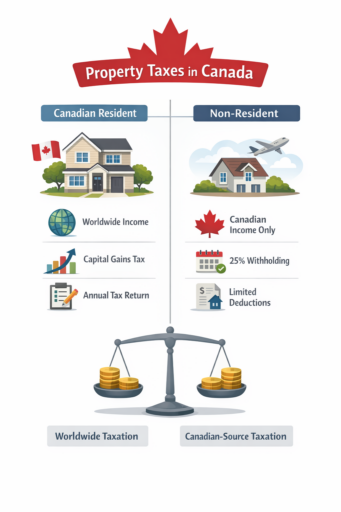
Your Canadian tax obligations hinge on whether you live in Canada or abroad: residents are taxed on worldwide income, while non-residents are taxed only on Canadian-source income.
| Aspect | Canadian Resident | Non-Resident |
| Income Tax | Taxed on worldwide income, including foreign rental and investment income | Taxed only on Canadian-source income, like rental income from Canadian property |
| Capital Gains | Gains from selling property are taxed, but the principal residence may be exempt | Gains from selling Canadian property are taxed; foreign property gains are generally not taxed |
| Rental Withholding | No special withholding; rental income reported on annual return | 25% withholding on gross rental income unless Section 216 election is filed |
| Deductions | Can deduct property taxes, mortgage interest, repairs, and other expenses against rental or business income | Can deduct property-related expenses only against Canadian-source rental income |
| Filing Requirement | Must file annual Canadian tax return | Must file only if earning Canadian-source income or disposing of property |
| Tax Treaties | Can claim foreign tax credits for taxes paid abroad | May benefit from reduced withholding under treaties with certain countries |
Conclusion
Owning Canadian property while living abroad is not just a real estate decision, as it creates an ongoing Canadian tax footprint.
The key risk for non-residents is not necessarily the tax itself, but failing to understand how withholding, filing requirements, and capital gains rules interact.
Most costly mistakes happen when owners assume that leaving Canada ends their obligations.
In reality, rental income, property sales, and even administrative steps like clearance certificates keep you connected to the Canadian tax system.
The difference between overpaying and optimizing often comes down to proactive filing and proper structuring.
When handled correctly, the system is manageable, but when ignored, it becomes expensive quickly.
FAQs
What is the 90% rule in Canada?
The 90% rule allows certain non-residents who earn at least 90% of their worldwide income from Canadian sources to claim specific personal tax credits similar to Canadian residents.
It typically applies to employment income and is less common for passive rental income.
Do I have to pay tax on foreign property in Canada?
Yes, if you are a Canadian tax resident, you must pay tax on income earned from foreign property.
No, if you are a non-resident of Canada. You generally do not pay Canadian tax on foreign property income.
How do I avoid capital gains tax on foreign property?
You generally cannot completely avoid capital gains tax on foreign property, but Canadian residents may reduce or eliminate it using the principal residence exemption or foreign tax credits.
Non-residents selling Canadian property must pay capital gains tax, though proper filing ensures tax is calculated on the actual gain.
What happens if you live outside of Canada for more than 6 months?
It is an immigration rule that allows most visitors to stay in Canada for up to six months unless a border officer sets a different departure date.
It governs how long you can legally remain in Canada as a visitor, not your tax obligations.
Pained by financial indecision?

Adam is an internationally recognised author on financial matters with over 830million answer views on Quora, a widely sold book on Amazon, and a contributor on Forbes.