Dubai and Abu Dhabi are top UAE business hubs, with Dubai excelling in international trade and tech, and Abu Dhabi standing out for stable, government-backed opportunities.
Choosing the best UAE jurisdiction for business requires understanding the unique advantages and limitations of each emirate in relation to business type, budget, and target market.
This article covers:
- What is the UAE business ecosystem?
- What are the 7 emirates of the UAE?
- Freezone vs mainland UAE
- Which business is most profitable in the UAE?
- What do you need to start a business in the UAE?
Key Takeaways:
- Dubai is ideal for international trade, tech, and high-exposure businesses.
- Abu Dhabi offers stability and government project opportunities but higher costs.
- Freezones provide 100% foreign ownership and tax benefits, mainland allows UAE-wide operations.
- Choosing the right emirate and setup is based on business type, market access, and cost efficiency.
My contact details are hello@adamfayed.com and WhatsApp +44-7393-450-837 if you have any questions. We also offer bespoke structuring solutions tailored to your situation.
The information in this article is for general guidance only, does not constitute financial, legal, or tax advice, and may have changed since the time of writing.

UAE Business Ecosystem Overview
The UAE has developed into a dynamic and diversified business ecosystem, combining strategic geographic positioning, investor-friendly regulations, and modern infrastructure.
Key sectors driving the economy include trade, tourism, finance, technology, logistics, and energy, with foreign direct investment reaching record levels in 2025 across multiple emirates.
Government initiatives, such as economic freezones, innovation hubs, and startup accelerators, support foreign ownership and simplify company formation.
Robust connectivity (air, sea, and digital) links the UAE to Asia, Europe, and Africa, making it a natural hub for regional and global operations.
Ease of doing business has improved steadily, supported by streamlined licensing, tax incentives in freezones, and regulatory reforms.
Together, these factors create a landscape where strategic sector alignment, regulatory compliance, and operational efficiency are critical for sustainable growth.
What are the 7 areas of the UAE?
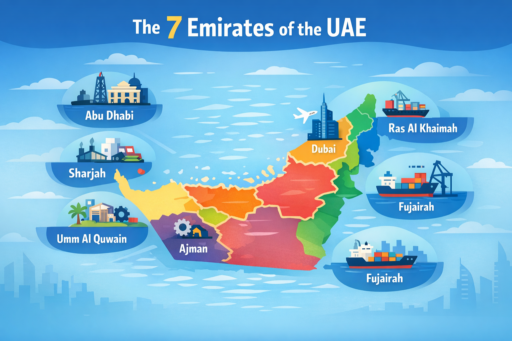
The UAE is made up of seven emirates, such as Abu Dhabi, Dubai, and Sharjah, each offering unique business opportunities, costs, and regulatory environments.
- Abu Dhabi – The capital and largest emirate, strong in energy, finance, and government services.
- Dubai – The commercial hub, ideal for trade, tourism, and technology startups.
- Sharjah – Known for manufacturing, education, and logistics.
- Ajman – Emerging for small-scale businesses and light industries.
- Ras Al Khaimah (RAK) – Attractive for cost-effective industrial setups.
- Fujairah – Focused on shipping, logistics, and import/export.
- Umm Al Quwain – Smaller market but growing in niche sectors like tourism and agriculture.
Which location is best for business?
Dubai and Abu Dhabi are the best UAE locations for business, offering international exposure, strong infrastructure, and government-backed opportunities.
Here’s an overview of the top UAE jurisdictions for business, including their advantages, drawbacks, and recommendations:
Dubai
Pros:
- Major global business hub: Dubai’s free zones like DMCC host over 26,000 registered companies, according to the official DMCC site. It accounted for about 15 % of Dubai’s foreign direct investment (FDI) in 2024, showing strong investor interest and ecosystem growth.
- Connectivity & infrastructure: Dubai International Airport handled a record 95.2 million passengers in 2025, as reported by North Shore News, linking the emirate to 291 destinations in 110 countries, which enhances trade, tourism, and business travel.
- 100 % ownership & tax benefits: Companies in many Dubai free zones enjoy full foreign ownership and 0 % corporate and personal tax, which boosts global competitiveness.
Cons:
- Higher costs: Office space and living costs in key commercial districts are above the UAE average, increasing initial expenses.
- Competitive market: Attractiveness to global firms also means more competition for talent and clients.
Recommendation:
Best for businesses targeting international markets, trade, e‑commerce, technology, tourism, and finance where global connectivity, deep talent pools, and scalable infrastructure are priorities.
Abu Dhabi
Pros:
- Economic powerhouse: Generates around 60 % of the UAE’s GDP, driven by energy, infrastructure, and sovereign-backed capital.
- Investment ecosystem: Home to major investors like Abu Dhabi Investment Authority and Mubadala Investment Company.
- Industrial & logistics: Zones such as Khalifa Industrial Zone Abu Dhabi (KIZAD) and Khalifa Port support large-scale industrial operations.
Cons:
- Smaller startup ecosystem: Fewer SMEs and tech startups compared to Dubai.
- Premium costs: Office and residential prices in prime districts are high.
Recommendation:
Best suited for energy, infrastructure, government-linked projects, industrial manufacturing, and capital-intensive ventures seeking long-term stability.
Sharjah
Pros:
- Cost-efficient setup: Business license and office costs are generally lower than Dubai, making it attractive for SMEs and startups.
- Industrial strength: Home to major industrial zones like Hamriyah Free Zone and Sharjah Airport International Free Zone (SAIF Zone), supporting manufacturing, warehousing, and logistics.
- Strategic proximity to Dubai: Direct access to Dubai’s ports and airports without paying Dubai-level operating costs.
Cons:
- Lower visibility: Less recognized internationally than Dubai.
- Limited tech & finance: Fewer venture capital networks and startup accelerators.
Recommendation:
Best suited for manufacturing, logistics, trading, education services, and SMEs seeking cost-effective operations while remaining close to Dubai’s commercial market.
Ajman & Ras Al Khaimah (RAK)
Pros:
- Low-cost entry point: Among the most affordable emirates for trade licenses, office space, and warehouse rentals, making them attractive for startups and SMEs.
- Established free zone ecosystems: Ajman Free Zone and RAK Free Trade Zone (now under RAKEZ) offer simplified company formation, 100% foreign ownership, and flexible office solutions.
- Growing industrial base: Ras Al Khaimah Economic Zone (RAKEZ) hosts thousands of companies across manufacturing, trading, and services, supporting light to medium industrial activity.
Cons:
- Smaller markets: Domestic markets are limited compared to Dubai and Abu Dhabi.
- Limited global reach: Lower connectivity and brand visibility for high-end international markets.
Recommendation:
Well-suited for cost-sensitive startups, trading firms, light manufacturing, consultancy services, and SMEs seeking affordable setup costs with room for gradual scaling.
Fujairah
Pros:
- Strategic maritime location: Positioned on the UAE’s east coast along the Gulf of Oman, providing direct access to major international shipping routes outside the Strait of Hormuz.
- Port and logistics strength: Home to Port of Fujairah, one of the world’s largest bunkering hubs and a key re-export gateway for fuel and cargo.
- Cost advantage: Generally lower warehouse and property costs compared to Dubai, supporting logistics and storage operations.
Cons:
- Small consumer base: Less local demand than Dubai or Abu Dhabi.
- Limited ecosystem: Fewer opportunities in tech, finance, and corporate services.
Recommendation:
Best suited for import/export companies, shipping firms, fuel trading, marine services, and logistics-focused businesses that benefit from port access and lower operating costs.
Umm Al Quwain
Pros:
- Low-cost business setup: Among the most affordable emirates for trade licenses, office space, and small industrial plots.
- Accessible free zone option: Umm Al Quwain Free Trade Zone offers simplified registration, flexible office solutions, and 100% foreign ownership for many activities.
- Emerging niche sectors: Gradual growth in tourism, aquaculture, and small-scale agriculture supported by the emirate’s coastal and natural resources.
Cons:
- Limited market size: Small domestic customer base.
- Fewer support networks: Minimal venture capital and corporate service providers.
Recommendation:
Best suited for small businesses, micro-enterprises, niche tourism operators, online businesses, and startups prioritizing low overhead and flexible licensing over large-scale market exposure.
Key Considerations:
- Your choice should balance cost efficiency, market access, and operational flexibility.
- Many investors adopt a hybrid approach: setting up in a freezone for tax benefits while maintaining a mainland branch to operate UAE-wide.
What is the difference between Freezone and Mainland in the UAE?
A freezone company operates within a designated economic zone with full foreign ownership and tax advantages, while a mainland company is licensed to trade directly across the UAE market without geographic restrictions.
Understanding this distinction is critical when structuring your business:
• Freezone:
- 100% foreign ownership
- 0% personal income tax and corporate tax incentives (subject to UAE corporate tax rules where applicable)
- Generally restricted from conducting direct business in the UAE mainland without a distributor or branch
• Mainland:
- May require a local service agent for certain regulated activities (many sectors now allow 100% foreign ownership)
- Can trade freely anywhere in the UAE
- Greater eligibility for government contracts and large domestic projects
Your choice should align with your intended customer base, operational scope, and long-term expansion strategy.
Which is the best business to start in the UAE?
The UAE’s most promising business opportunities include e‑commerce, tourism, real estate, tech, health, and logistics, all backed by strong growth forecasts and market demand.
- E‑commerce and retail: The UAE’s e‑commerce market is forecast to reach about USD 21.01 billion by 2031, driven by high internet and smartphone penetration along with expanding digital payment adoption.
- Tourism and hospitality: Tourism remains a key growth engine, with the UAE aiming to attract 40 million hotel guests by 2031 under its Tourism Strategy, supporting hotels, travel services, and experience‑based ventures.
- Real estate development and property management: In the first half of 2025, real estate transactions in the UAE topped AED 431 billion, highlighting continued demand for residential and commercial spaces.
- Tech startups and fintech: The UAE fintech market is valued at around USD 52.07 billion in 2026 and is projected to reach about USD 90.06 billion by 2031, reflecting strong growth driven by digital payments, mobile banking, and open‑finance expansion.
- Health and wellness services: Healthcare and medical tourism are expanding rapidly, with medical tourism projected to grow at a CAGR of ~8.7 % through 2033.
- Logistics and import/export: The UAE’s strategic location has propelled non‑oil foreign trade past AED 1.7 trillion in H1 2025, underscoring demand for freight, warehousing, and supply chain businesses.
Entrepreneurs should align market demand, capital investment requirements, and regulatory compliance when selecting the ideal business to start, ensuring both growth potential and operational fit within the UAE’s dynamic economy.
What do I need to start a business in the UAE?
To open a business in the UAE, a valid passport and visa, a trade license, a registered office, and a clear corporate structure are required.
Basic requirements include:
- Valid passport and visa for the owner(s): Needed to legally register and operate a business in the UAE.
- Business plan and corporate structure: Outlines your company’s objectives, ownership, and management framework for authorities and banks.
- Trade license (freezone or mainland): Official permission to conduct business in a specific sector; determines operational scope and legal obligations.
- Office space or flexi-desk for registration: Physical or virtual office is required to secure your license; some freezones allow shared/flexi-desk options.
- Bank account and initial capital (depending on license type): Essential for company operations; certain licenses have minimum capital requirements that must be deposited.
Certain industries may require special approvals or additional permits.
Is the UAE a good place to start a business?
The UAE is an excellent place to set up a business, offering strategic access to global markets, tax incentives through freezones, advanced infrastructure, and a skilled, multinational workforce.
The country’s location connects Asia, Europe, and Africa, while business-friendly regulations and robust logistics support growth across industries.
Freezones provide full foreign ownership and tax advantages, making setup easier for entrepreneurs.
However, challenges remain, including higher costs in prime cities and the need to navigate regulatory compliance, particularly for mainland operations.
Conclusion
The UAE’s business environment combines global connectivity, regulatory incentives, and diverse market opportunities, creating a platform for both established firms and innovative startups.
Long-term success relies on anticipating industry trends and identifying emerging sectors where demand is growing.
Strategic use of freezones alongside mainland operations can enhance operational flexibility, access to talent, and market reach.
Ultimately, businesses that align resources with local strengths, maintain agility, and plan for sustainable growth are best positioned to thrive in this dynamic and competitive economy.
FAQs
Is the UAE an offshore jurisdiction?
While certain freezones and offshore entities allow 100% foreign ownership and tax advantages, the UAE is no longer a traditional offshore jurisdiction.
It is a fully regulated country aligned with global compliance frameworks, and entities must meet economic substance, reporting, and regulatory requirements.
Where is the easiest country to start a business?
Countries such as New Zealand, Singapore, Estonia, and UAE freezones are among the easiest to start a business due to streamlined registration, low bureaucracy, minimal capital requirements, and digital filing systems.
These jurisdictions allow fast company setup, often online, and generally permit full foreign ownership in most sectors.
Is it better to buy property in the free zone area or mainland UAE?
Buying mainland property is better for long-term investment, resale potential, and access to the entire UAE market.
Freezone property is suitable primarily for business-linked use, with simpler legal procedures but limited market access.
Pained by financial indecision?

Adam is an internationally recognised author on financial matters with over 830million answer views on Quora, a widely sold book on Amazon, and a contributor on Forbes.