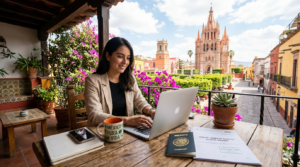
While Mexico does not have a dedicated digital nomad visa, remote workers can use the country’s Temporary Resident Visa to live and work legally while earning income from abroad.
This route effectively functions as a digital nomad visa in Mexico, allowing professionals to enjoy cities like Mexico City, Playa del Carmen, and Guadalajara, experience the local lifestyle, and stay long-term without taking employment with a local company.
This article covers:
- Who is eligible for a temporary resident permit?
- How to get a Mexico digital nomad visa?
- How much is a digital nomad visa for Mexico?
- How long can you stay in Mexico with a temporary residency?
Key Takeaways:
- Total costs for the Temporary Resident Card range from $350–$1,000 USD.
- Processing takes a few weeks to several months.
- Digital nomads can stay in Mexico typically up to 1 year, with renewal options.
- Income proof, employment documentation, and minimum earnings are required.
My contact details are hello@adamfayed.com and WhatsApp +44-7393-450-837 if you have any questions.
For digital nomad or residence visas that require income, assets, or qualifying investments, we can help structure suitable investment solutions that may align with those requirements, depending on your circumstances.
The information in this article is for general guidance only. It does not constitute financial, legal, or tax advice, and is not a recommendation or solicitation to invest. Some facts may have changed since the time of writing.

What is a digital nomad visa in Mexico?
The digital nomad visa in Mexico refers to a Temporary Resident Visa that allows foreign remote workers to live in Mexico while working for employers or clients based outside the country.
Unlike a traditional employment visa, this pathway lets remote professionals, freelancers, and entrepreneurs legally reside in Mexico for extended periods without taking local jobs, as long as their income comes from abroad.
It emerged in response to the growing global trend of remote work, where professionals seek flexible, long-term stays abroad without relocating their employers.
Rather than create an entirely new category, Mexican immigration policy has adapted by allowing digital nomads to use the existing Temporary Resident Visa framework to meet this demand.
Mexico’s approach reflects its aim to attract remote workers who contribute to the local economy without competing for Mexican jobs.
It offers stability for long‑term stays beyond typical tourist limits while bolstering tourism, rental markets, and local spending.
How long can digital nomads stay in Mexico?
Digital nomads in Mexico can initially stay for up to 1 year under the Temporary Resident Visa, which is the primary pathway used for remote workers.
After the first year, the visa can typically be renewed annually for up to four years total, giving remote professionals flexibility to plan long-term stays.
Unlike a standard tourist visa, which only allows up to 180 days, this visa ensures legal residency without leaving the country every few months.
The duration may vary slightly depending on the consulate where the application is processed, so it’s important to check specific local requirements before applying.
How to get temporary residency visa in Mexico?
To get a digital nomad visa in Mexico, you must apply for a Temporary Resident Visa for remote workers at a Mexican consulate in your home country and provide all required documentation.
The process generally involves:
1. Apply at a consulate – Submit your visa application at a Mexican consulate in your home country.
2. Provide income proof – Show bank statements, proof of stable foreign income, and employment or freelance contracts.
3. Submit identification – Present a valid passport and other required ID documents.
4. Attend an interview – Participate in a consular interview if requested.
5. Enter and register – After approval, enter Mexico and register with local immigration authorities to complete your residency.
Who can get a temporary resident permit?
To qualify for Mexico’s digital nomad visa, you must provide proof of foreign income, official identification, and other documents required by Mexican immigration for temporary residency.
These usually include:
- Valid passport – Your passport must be current and valid for the duration of your stay.
- Proof of income or savings – Demonstrate stable foreign income, typically between $2,600–$4,400 USD per month for the last 6 months, or show a bank or investment balance of roughly $43,000–$74,000 USD over the past year. These ranges reflect differences in consulate requirements and currency calculations.
- Employment documentation – Provide remote employment contracts or freelance agreements showing your work is conducted outside of Mexico.
- Completed application form – Fill out the official visa application accurately.
- Photos and fees – Submit passport-sized photos and pay the required consular fees for the visa and Temporary Resident Card.
How much does it cost to get a temporary resident visa in Mexico?
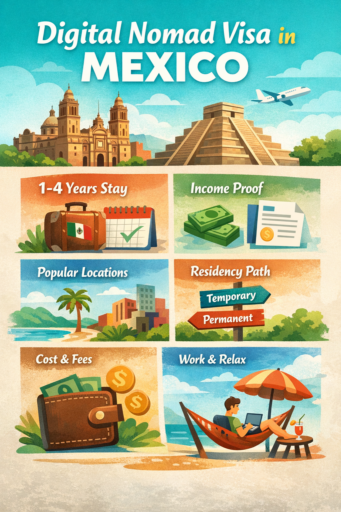
The main expenses for remote workers using Mexico’s Temporary Resident Visa generally range from $350–$1,000 USD, covering consular fees, the Temporary Resident Card, and typical document or processing costs.
Additional costs: Document preparation (translations, notarizations, apostilles), passport photos, travel to the consulate, and optional legal assistance.
Consular visa application fee: Around $50–$60 USD, depending on the consulate and exchange rates.
Temporary Resident Card fee (in Mexico): Typically $280–$630 USD, based on the residency duration.
How long does it take to process a digital nomad visa?
Processing a digital nomad visa in Mexico generally takes 1 to 3 months, based on the consulate where you apply and how complete your application is.
Some consulates may schedule an in-person interview, which can add additional time to the process.
Submitting all required documentation accurately and in the correct format can help prevent delays.
Once approved, you typically have a limited window to enter Mexico and finalize registration with the Instituto Nacional de Migración (INM), after which your Temporary Resident Card will be issued.
What are the benefits of being a digital nomad in Mexico?
Living in Mexico as a digital nomad offers remote workers the chance to enjoy extended stays in vibrant cities like Mexico City, Playa del Carmen, and Guadalajara while legally working for foreign clients.
Benefits of being a digital nomad in Mexico include:
- Affordable cost of living – Lower expenses compared to the US or Europe make it easier to maintain a high quality of life.
- Vibrant culture and diverse cities – Rich history, food, music, and festivals provide a stimulating environment for long-term stays.
- Warm climate and access to nature – From beaches to mountains, Mexico offers outdoor activities year-round.
- Strong expat communities and coworking spaces – Easy networking and collaboration opportunities for remote professionals.
- Easy access to North and Central America – Convenient travel to nearby countries for leisure or work trips.
What are the disadvantages of being a digital nomad in Mexico?
Digital nomads living in Mexico may face safety concerns in certain states, complex immigration procedures, and infrastructure differences compared to the US or Europe.
Some disadvantages of being a digital nomad in Mexico may include:
- Safety concerns – Certain regions have higher crime rates, so careful research and local awareness are essential.
- Bureaucratic processes – Navigating visa applications, renewals, and registrations with Mexican authorities can be time-consuming and paperwork-heavy.
- Variable healthcare quality – Access to high-quality medical care depends heavily on whether you are in a major city or a smaller town.
- Internet connectivity issues – Remote or rural areas may experience slower or less reliable internet service.
- Currency fluctuations – Changes in exchange rates can impact budgeting, especially for those earning in foreign currencies.
Is Mexico cracking down on digital nomads?
Mexico is not officially cracking down on digital nomads as a group, and there’s no national policy targeting remote workers specifically.
Remote workers still largely enter Mexico using the Temporary Resident Visa or tourist stays and contribute to the local economy without facing enforcement simply for being digital nomads.
However, there have been indirect policy changes and pressures in some places:
- Some Mexican cities, like Mexico City, have seen public protests linking rising rents and gentrification to the influx of foreigners, including remote workers, prompting discussions about housing regulations.
- Immigration officers are exercising more discretion at borders, and relying on tourist stays for long-term nomad use (e.g., repeatedly getting 180-day tourist admissions) is less predictable than in the past.
These shifts reflect broader immigration enforcement tightening and local backlash to overcrowding or housing cost increases, not a federal crackdown specifically on digital nomads.
In short: as long as you follow the visa rules and maintain proper documentation, Mexico continues to be open to remote workers, but planning your stay wisely and legally is increasingly important.
Long‑Term Residency Strategy in Mexico
In recent years, Mexico City, Playa del Carmen, and other popular nomad hubs have seen the average stay of digital nomads exceed 50 weeks, demonstrating that remote workers are increasingly transitioning from short-term visits to long-term residency.
Rather than simply passing through, many are establishing deeper ties to local communities, integrating into the housing market, and planning extended stays that align with the Temporary Resident Visa framework.
Transitioning from Temporary to Permanent Residency
Mexico’s Temporary Resident status is typically valid for up to four years, after which long-term nomads become eligible to apply for Permanent Resident status.
This pathway removes the need for frequent renewals, provides stability for indefinite stays, and supports activities like opening local bank accounts or purchasing property.
Renewal Planning and Timing
Temporary residency must be renewed before expiration, and careful timing is crucial to avoid complications or additional fees.
Planning ahead, including ensuring continued proof of income or savings, helps maintain uninterrupted legal status.
Property, Lifestyle, and Long-Term Settlement
Many digital nomads eventually pursue longer-term housing options or property ownership.
Foreigners can buy property in Mexico, though certain coastal and border areas require a fideicomiso (bank trust) arrangement.
Residency status influences settlement choices, integration into local life, and long-term planning.
Retirement and Future Considerations
Mexico is also popular for blending remote work with retirement planning.
Using the Temporary Resident pathway strategically allows remote workers to combine professional flexibility, cultural immersion, and long-term lifestyle goals, potentially leading to permanent residency and a stable base for the future.
Conclusion
Mexico remains one of the most practical and accessible destinations for remote workers seeking long-term residency without overly complex immigration barriers.
The key consideration is whether Mexico’s Temporary Resident framework aligns with an individual’s income structure, mobility needs, and long-term objectives; for many remote professionals, it does.
At the same time, Mexico is evolving.
Rising income thresholds, stricter border discretion, housing pressures in popular cities, and shifting local sentiment are gradually shaping how foreign remote workers integrate into the country.
Digital nomads who approach Mexico strategically, securing proper residency, understanding potential tax exposure, and selecting locations carefully, are far more likely to establish a stable and sustainable presence.
Ultimately, Mexico can serve as an outstanding base for remote work, but long-term success depends on regulatory compliance, financial preparedness, and cultural awareness rather than simply pursuing a lower cost of living.
FAQs
Does Mexico tax digital nomads?
Mexico taxes residents on worldwide income, but digital nomads on temporary visas may not be considered tax residents if their stay is under 183 days per year.
However, it is important to check individual circumstances and consult a tax professional to avoid double taxation.
Can I work remotely in Mexico as a US citizen?
Yes, US citizens can work remotely in Mexico with the appropriate visa, such as the digital nomad visa or temporary resident visa, while maintaining legal compliance.
Why are people moving away from Mexico?
Some people move away due to safety concerns, cost of healthcare in certain regions, or job opportunities elsewhere.
Others seek more stable infrastructure or tax environments.
Can I retire in Mexico on $3,000 a month?
Yes, $3,000 a month is generally sufficient to retire comfortably in many parts of Mexico, covering housing, food, healthcare, and leisure activities.
Costs will vary by city or region.
Is Mexico friendly to immigrants?
Mexico is generally immigrant-friendly, offering several visa options for retirees, remote workers, and skilled professionals.
Expat communities are widespread, and many cities provide resources to support newcomers.
Pained by financial indecision?

Adam is an internationally recognised author on financial matters with over 830million answer views on Quora, a widely sold book on Amazon, and a contributor on Forbes.