Second citizenship for Kenyans usually involves obtaining residency abroad and later naturalizing in countries such as Canada or Portugal while retaining Kenyan nationality.
Under Kenyan law, dual citizenship is permitted, allowing citizens to legally hold two passports and benefit from the rights and opportunities available in both countries.
This article covers:
- What is the easiest country to get a second passport in?
- Do you have to declare dual citizenship in Kenya?
- What are the pros and cons of dual citizenship for Kenyans?
- How good is a Kenyan passport?
Key Takeaways:
- Kenya permits dual citizenship if properly declared.
- Canada and Portugal are common second citizenship destinations for Kenyans.
- Dual citizenship expands travel, work, and investment options.
- Failing to declare dual citizenship in Kenya can lead to legal penalties.
My contact details are hello@adamfayed.com and WhatsApp +44-7393-450-837 if you have any questions.
For digital nomad or residence visas that require income, assets, or qualifying investments, we can help structure suitable investment solutions that may align with those requirements, depending on your circumstances.
The information in this article is for general guidance only. It does not constitute financial, legal, or tax advice, and is not a recommendation or solicitation to invest. Some facts may have changed since the time of writing.

What is second citizenship?
Second citizenship for Kenyans means legally becoming a citizen of another country while still retaining Kenyan nationality.
This allows a Kenyan to hold two passports and be recognized as a citizen in both countries at the same time.
Second citizenship can be obtained through several pathways. Each pathway has its own eligibility rules, timelines, and legal requirements.
For many Kenyans, second citizenship is not just about having another passport.
It can open access to broader employment opportunities, stronger travel mobility, and the ability to live or study abroad without needing visas or long immigration processes.
It may also allow easier access to healthcare systems, education programs, and financial services in another country.
However, holding second citizenship also means being subject to the laws and responsibilities of both countries.
This may include complying with immigration regulations, tax rules, or legal obligations depending on the jurisdictions involved.
Because of this, Kenyans seeking another nationality should understand both Kenyan laws on dual citizenship and the citizenship requirements of the country they plan to acquire.
Pathways to Second Citizenship for Kenyans
Kenyans obtain second citizenship through naturalization, ancestry, marriage, or investment programs, with each pathway offering specific requirements, timelines, and benefits.
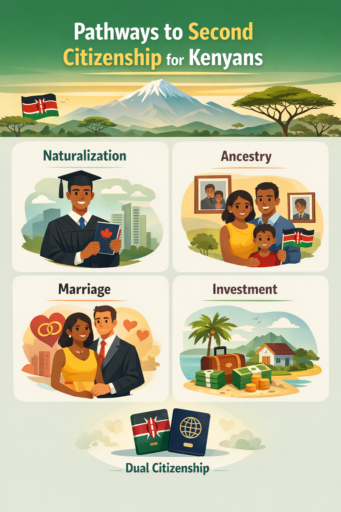
1. Naturalization
- Common for Kenyans living abroad for work or family.
- Countries like Canada, Australia, New Zealand, and Portugal allow citizenship after 3–10 years of permanent residence.
- Requires language skills, employment stability, and good character.
2. Descent or Ancestry
- Children born abroad to Kenyan parents may hold dual citizenship.
- Countries like Ireland, Italy, and the UK offer citizenship through ancestry without long residency.
3. Marriage
- Marriage to a foreign national can grant citizenship after 2–5 years.
- Countries like Canada and Portugal have accelerated spousal pathways.
4. Investment
- Caribbean nations like St. Kitts & Nevis and Antigua & Barbuda offer fast citizenship via investment.
- Minimal residency required, but financial and due diligence obligations are strict.
Which country is best for second citizenship for Kenyans?
Canada is often considered the best country for second citizenship for Kenyans owing to its strong, visa-friendly passport, a stable economy with opportunities for skilled workers, and a welcoming Kenyan diaspora that helps new immigrants settle quickly.
What makes Canada especially attractive to Kenyans is its pathways for professionals and families, allowing them to maintain ties to Kenya while accessing high-quality education, healthcare, and business opportunities abroad.
The main challenges include meeting residency requirements, demonstrating language proficiency, and navigating the point-based immigration system.
Other countries popular for second citizenship for Kenyans include:
- Portugal – Offers citizenship through investment or long-term residence, granting visa-free access across the EU. It requires several years of residency and some financial commitment.
- United States – Citizenship offers economic opportunities and global mobility, but the naturalization process is long, and tax obligations may apply.
- Caribbean countries (St. Kitts & Nevis, Antigua and Barbuda) – Offer fast, investment-based citizenship with minimal residency, ideal for Kenyans seeking quick access to visa-free travel.
- Australia – Offers citizenship through long-term residence for skilled professionals; strong economy and quality of life. It has a point-based immigration system similar to Canada.
- New Zealand – Another skilled-migration-friendly country with a high standard of living, work opportunities, and eventual citizenship after several years of residence.
- Germany – While naturalization requires residence and language proficiency, Germany passport provides strong EU benefits and is attractive for professionals in tech, business, and research.
- Ireland – Citizenship through ancestry or residency is possible. Ireland has a strong passport for travel, access to the EU, and an English-speaking environment.
- United Kingdom – For Kenyans with historical or family ties, UK citizenship offers strong mobility, work, and education opportunities. Naturalization requires residence and sometimes English-language proficiency.
Choosing the right country for a second citizenship depends on your priorities, such as travel freedom, economic opportunities, investment options, and ease of immigration.
For many Kenyans, the appeal of countries like Canada, Australia, and New Zealand lies in their friendly pathways for skilled professionals, reflecting Kenya’s strong pool of educated and highly skilled workers who seek global opportunities.
By considering both personal goals and country-specific requirements, Kenyan applicants can select a second citizenship that maximizes benefits while maintaining ties to their home country.
Which country has the most Kenyan immigrants?
The United States has the largest Kenyan immigrant population in the world, with around 157,000 migrants, making it the top destination for Kenyans living abroad.
Following closely is the United Kingdom, home to about 139,000 Kenyan immigrants as of recent estimates.
These Western countries attract Kenyans for reasons including higher education, employment opportunities, and established diaspora communities that help new arrivals integrate.
Canada also hosts a significant number of Kenyan immigrants (around 29,000), drawn by its welcoming immigration policies and strong job market.
Beyond these, many Kenyans live in African countries like Uganda and South Africa, as well as Australia and parts of Europe, reflecting diverse migration patterns.
Overall, the concentration of Kenyan immigrants in the US and UK underscores these countries’ continued appeal for work, study, and long‑term settlement.
What is the easiest country to immigrate to from Kenya?
Canada is widely considered the easiest country for Kenyans to immigrate to, especially skilled professionals, due to its structured point-based immigration system and clear pathways to permanent residency.
The country evaluates applicants based on education, work experience, language proficiency, and age, making it accessible for many Kenyan professionals.
Other countries like Australia and New Zealand also offer point-based systems for skilled workers, while Caribbean nations such as St. Kitts & Nevis or Antigua and Barbuda provide fast investor-based migration with minimal residency requirements.
The ease of immigration depends on factors like processing times, residency obligations, eligibility requirements, and support for integration, including existing Kenyan diaspora communities.
While Canada may take a few years to transition from permanent residency to citizenship, its combination of clear criteria, predictable processes, and solid options for skilled workers makes it a practical first choice for Kenyans planning to move abroad.
Does Kenya allow dual citizenship?
Yes, Kenya allows dual citizenship under the 2010 Constitution and the Kenya Citizenship and Immigration Act of 2011.
These laws permit Kenyan citizens to acquire citizenship in another country while still retaining their Kenyan nationality.
Dual citizens can still hold a Kenyan passport, own property, and live or work in Kenya without being treated as foreigners.
However, certain high-level public offices may require exclusive Kenyan citizenship.
Who qualifies for dual citizenship in Kenya?
Kenyan citizens by birth can qualify for dual citizenship if they acquire another nationality later in life.
With Kenyan citizenship, individuals do not automatically lose it when becoming citizens of another country.
Children born outside Kenya to at least one Kenyan parent may also be eligible for Kenyan citizenship.
In many cases, they can hold the citizenship of their country of birth while maintaining their legal status as Kenyan citizens.
Foreign nationals who later become Kenyan citizens through naturalization or marriage may also retain their original nationality if their home country permits it.
Because dual citizenship involves two legal systems, eligibility ultimately depends on the citizenship rules of both countries involved.
What are the advantages of dual citizenship to a Kenyan?
For a Kenyan, holding dual citizenship allows strong ties to Kenya while accessing opportunities abroad, such as education, employment, and business in countries with stronger economies.
Dual citizenship offers several advantages:
- Freedom to live, work, and own property in Kenya and another country, which is especially valuable for diaspora Kenyans who want to invest back home.
- Access to healthcare, education, and social benefits abroad, giving families better schooling options and medical coverage that may be limited in Kenya.
- Easier international travel with multiple passports, allowing Kenyans to enter countries that have stricter visa rules for Kenyan passport holders.
- Business and investment opportunities in both countries, including the ability to set up companies, acquire real estate, or engage in cross-border trade.
- Protection against political or economic instability, providing Kenyans with a safety net if crises affect Kenya’s economy or governance.
What are the disadvantages of dual citizenship in Kenya?
The main disadvantages of dual citizenship for Kenyans are potential tax obligations and legal complexities that arise from being subject to the laws of two countries.
Other drawbacks include:
- Complex property and inheritance laws, which may differ between Kenya and the other country, potentially creating legal disputes.
- Restrictions on holding certain government or security positions in Kenya, as some offices require exclusive Kenyan nationality.
- Administrative requirements, such as declaring dual citizenship to Kenyan authorities, with penalties if not done properly.
While dual citizenship offers many benefits, these challenges require careful planning to avoid financial or legal complications.
What happens if I don’t declare dual citizenship in Kenya?
If a Kenyan fails to declare dual citizenship, they risk legal consequences including fines, penalties, or even challenges to their Kenyan nationality.
The Kenyan government requires all dual citizens to submit a formal declaration to the Department of Immigration Services, which ensures their status is properly recorded and recognized.
Failure to comply can create difficulties with passport renewals, property ownership, or access to government services in Kenya.
In extreme cases, authorities could question the validity of your Kenyan citizenship, affecting your ability to work in government positions or vote.
Properly declaring dual citizenship not only avoids these risks but also ensures that a Kenyan can legally enjoy the benefits of both nationalities without future complications.
Conclusion
Holding a second citizenship can open doors that extend beyond travel, offering access to education, business, and security in multiple countries.
Kenyans considering this step should weigh each country’s legal requirements, economic opportunities, and ease of integration carefully.
Skilled professionals, investors, and families can benefit the most when choices align with personal goals and long-term plans.
Done thoughtfully and in compliance with Kenyan law, dual citizenship can become a practical advantage that supports both global mobility and local ties.
FAQs
Can an American have dual citizenship with Kenya?
Yes, an American can hold dual citizenship with Kenya, provided they follow Kenya’s declaration requirements.
Which African countries do not allow dual citizenship?
Some African countries, such as Ethiopia, Tanzania, and Botswana, generally restrict or prohibit dual citizenship.
Is Kenyan passport strong?
The Kenyan passport allows visa-free or visa-on-arrival access to over 70 countries, making it moderately strong, though second citizenship can expand travel freedom significantly.
Pained by financial indecision?

Adam is an internationally recognised author on financial matters with over 830million answer views on Quora, a widely sold book on Amazon, and a contributor on Forbes.