South Africans are increasingly exploring investment migration programs like the Portugal Golden Visa to gain residency or citizenship in stable, globally connected countries.
Investment migration provides pathways to secure international mobility, business opportunities, and family security through qualifying financial contributions.
This article covers:
- Why are people moving from South Africa?
- Which country has the most South Africans outside South Africa?
- What is the easiest country to immigrate to as a South African?
- Can you get multiple dual citizenships?
Key Takeaways:
- Investment migration gives South Africans fast-tracked residency or citizenship abroad.
- Top destinations include Portugal, Malta, and the UAE, with options in the Caribbean and Europe.
- South Africans can hold multiple citizenships while keeping their South African passport.
- Citizenship-by-investment programs offer stronger passports and greater global mobility.
My contact details are hello@adamfayed.com and WhatsApp +44-7393-450-837 if you have any questions.
For digital nomad or residence visas that require income, assets, or qualifying investments, we can help structure suitable investment solutions that may align with those requirements, depending on your circumstances.
The information in this article is for general guidance only. It does not constitute financial, legal, or tax advice, and is not a recommendation or solicitation to invest. Some facts may have changed since the time of writing.

Why are so many South Africans immigrating?
Many South Africans are emigrating to seek better safety, economic stability, and global opportunities.
BusinessTech data shows that over 1 million South Africans currently live abroad, with roughly 108 000 leaving between 2020 and 2024, averaging about 27 000 per year.
Key factors driving this trend include:
- Economic pressures: High unemployment, above 30%, pushes skilled professionals to seek secure jobs abroad.
- Safety and quality of life concerns: Crime and political uncertainty motivate families to relocate.
- Future prospects: Access to better education, healthcare, and stable governance attracts middle- and high-net-worth individuals.
- Skill-based migration: Surveys show that the most educated and financially able South Africans are most likely to emigrate.
For those with resources, investment migration offers a legal and structured way to gain residency or citizenship in stable, globally connected countries, providing access to travel, education, and business opportunities while safeguarding family security.
Where are most South Africans moving to?
Most South Africans who emigrate settle in the United Kingdom, Australia, the United States, New Zealand and Canada, with growing communities also in Europe and the Middle East.
According to the latest migrant stock data, the UK hosts the largest South African expatriate population (about 245 000+ residents), followed by Australia (213 000+) and the US (161 000+), with New Zealand and Canada also important destinations.
These destinations are popular not just because of language and cultural ties, but also due to stronger economies, higher wages, more stable governance, and better public services.
Such factors appeal to both skilled professionals and families seeking long‑term security.
In addition to these traditional countries:
- Europe, especially the Netherlands and Portugal, has seen notable growth in South African residents.
- The United Arab Emirates has long been home to an estimated South African community, particularly in cities like Dubai and Abu Dhabi.
For South Africans pursuing investment migration, countries like Portugal and Malta are also attractive.
Their residency‑by‑investment and citizenship‑by‑investment programs provide pathways to EU residence and travel freedom, even if they don’t yet have the largest diaspora numbers.
What is the easiest country for South Africans to immigrate to?
Portugal, the United Arab Emirates, and Malta are often considered among the easiest countries for South Africans to immigrate to through investment migration.
These destinations offer structured investor visa programs, relatively clear requirements, and faster processing compared with traditional immigration pathways.
In general, a country is considered easy to immigrate to if it offers:
- Transparent application requirements and predictable approval processes
- Reasonable investment thresholds compared with other programs
- Fast processing times for residency permits
- Flexible or minimal physical residency requirements
- A pathway to permanent residency or citizenship
Portugal is widely regarded as one of the most accessible European options for South Africans pursuing investment migration.
The country offers a well-known residency pathway for foreign investors and has relatively flexible stay requirements compared with many other immigration routes.
It is particularly attractive because residency can eventually lead to Portuguese citizenship, giving successful applicants access to a European Union passport and broader global mobility.
The United Arab Emirates (UAE) is another popular destination for South Africans looking for a relatively straightforward relocation option.
Investor visa pathways allow foreign nationals to obtain long-term residency through business or property investment.
The UAE’s strong economy, tax-friendly environment, and role as a global business hub make it especially appealing to entrepreneurs and internationally mobile professionals.
Malta also stands out as a practical option for investment migration.
The country offers permanent residency pathways designed for international investors, providing access to living and traveling within Europe.
For many applicants, Malta’s stable political environment, strong financial sector, and English-speaking population make the transition easier.
Other destinations such as Cyprus and Greece may also appeal to South Africans seeking residency through investment, particularly because they provide access to residence permits within Europe.
Top Residency by Investment for South Africans
Residency-by-investment programs allow South Africans to obtain legal residence in another country by making qualifying financial investments such as funds, real estate, or business ventures.
These programs are designed to attract foreign capital while giving investors access to new markets, travel mobility, and lifestyle opportunities.
Some of the top residency by investment options for South Africans include:
- Portugal Golden Visa – Investors can qualify by investing in approved Portuguese investment funds or other eligible capital investments, typically starting from €500,000. The program grants residency with minimal stay requirements and can eventually lead to Portuguese citizenship.
- Malta Permanent Residence Programme (MPRP) – Investors obtain permanent residency through a combination of property investment or rental and government contributions. Property purchases generally start around €375,000, while rental options require about €14,000 per year, along with additional fees and contributions.
- United Arab Emirates Investor Visa – Long-term residency can be obtained through property investment or business ownership, with property investment thresholds commonly starting around AED 2 million (about $545,000) for long-term Golden Visa eligibility.
- Cyprus Permanent Residency – Investors can obtain permanent residency by purchasing qualifying real estate worth at least about €300,000, making it one of the more straightforward EU residency-by-investment options.
Top Citizenship by Investment for South Africans
Citizenship-by-investment programs allow South Africans to obtain a second passport by making qualifying financial contributions to another country.
These programs typically provide benefits such as expanded visa-free travel, international business opportunities, and greater global mobility.
Some of the top citizenship by investment options for South Africans include:
- Saint Kitts and Nevis Citizenship by Investment – One of the longest-running programs in the world. Citizenship is available through a government contribution starting at about $250,000 to the Sustainable Island State Contribution fund or real estate investment from about $325,000 in an approved development.
- Dominica Citizenship by Investment – Known as one of the more affordable programs, offering citizenship through a government donation starting at about $200,000 or an approved real estate investment.
- Antigua and Barbuda Citizenship by Investment – Citizenship can be obtained through a government donation starting around $230,000, a real estate investment, or a qualifying business investment. (Processing usually takes several months.)
- Malta Citizenship by Naturalization for Exceptional Services – A more complex pathway that requires significant economic contributions starting around €600,000–€750,000, along with property commitments and residency before naturalization.
These programs are particularly attractive for South Africans seeking stronger passports, expanded travel freedom, and greater flexibility for international business and lifestyle planning.
Can South Africans hold multiple citizenships?
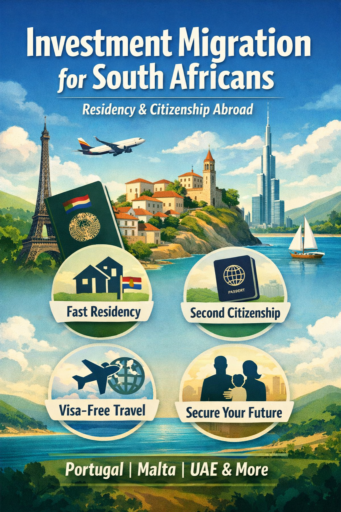
Yes, South Africans can hold multiple citizenships.
South Africa allows dual or multiple nationality, meaning South Africans may acquire foreign citizenship while retaining their South African passport.
However, South African citizens must apply for permission to retain their citizenship before acquiring another nationality; otherwise, they may automatically lose their South African citizenship under the law.
For those who follow the proper process, holding multiple citizenships can offer significant advantages.
It allows South Africans to maintain their legal status and rights at home while benefiting from the travel access, economic opportunities, and security that another passport may provide.
Dual citizens must still comply with certain South African legal obligations, including using their South African passport when entering or leaving the country and meeting applicable tax and administrative requirements.
Because of these rules, many South Africans pursuing investment migration carefully plan their second citizenship strategy to ensure they preserve their South African nationality while gaining the benefits of an additional passport.
Strategic Approaches for South Africans
One common strategic approach for South Africans is to start with a residency-by-investment program and later transition to citizenship, allowing flexibility while securing long-term global mobility.
By carefully selecting programs and timing investments, applicants can maximize travel freedom, financial security, and family benefits while minimizing risks.
1. Combining Residency and Citizenship Pathways
- Many investors begin with a residency-by-investment program to gain legal residence quickly and maintain flexibility.
- Over time, they can leverage these programs to transition to citizenship, as with Portugal’s Golden Visa or Malta’s naturalization pathway.
- This staged approach allows South Africans to test living in a new country while keeping options open.
2. Diversifying Geographical and Economic Exposure
- Holding residency or citizenship in multiple jurisdictions spreads personal and business risk across stable economies.
- For entrepreneurs or investors, this can protect assets from political, economic, or regulatory uncertainties at home.
- Examples: Combining EU residency (Portugal/Malta) with Caribbean citizenship (St Kitts & Nevis or Dominica) to balance mobility, tax planning, and lifestyle.
3. Family and Education Planning
- Strategic migration often includes family considerations, ensuring children have access to international schools and higher education.
- Programs with family-inclusive benefits allow spouses, dependent children, and sometimes parents to gain residency or citizenship alongside the main applicant.
- This approach secures generational flexibility and future-proofing.
4. Timing and Investment Strategy
- Selecting the right moment to invest can reduce costs and accelerate benefits; for example, capitalizing on program updates or temporary incentives.
- Some programs allow staggered investments (e.g., rental property + government contribution) to minimize upfront financial strain.
- Aligning migration strategy with broader personal finance and business planning ensures smoother execution.
5. Professional Guidance and Due Diligence
- Working with legal, tax, and investment experts is crucial to navigate complex application rules, compliance requirements, and international regulations.
- Proper planning ensures that investment migration decisions align with South African laws, including dual citizenship rules, tax obligations, and passport usage requirements.
By taking a strategic, staged, and informed approach, South Africans can use investment migration not only to relocate but to expand global opportunities, secure family futures, and maintain control over financial and personal freedom.
Conclusion
For South Africans today, investment migration is not just about leaving; it’s about gaining choice and freedom in a complex world.
These programs offer a way to secure stability, protect family futures, and expand opportunities across borders, without necessarily severing ties to home.
The real value lies in flexibility: the ability to live, work, and invest in multiple countries, access better education or healthcare, and respond to global economic or political shifts.
By carefully selecting the right residency or citizenship pathway, South Africans can transform uncertainty into strategic mobility and long-term security, making their international options work for them rather than being dictated by circumstance.
FAQs
How much do I need to invest in South Africa to get citizenship?
South Africa does not offer a citizenship-by-investment program.
Foreigners can gain residency through business, work, or financial investment, but citizenship requires naturalization after several years of permanent residence.
Which countries can South Africans go without a visa?
South African passport holders can travel visa-free to over 100 countries, including Singapore, Hong Kong, Brazil, and Costa Rica.
Does South Africa accept immigrants?
Yes, South Africa accepts immigrants, but mainly through selective, skill-based, or investment-focused programs rather than open immigration.
The government prioritizes applicants who contribute to the economy, such as skilled workers, business owners, or financially independent retirees.
Which country is SA’s largest trading partner?
China is currently South Africa’s largest trading partner, followed by the United States, Germany, and other key economies.
This global connectivity influences where South Africans choose to invest and migrate.
Pained by financial indecision?

Adam is an internationally recognised author on financial matters with over 830million answer views on Quora, a widely sold book on Amazon, and a contributor on Forbes.