Investment migration for Moroccans allows them to gain residency or citizenship through programs like Portugal’s Golden Visa or Saint Kitts & Nevis citizenship by investment.
These programs give Moroccans a structured path to international mobility, better business opportunities, and family security.
This article covers:
- Why do people migrate from Morocco?
- Where are Moroccans migrating to?
- Which country gives a golden visa easily?
- Which country is the easiest to get citizenship through investment?
Key Takeaways:
- Moroccans are increasingly seeking programs in Portugal, the Caribbean, and the UAE for better opportunities.
- Citizenship by investment is fastest in Caribbean nations, while residency can be easier in Europe and the UAE.
- Migration offers improved mobility and business opportunities but comes with integration and cost challenges.
- Over 85% of Moroccans abroad live in Europe, mainly in France and Spain, making Europe their primary migration hub.
My contact details are hello@adamfayed.com and WhatsApp +44-7393-450-837 if you have any questions.
For digital nomad or residence visas that require income, assets, or qualifying investments, we can help structure suitable investment solutions that may align with those requirements, depending on your circumstances.
The information in this article is for general guidance only. It does not constitute financial, legal, or tax advice, and is not a recommendation or solicitation to invest. Some facts may have changed since the time of writing.

What is investment migration?
Investment migration allows individuals to obtain residency or citizenship in another country by making a qualifying financial investment, such as purchasing real estate, starting a business, or contributing to government-approved economic programs.
It is a legal pathway designed for individuals and families who want faster access to international mobility, stable economies, and enhanced lifestyle opportunities.
This type of migration is different from traditional immigration because it is based on financial contribution rather than work permits, family ties, or asylum.
For Moroccans, investment migration can open doors to countries with stronger healthcare and education systems, easier access to global business networks, and the potential for tax optimization.
Programs like Portugal’s Golden Visa, Malta’s citizenship by investment, or Saint Kitts & Nevis citizenship scheme have made this approach increasingly popular, offering a streamlined and secure route for Moroccans seeking long-term stability abroad.
Beyond the individual benefits, investment migration also allows Moroccan investors to diversify assets internationally, participate in emerging markets, and ensure their families have access to opportunities that may not be available domestically.
However, it requires careful planning, understanding of legal frameworks, and evaluation of costs, benefits, and potential risks in the destination country.
Why are Moroccans leaving Morocco?
Moroccans are leaving Morocco mainly due to limited job opportunities, high youth unemployment, and the search for better economic prospects abroad.
As of 2025, Morocco’s national unemployment rate is about 13%, with roughly 1.62 million people unemployed, according to the country’s High Commission for Planning.
Youth unemployment is an even bigger challenge.
Among Moroccans aged 15–24, unemployment exceeds 37%, meaning more than one in three young people struggle to find work.
This gap between education and available jobs has pushed many young graduates and skilled professionals to seek opportunities abroad where wages and career prospects are stronger.
Economic pressures are not the only reason behind migration.
Many Moroccans also pursue better education systems, healthcare, and career mobility in Europe, North America, and the Gulf.
Universities and employers in these regions often offer wider professional networks and internationally recognized qualifications, which can significantly improve long-term career prospects.
Entrepreneurship also plays a role.
Some Moroccan investors and business owners look to countries that provide more developed business ecosystems, investor visas, and favorable tax regimes.
These programs allow entrepreneurs to expand internationally while securing residency or citizenship for themselves and their families.
Lifestyle factors further influence migration decisions.
Many Moroccan families seek greater political stability, higher living standards, and stronger public services.
This encourages both professionals and high-net-worth individuals to explore relocation options, including structured pathways such as investment migration programs.
Where do most Moroccans migrate to?
Most Moroccans migrate to France, Spain, and other European countries, with France alone hosting around 900,000 to over 1 million Moroccans, making them one of the largest foreign communities in the country.
Europe remains the primary destination for Moroccan migrants.
Estimates suggest that around 5.5 million Moroccans live abroad, and about 85–89% of them reside in Europe, particularly in France, Spain, Belgium, the Netherlands, and Italy.
France has the largest Moroccan diaspora, followed by Spain with roughly 900,000 Moroccans, while Belgium and the Netherlands also host large Moroccan communities.
In Spain, most Moroccans relocate through employment, family reunification, or student visas rather than investment programs, as the Golden Visa was discontinued in 2025.
Beyond Europe, Moroccans increasingly migrate to the United Arab Emirates, Canada, and the United States, drawn by business opportunities, education, and favorable immigration programs.
These destinations offer strong economies, political stability, and access to international markets, making them attractive for Moroccan professionals, entrepreneurs, and families seeking long-term opportunities abroad.
Which country is the easiest to get citizenship by investment?
The easiest countries for Moroccans to obtain citizenship by investment are Caribbean programs such as Saint Kitts and Nevis, Dominica, Antigua and Barbuda, and Grenada, which have relatively lower investment requirements.
These countries also offer faster processing times, often between 3 to 6 months.
Saint Kitts and Nevis Citizenship by Investment
Saint Kitts and Nevis offers one of the longest-running citizenship by investment programs.
Moroccans can qualify through a minimum government contribution of about $250,000 to the Sustainable Island State Contribution (SISC) fund or through approved real estate investments starting around $325,000.
The program is known for its efficient processing and well-established due diligence system.
Dominica Citizenship by Investment
Dominica is often considered one of the most affordable programs.
Investors can obtain citizenship through a government contribution starting at about $200,000 or an approved real estate investment of at least $200,000.
The process is relatively straightforward and does not require physical residence, making it accessible for international applicants.
Antigua and Barbuda Citizenship by Investment
Antigua and Barbuda is attractive for families applying together.
Investors can qualify with a government contribution starting at about $230,000, a real estate investment from $300,000, or a business investment option.
Processing generally takes 4 to 6 months, and the program allows multiple dependents in one application.
Grenada Citizenship by Investment
Grenada requires a minimum contribution of around $235,000 to the National Transformation Fund or a real estate investment starting at $270,000.
One of its key advantages is that Grenadian citizens can apply for the US E-2 Investor Visa, which allows them to establish and run a business in the United States.
Saint Lucia Citizenship by Investment
Saint Lucia offers another accessible Caribbean option.
Moroccan investors can qualify through a government contribution starting at about $240,000 or a real estate investment beginning at around $300,000.
The program has no long-term residency requirement and typically processes applications within a few months.
Other options to consider
Other options include Turkey’s Citizenship by Investment Program, which grants citizenship through a real estate investment of at least $400,000.
The process is relatively straightforward and can be completed in around 6 to 12 months, making it one of the more accessible citizenship-by-investment options outside the Caribbean.
Investors may also consider programs such as North Macedonia’s citizenship by investment route, which requires a significant investment in government-approved development funds.
While these non-Caribbean programs often involve higher investment thresholds or more complex requirements, they can appeal to Moroccan investors seeking strategic locations, business expansion opportunities, or access to different regional markets.
Which country is the easiest to get permanent residency with investment?
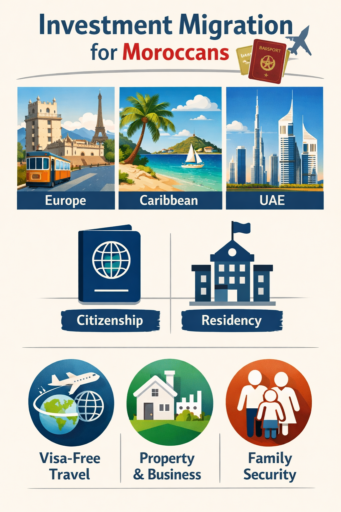
The easiest countries for Moroccans to obtain permanent residency through investment include Portugal, Greece, and the United Arab Emirates, which offer residency permits in exchange for property purchases or business investments.
These programs generally have clear requirements, relatively straightforward application processes, and lower thresholds than full citizenship programs.
Portugal’s Golden Visa is one of the most well-known residency-by-investment programs.
Moroccan investors can qualify by investing at least €500,000 in eligible investment funds or €200,000 in cultural or heritage projects.
The program allows residency with minimal stay requirements and provides a path to Portuguese citizenship after five years, making it attractive for those seeking long-term EU access.
Greece offers one of the most accessible property-based residency programs in Europe.
Investors can obtain residency by purchasing real estate starting from €250,000 in certain areas, although some high-demand locations require €400,000–€800,000.
The permit can be renewed indefinitely as long as the investment is maintained, and it allows visa-free travel within the Schengen Area.
United Arab Emirates Investor Visa
The UAE provides residency through several investment options, including the UAE Golden Visa, which can be obtained through real estate investment starting at around AED 2 million.
The visa can grant long-term residency of 5 or 10 years, allowing investors to live, work, and run businesses in one of the Middle East’s most dynamic economic hubs.
Other residency programs to consider
Moroccan investors may also explore residency-by-investment options in countries such as Italy and Cyprus, which offer residence permits through property or financial investments.
Spain previously offered a popular residency-by-investment program, but this route was officially discontinued in 2025 and is no longer available to new applicants.
While these programs may require larger investments or longer residency periods, they can eventually provide pathways to permanent residency or citizenship depending on each country’s naturalization rules.
What are the advantages and disadvantages of migration in the source country and destination countries?
Migration from Morocco offers advantages such as better economic opportunities, global mobility, and improved living standards, but it can also involve social, financial, and integration challenges for migrants and their families.
Advantages for Moroccans leaving Morocco:
- Access to stronger economies and job markets
- Better healthcare and education systems
- International mobility and business opportunities
Disadvantages for Moroccans leaving Morocco:
- Separation from family and cultural roots
- High cost of living in destination countries
- Legal and bureaucratic challenges
Advantages in destination countries:
- Political and social stability
- Business-friendly environments
- Potential tax benefits
Disadvantages in destination countries:
- Integration challenges and cultural adaptation
- Initial investment and residency costs
- Possible restrictions on certain rights until full citizenship
Citizenship vs. Residency: Which Path Fits Moroccan Investors?
For Moroccans, citizenship-by-investment programs offer fast access to a second passport and global mobility, while residency-by-investment programs provide a pathway to long-term integration in stable economies and eventual citizenship.
Choosing the right path depends on whether the priority is speed, international access, or long-term economic and family planning.
1. Investment Thresholds and Initial Costs
Citizenship-by-investment (CBI) programs, especially in the Caribbean, generally require larger upfront contributions but offer a faster route to a second passport, often in 3–6 months.
For example, Saint Kitts & Nevis starts at around $250,000, while Dominica is about $200,000.
Residency-by-investment programs in Europe or the UAE may have lower entry points for property or business investment, but acquiring citizenship can take 5–10 years of legal residence.
Moroccan investors should weigh whether immediate global mobility or gradual integration into a major economy aligns better with their goals.
2. Speed vs. Long-Term Benefits
CBI programs provide instant citizenship and visa-free travel for families, making them ideal for those who need quick international access.
Residency programs offer slower, but often more sustainable benefits, including eligibility for EU markets, education systems, and potential eventual citizenship.
For Moroccans seeking business expansion or EU integration, residency-first programs may provide broader long-term advantages despite slower processing.
3. Family Inclusion and Lifestyle Considerations
Many citizenship programs allow multiple dependents to be included immediately, which can secure education, healthcare, and travel flexibility for Moroccan families.
Residency programs often require longer-term commitments, meaning families may have to maintain residence or meet minimum stay requirements to benefit fully.
4. Strategic Flexibility
Moroccan investors should consider how each program aligns with career plans, business ambitions, and lifestyle objectives.
Citizenship offers maximum mobility, but less connection to local economies, while residency can anchor a family in a stable economy with pathways for property ownership, business development, and eventual citizenship.
5. Risk and Compliance Factors
Both paths require attention to legal, tax, and regulatory obligations.
Citizenship programs may involve due diligence and disclosure of assets, while residency programs may require ongoing compliance with investment, residency, or tax requirements.
Moroccan investors should plan ahead to minimize risks and optimize benefits in both Morocco and the destination country.
Insight: The right choice depends on whether the priority is speed and global mobility or long-term economic integration and lifestyle planning.
For many Moroccans, a hybrid approach, using residency as a bridge to eventual citizenship can balance both objectives, providing flexibility and security for the entire family.
Conclusion
Investment migration for Moroccans is a pragmatic response to opportunity and uncertainty, not just a relocation strategy.
It allows individuals and families to position themselves where economies, education, and business environments align with their ambitions, while still maintaining connections to Morocco.
Beyond passports and residency, the true advantage lies in strategic flexibility, being able to pivot between markets, leverage international networks, and secure long-term stability.
When approached thoughtfully, investment migration becomes a tool for resilience, growth, and global engagement, rather than merely a change of address.
FAQs
Which countries are investing in Morocco?
France, Spain, and the UAE are among the largest investors in Morocco, particularly in sectors like tourism, real estate, and renewable energy.
Who is Morocco’s biggest ally?
France is Morocco’s closest ally, with strong historical, cultural, and economic ties and significant French investment and trade.
The United States and the European Union are also key partners, supporting Morocco through trade, investment, and strategic diplomatic cooperation.
What is the best investment in Morocco?
Real estate, renewable energy projects, and tourism-related businesses are considered among the best investment opportunities in Morocco due to growing demand and government incentives.
Is Morocco a high-risk country?
Morocco is generally considered stable, but risks can exist in certain economic sectors or remote areas.
Political stability, business regulation, and infrastructure development are improving, making it a moderate-risk investment environment.
Pained by financial indecision?

Adam is an internationally recognised author on financial matters with over 830million answer views on Quora, a widely sold book on Amazon, and a contributor on Forbes.