Trusts for property allow real estate to be owned and managed through a legal structure where a trustee holds the property for the benefit of beneficiaries.
This setup separates legal ownership from beneficial ownership, which can help with estate planning, asset protection, and property investment management.
This article covers:
- What are the 5 forms of trust?
- What is the best trust to hold property?
- Why should I put my assets in a trust?
- How do you add assets to an existing trust?
- What percent tax do you pay on a trust?
- What is the negative side of a trust?
Key Takeaways:
- Trusts separate legal from beneficial ownership, allowing property to be managed for beneficiaries.
- Different trust types serve different purposes, like asset protection, estate planning, or investment flexibility.
- Property can be transferred into a trust, but the process may trigger transfer taxes or stamp duties.
- Choosing the right jurisdiction and trust structure can impact asset protection and long-term estate planning outcomes.
My contact details are hello@adamfayed.com and WhatsApp +44-7393-450-837 if you have any questions. We also offer bespoke structuring solutions tailored to your situation.
The information in this article is for general guidance only, does not constitute financial, legal, or tax advice, and may have changed since the time of writing.

How does a property trust work?
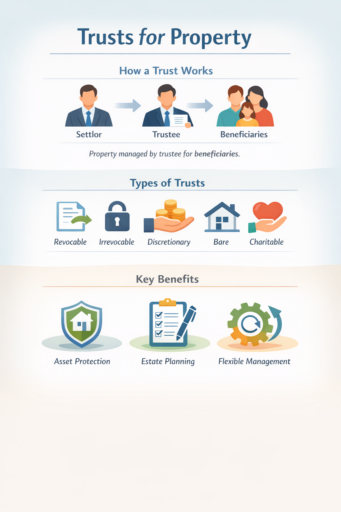
A property trust is a legal arrangement where property ownership is transferred to a trust, which is then managed by a trustee for the benefit of designated beneficiaries.
A typical structure includes three parties:
- Settlor (Grantor) – the person who creates the trust and transfers the property into it
- Trustee – the individual or entity responsible for managing the property
- Beneficiaries – the individuals who benefit from the property, income, or eventual transfer
In practice, the trust becomes the legal owner of the property, while beneficiaries retain the beneficial interest.
For example, rental income generated by a property held in trust may be distributed to beneficiaries according to the trust deed.
What is the difference between ownership and trust?
Direct ownership gives an individual full legal and beneficial rights to a property, including control and title in their name. In a trust, legal ownership is held by the trustee, while beneficiaries enjoy the benefits of the property without holding legal title.
This separation creates a clear distinction between who manages the property and who benefits from it.
Understanding this difference is crucial for estate planning, asset protection, and structuring property investments effectively.
What are the different types of trusts?
The different types of trusts commonly used for property include revocable trusts, irrevocable trusts, discretionary trusts, bare trusts, and charitable trusts, each designed for different legal and financial purposes.
Revocable Trust
A trust that the settlor can modify or dissolve during their lifetime.
It provides flexibility but generally limited protection from creditors or claims.
Irrevocable Trust
Once established, this trust cannot easily be changed.
Assets transferred into it are legally owned by the trust, offering stronger protection and potential tax benefits.
Discretionary Trust
The trustee has discretion over how property or income is distributed among beneficiaries, allowing adaptable management of trust assets.
Bare Trust
The beneficiary has an immediate and absolute right to the trust property, with the trustee acting primarily as a legal holder.
Charitable Trust
Property is held to support charitable purposes, often providing tax advantages while benefiting non-profit objectives.
What is the best trust for property?
The best trust for property is typically a discretionary trust for family property planning, an irrevocable trust for asset protection, and a revocable trust for estate planning purposes.
For example:
- Family property planning: Trusts can allow rental income or property benefits to be distributed among family members in a flexible way.
- Asset protection: Certain trust structures can separate property ownership from personal assets, helping shield real estate from potential claims.
- Estate planning: Property held in a trust may transfer to heirs without going through probate, simplifying inheritance.
- Property investment portfolios: Trusts can help investors manage multiple properties while maintaining structured control over income and ownership.
The optimal trust structure ultimately depends on the investor’s tax residency, legal system, and long-term goals.
How do I add property to an existing trust?
The best way to add property to a trust is to create the trust first and acquire property through it. If the property is already owned, it can be transferred into an existing trust by legally moving ownership to the trustee.
The process usually includes:
1. Trust deed review: Confirm that the trust allows additional assets to be added and that the property transfer complies with the trust terms.
2. Preparation of transfer documents: Prepare a property transfer deed or deed of assignment to move ownership into the trust.
3. Property registration: Register the property under the name of the trustee or the trust structure where required by law.
4. Payment of applicable taxes or duties: Pay any stamp duties, transfer taxes, or registration fees that apply when transferring property into a trust.
5. Trust record updates: Update trust records, asset schedules, and beneficiary documentation to reflect the new property asset.
Whenever possible, establish the trust before purchasing property to simplify administration and reduce potential taxes or fees.
Where is the best place to set up a trust?
The best places to set up a trust are jurisdictions with well-established trust laws, strong asset protection frameworks, and clear tax regulations, such as the Cayman Islands, Singapore, the United Kingdom, New Zealand, and certain US states.
- The Cayman Islands – known for strong asset protection laws
- Singapore – widely used for Asian wealth planning
- The United Kingdom – long-standing trust law framework
- New Zealand – historically attractive for foreign trusts
- The United States – certain states offer specialized trust laws
The ideal jurisdiction depends on factors such as the property location, the residency of beneficiaries, and tax considerations.
How much tax is charged on trust?
Property held in a trust is taxed at rates between 17% and 45%, with retained trust income often taxed at the higher end and distributed income potentially taxed at lower rates for beneficiaries.
Taxes that may apply include:
- Income tax: on rental income generated by the property, which may be taxed at higher trustee rates or passed to beneficiaries. For example, South African trusts pay a flat 45% on retained income, while Singaporean trusts are taxed at 17%.
- Capital gains tax: when the property is sold, varying by jurisdiction and trust structure. US trusts may pay up to 20% on long-term gains plus a 3.8% net investment income tax.
- Inheritance or estate taxes: depending on whether the trust is revocable or irrevocable and local estate rules.
- Stamp duties or transfer taxes: applied when property is transferred into the trust.
Some jurisdictions tax trust income at higher rates, while others allow income to be distributed to beneficiaries who pay tax individually.
Proper structuring can sometimes reduce tax exposure, but the rules are highly location-dependent.
What are the advantages and disadvantages of a trust
The main advantages of a trust are asset protection, efficient estate planning, privacy, and controlled inheritance, while the main disadvantages are administrative costs, tax complexity, and potential loss of control over the property.
Advantages
- Asset protection: Trusts can help shield property from personal liabilities in certain legal contexts.
- Estate planning efficiency: Trusts often allow property to transfer to heirs without probate.
- Privacy: Trust structures can provide greater confidentiality than direct property ownership.
- Controlled inheritance: Trustees can manage how and when beneficiaries receive benefits.
Disadvantages
- Administrative costs: Trusts require legal setup, ongoing management, and sometimes professional trustees.
- Tax complexity: Trust tax rules can be complicated and vary widely between jurisdictions.
- Loss of control: In some trust types, particularly irrevocable trusts, the settlor gives up direct control of the property.
Integrating Trusts with Other Legal Structures
Trusts do not have to operate in isolation. Combining them with other legal entities, such as companies, partnerships, or limited liability vehicles, can create powerful strategies for property management and investment.
For example, placing property into a company owned by a trust can shield assets from personal liability, while still allowing the trust to control income distribution and succession planning.
This approach also allows for tax optimization in certain jurisdictions.
Rental income, capital gains, or profits from property development can be managed through the entity, potentially taking advantage of corporate tax rules, deductions, or deferred distributions.
Additionally, multi-property portfolios can be structured so that each property sits in a separate company under the same trust, isolating risk while keeping control centralized.
Beyond financial and legal benefits, integrating trusts with other structures provides flexibility for future changes.
The trust can adapt its holdings without needing to restructure ownership of the underlying properties directly, making it easier to bring in new investors, plan for multiple generations, or respond to regulatory changes.
In essence, combining trusts with complementary legal structures turns a simple property-holding trust into a dynamic framework for asset protection, investment growth, and long-term estate planning.
Conclusion
Property trusts are evolving tools that extend beyond traditional estate planning.
Investors and families are increasingly using them to adapt to complex global markets, regulatory changes, and cross-border tax considerations.
Setting up a trust is not just about protecting assets.
It can unlock strategic opportunities, such as enabling collaborative investment, separating risk among properties, and creating flexible income streams for multiple generations.
The real advantage comes from treating a trust as a dynamic management framework, rather than a static ownership structure, allowing property owners to respond to legal, financial, and family changes over time.
FAQs
Who holds the money in a trust?
The trustee holds and manages trust assets, including property or money, on behalf of the beneficiaries.
The trustee must follow the instructions set out in the trust deed.
What is the best trust structure for property investment?
For property investors, discretionary trusts are often popular because they allow flexible distribution of rental income and potential tax planning among beneficiaries.
However, some investors prefer company-trust hybrid structures or limited partnerships depending on their jurisdiction.
What is the 7 year rule for trusts?
The 7-year rule in the UK means that gifts or transfers into certain trusts may escape inheritance tax if the settlor survives seven years after the transfer.
This rule is specific to the UK and does not apply in most other jurisdictions, so local tax laws should always be checked.
Pained by financial indecision?

Adam is an internationally recognised author on financial matters with over 830million answer views on Quora, a widely sold book on Amazon, and a contributor on Forbes.