The United States, UAE, Singapore, Hong Kong, and the Netherlands are among the jurisdictions where ultimate beneficial ownership (UBO) registers are not publicly accessible.
Most countries today maintain systems to identify the ultimate owners of companies and legal entities.
However, in these jurisdictions, beneficial ownership information is typically restricted to regulators and authorized authorities rather than the general public.
This article covers:
- What is the UBO register?
- What is the purpose of UBO?
- What are the countries without UBO register?
- Who is an ultimate beneficial owner?
Key Takeaways:
- Most countries require UBO identification—even without public registers.
- No UBO register often means non-public, not non-existent.
- Financial institutions still enforce strict UBO disclosure rules.
- Regulations apply even in jurisdictions without public registers.
My contact details are hello@adamfayed.com and WhatsApp +44-7393-450-837 if you have any questions. We also offer bespoke structuring solutions tailored to your situation.
The information in this article is for general guidance only, does not constitute financial, legal, or tax advice, and may have changed since the time of writing.

What is ultimate beneficial ownership register?
A UBO (Ultimate Beneficial Ownership) register is an official database that records the individuals who ultimately own or control a company, even when ownership is structured through multiple layers of entities, nominees, or trusts.
These registers are typically maintained by government authorities and may be:
- Public (accessible to anyone)
- Semi-public (restricted access to certain users)
- Private (accessible only to regulators and law enforcement)
The core purpose of a UBO register is to make real ownership visible, reducing the ability to hide behind complex corporate structures.
This supports stronger oversight across financial systems and improves trust in cross-border business.
In practice, UBO registers are used to:
- Combat money laundering by tracing funds back to real individuals
- Prevent tax evasion by exposing hidden ownership of income-generating assets
- Detect and disrupt terrorist financing networks
- Strengthen due diligence for banks and institutions during KYC checks
- Support investigations into fraud, corruption, and illicit wealth
By linking companies to real people, UBO registers play a key role in aligning jurisdictions with global transparency standards set by organizations like the Financial Action Task Force.
Does every company have UBO?
No, not every company has an identifiable ultimate beneficial owner under standard definitions.
While most private companies do have one or more individuals who ultimately own or control them, there are exceptions.
For example, companies that are widely held or publicly listed may not have any single individual meeting the typical UBO threshold (often 25% ownership or control).
In most jurisdictions, however, companies are still required to identify their UBOs internally where applicable, even if those details are not recorded in a public register.
In general:
- Companies must declare UBOs during incorporation or compliance checks
- Financial institutions require UBO disclosure when opening accounts
- Regulations apply even in jurisdictions without public registers
However, the level of enforcement, verification, and disclosure varies significantly depending on the country.
Countries With No UBO Register
Several countries including the United States, United Arab Emirates, Singapore, Hong Kong, and Panama, do not have fully public ultimate beneficial ownership (UBO) registers, meaning ownership data is not openly accessible to the general public.
While many countries have adopted UBO registers under global pressure from organizations like the Financial Action Task Force (FATF), some jurisdictions still maintain limited or non-public UBO registers.
1. United States (limited and evolving transparency framework)
- No fully public UBO register at the federal level
- Corporate Transparency Act introduced beneficial ownership reporting, but requirements have been scaled back and partially suspended
- Reporting currently applies mainly to certain foreign entities
- Data (where collected) is not publicly accessible
2. United Arab Emirates
- Requires companies to maintain UBO records internally
- No centralized public UBO register
- Disclosure mainly for regulatory authorities
3. Singapore
- Maintains a private register of controllers
- Not accessible to the general public
- Strong compliance but limited transparency externally
4. Hong Kong
- Requires a Significant Controllers Register
- Not publicly accessible
- Available only to authorities upon request
5. Panama
- Historically known for corporate privacy
- UBO information exists but is not public
- Access restricted to competent authorities
6. India
- Maintains a centralized Significant Beneficial Owners (SBO) register under the Companies Act and SBO Rules
- Companies and LLPs must identify and file individuals with 10% or more beneficial ownership or control
- Register is maintained with authorities and is not freely accessible to the public
- Access is limited to regulators, authorized parties, or those with a legitimate inspection request
7. Netherlands
- Maintains a UBO register in line with EU directives
- Public access is restricted following privacy-related court rulings
- UBO data is accessible only to regulators, authorities, or authorized parties
- Companies must still identify and report UBOs internally, ensuring compliance with transparency and AML requirements
Who is considered the ultimate beneficial owner of an account?
The ultimate beneficial owner (UBO) of an account is the natural person who ultimately owns, controls, or benefits from the account or entity.
A UBO is typically defined as a natural person who:
- Owns 25% or more of a company or asset (except in jurisdictions like India, where the threshold is 10%)
- Exercises significant control over decision-making
- Benefits financially from the entity
This definition applies to:
- Corporate bank accounts
- Investment accounts
- Trust structures
Financial institutions are required to identify UBOs as part of Know Your Customer (KYC) procedures.
Who is excluded from beneficial ownership?
Entities or individuals who do not meet the ownership or control thresholds, or are explicitly exempt by law, are excluded from UBO classification.
Certain examples include:
- Publicly listed companies (due to existing transparency requirements)
- Government-owned entities
- Individuals with minimal ownership (below threshold, e.g., under 25%)
However, even excluded entities may still be subject to reporting obligations in some jurisdictions.
What are common UBO red flags?
Common UBO red flags are indicators that a company’s ownership or control may be hidden, complex, or potentially suspicious.
Regulators and financial institutions look for warning signs such as:
- Complex multi-layered ownership chains
- Use of offshore entities with no clear purpose
- Nominee shareholders or directors
- Frequent ownership changes
- Lack of commercial rationale
These red flags often trigger enhanced due diligence by authorities and financial institutions.
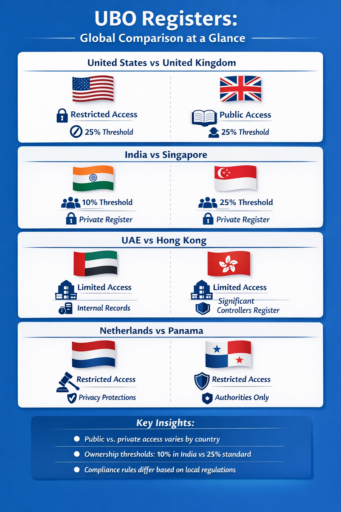
Comparative View of UBO Registers Across Key Jurisdictions
Although all recognized jurisdictions maintain UBO registers, accessibility and ownership thresholds vary, affecting how businesses and regulators interact with ownership data.
United States vs. United Kingdom
The US has a UBO register under the Corporate Transparency Act, but access is restricted to regulators and certain reporting entities.
The UK, in contrast, maintains a public register via Companies House, allowing broader transparency and easier due diligence.
India vs. Singapore
India requires companies and LLPs to report individuals with 10% or more ownership or control, lower than the common 25% threshold.
Singapore maintains a private register of controllers for individuals with 25% or more ownership, with access limited to regulators.
United Arab Emirates vs. Hong Kong
The UAE requires companies to maintain internal UBO records, while Hong Kong mandates a Significant Controllers Register, both restricted from public access and available only to authorities.
Netherlands vs. Panama
The Netherlands’ UBO register complies with EU directives but public access is restricted due to privacy rulings.
Panama similarly maintains records accessible only to competent authorities.
Hungary, Lithuania, and Italy
These EU countries follow the standard 25% threshold, with restricted or controlled access to UBO registers, ensuring oversight while protecting ownership confidentiality.
Conclusion
Understanding UBO frameworks is no longer optional for businesses and investors operating globally.
Even in jurisdictions without public registers, the responsibility to identify and disclose ultimate beneficial owners has become a key compliance and risk-management factor.
The landscape shows that transparency is advancing, but unevenly, creating opportunities for both diligence and potential regulatory pitfalls.
For companies and financial institutions, the challenge is not just following the rules.
It’s anticipating how evolving global standards will reshape reporting, due diligence, and corporate transparency.
Those who proactively integrate UBO insights into governance and risk strategies are better positioned to navigate cross-border transactions, strengthen stakeholder trust, and avoid legal exposure.
In essence, UBO transparency is less about the register itself and more about how organizations use ownership visibility to protect integrity, mitigate risk, and build credibility in an increasingly scrutinized financial world.
FAQs
What is the difference between beneficial owner and ultimate beneficial owner?
A beneficial owner benefits from an entity, while the ultimate beneficial owner (UBO) is the natural person who ultimately owns or controls it, regardless of intermediate layers.
This means the UBO is the final individual behind ownership, even if multiple companies, trusts, or nominees are used in between.
Why is it important for accountable institutions to identify UBOs?
Accountable institutions must identify UBOs to comply with anti-money laundering regulations, prevent financial crime, and ensure transparency.
Failing to do so can lead to regulatory penalties, legal consequences, and reputational damage.
What is the UBO declaration of ultimate beneficial owner?
A UBO declaration is a formal statement in which a company identifies the individuals who ultimately own or control it, usually submitted as part of regulatory filings rather than as a separate document.
Pained by financial indecision?

Adam is an internationally recognised author on financial matters with over 830million answer views on Quora, a widely sold book on Amazon, and a contributor on Forbes.