Trusts in Florida are legal arrangements that allow individuals to manage, protect, and transfer assets efficiently while avoiding probate and maintaining privacy.
They are governed by the Florida Trust Code and are widely used for estate planning, asset protection, and long-term wealth management.
This article covers:
- How does a trust work in Florida?
- What type of trust should I use?
- How many years is a trust good for in Florida?
- How do you set up a trust in Florida?
- What is the cost of a trust in Florida?
- Why is a trust better than a will in Florida?
Key Takeaways:
- Revocable living trusts are the most commonly used in Florida.
- Trusts help avoid probate and keep estate matters private.
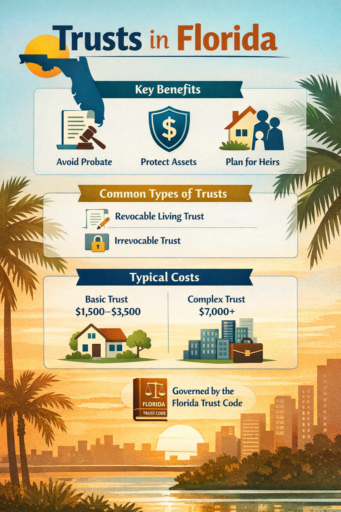
- Florida trust costs range from $1,500 for basic trusts to $7,000+ for complex estates with multiple assets.
- Proper funding is essential for a trust to be effective.
My contact details are hello@adamfayed.com and WhatsApp +44-7393-450-837 if you have any questions. We also offer bespoke structuring solutions tailored to your situation.
The information in this article is for general guidance only, does not constitute financial, legal, or tax advice, and may have changed since the time of writing.

What are the trust laws in Florida?
Florida trust law is governed by the Florida Trust Code (Chapter 736 of the Florida Statutes), which outlines how trusts are created, managed, and enforced.
Key points include:
- Trusts must have a valid purpose and defined beneficiaries
- The settlor (creator) must have legal capacity
- Trustees must act in a fiduciary capacity
- Florida allows revocable and irrevocable trusts
- The state follows the Uniform Trust Code framework, with local modifications
Florida is considered a trust-friendly state, offering strong asset protection and flexibility in structuring trusts.
What are the different types of trusts in Florida?
The different types of trusts in Florida include revocable, irrevocable, testamentary, special needs, charitable, and spendthrift trusts, each designed for specific estate planning, asset protection, or financial goals.
- Revocable Living Trust – A flexible trust you can modify or revoke during your lifetime, commonly used to avoid probate and manage assets seamlessly if you become incapacitated.
- Irrevocable Trust – A trust that generally cannot be changed once created, offering stronger asset protection from creditors and potential estate tax advantages by removing assets from your ownership.
- Testamentary Trust – A trust created through your will that only takes effect after death, often used to control how assets are distributed to minors or beneficiaries over time.
- Special Needs Trust – Designed to provide financial support to a disabled beneficiary without disqualifying them from government benefits like Medicaid or Supplemental Security Income (SSI).
- Charitable Trust – Established to benefit a charitable cause or organization, while sometimes providing tax advantages or income streams to the donor or beneficiaries.
- Spendthrift Trust – Limits a beneficiary’s access to trust assets and protects those assets from creditors, ensuring funds are used responsibly over time.
Each type has distinct legal and financial implications depending on your objectives.
What are the elements of a trust in Florida?
The elements of a trust in Florida are the settlor, trustee, beneficiaries, trust property, and clear intent, all of which must be present for the trust to be legally valid.
- Settlor – The person who creates the trust and transfers assets into it, also known as the grantor, who must have legal capacity and a clear understanding of the trust’s purpose.
- Trustee – The individual or institution responsible for managing the trust, administering its assets, and carrying out its terms while acting in a fiduciary capacity in the best interests of the beneficiaries.
- Beneficiaries – The individuals or entities who receive the benefits of the trust, whether through income, assets, or other distributions as specified in the trust document.
- Trust property – The assets placed into the trust, such as real estate, cash, investments, or business interests, which must be properly transferred or funded into the trust.
- Intent – A clear and demonstrable intention by the settlor to create a trust, typically expressed in a written trust document that outlines how the trust should operate.
What assets cannot be placed in a trust?
In Florida, most assets can be placed in a trust, such as cash and investments, but some like retirement accounts, certain insurance policies, vehicles, and HSAs, cannot be directly transferred or require special handling to avoid legal, tax, or administrative problems.
- Retirement accounts (e.g., IRAs, 401(k)s) – These accounts usually cannot be retitled into a trust, but you can name the trust as a beneficiary to control distribution after death.
- Certain insurance policies – Life insurance is typically managed via beneficiary designations rather than being placed directly in a trust.
- Vehicles – Motor vehicles can be placed in a trust, but Florida registration and title rules can make this impractical.
- Health savings accounts (HSAs) – HSAs cannot be transferred into a trust during the account holder’s lifetime under federal and Florida rules.
- Assets that can be placed in a trust – Cash, bank accounts, stocks, bonds, real estate (other than homestead property if special rules apply), business interests, and personal property can generally be transferred into a trust.
Properly funding a trust with eligible assets and handling restricted assets correctly is critical to avoid tax consequences, penalties, or administrative issues in Florida.
How long does a trust last in Florida?
In Florida, a trust lasts from the lifetime of the beneficiary up to 1,000 years for long-term or dynasty trusts, as allowed under Fla. Stat. § 689.225.
- Many trusts last for the lifetime of beneficiaries.
- Dynasty or long-term trusts can continue for up to 1,000 years under Florida law.
- Revocable trusts become irrevocable upon the settlor’s death.
The duration of a trust is set in the trust document and must comply with Florida’s modern rule against perpetuities.
Why would I need a trust in Florida?
In Florida, trusts are especially useful for avoiding probate delays, managing homestead property rules, and simplifying the transfer of real estate.
Several reasons individuals set up trusts in Florida include:
- Avoiding probate (which can be time-consuming and public)
- Protecting assets from creditors (in certain trust types)
- Controlling asset distribution over time
- Providing for minor children or dependents
- Planning for incapacity
- Maintaining privacy (trusts are not public records like wills)
Trusts are especially useful if you own real estate, a business, or significant financial assets.
What is the best trust to have in Florida?
A revocable living trust is the most recommended trust in Florida because it allows full control over assets during your lifetime, provides flexibility to make changes, and helps avoid probate after death.
Other options for specific goals include:
- For asset protection: An irrevocable trust offers stronger protection from creditors and potential estate or tax benefits.
- For special family needs: A special needs trust provides for disabled beneficiaries without affecting their eligibility for government benefits.
Many Florida estate plans pair a revocable trust with a pour-over will to ensure all assets are properly transferred and managed.
What is the average cost of a trust in Florida?
In Florida, creating a trust with an attorney typically costs $1,500–$3,500 for a basic revocable living trust, while more complex trusts with multiple assets or special provisions can range from $3,000–$7,000+.
- Basic revocable trust: Around $1,500–$3,500 for a standard estate planning trust prepared by a Florida attorney.
- More complex trusts: Trusts involving multiple properties, businesses, or customized distribution rules can cost $3,000–$7,000+.
Additional costs include:
- Complex assets – Multiple properties or business interests require extra legal work.
- Legal customization – Special provisions or tax planning increase attorney fees.
- Trustee fees and administration – Using a professional trustee or ongoing accounting adds to long-term costs.
This reflects typical Florida attorney-prepared trust costs and associated ongoing expenses.
How to set up a trust in Florida?
To set up a trust in Florida, start by clearly defining your goals, then create the trust document, fund it with assets, and appoint a trustee to manage it according to your objectives.
1. Identify your goals: Decide why you are creating the trust, such as asset protection, probate avoidance, or managing distributions.
2. Choose the right trust type: Select the trust that aligns with your objectives, like revocable, irrevocable, or special needs trusts.
3. Draft the trust document: Work with a Florida estate planning attorney to create a legally valid and comprehensive trust agreement.
4. Appoint a trustee: Designate an individual or institution to manage the trust and act in the best interests of the beneficiaries.
5. Fund the trust: Transfer your assets including real estate, bank accounts, and investments, into the trust to make it effective.
6. Review and update regularly: Revisit the trust periodically to ensure it reflects changes in assets, laws, or family circumstances.
Proper funding is essential; an unfunded trust provides little or no legal benefit.
Do you need a lawyer for a trust in Florida?
Legally, you do not need a lawyer to create a trust in Florida, but working with a qualified Florida estate attorney is highly recommended to ensure the trust is valid, properly funded, and tailored to your goals.
A well-drafted trust can prevent disputes among beneficiaries, protect assets, and reduce the risk of probate issues.
A Florida estate attorney can:
- Ensure compliance with the Florida Trust Code and all statutory requirements.
- Customize provisions for your situation, including special instructions for beneficiaries or asset management.
- Avoid costly mistakes that could make the trust invalid or difficult to administer.
- Handle asset transfers correctly, ensuring the trust is fully funded and effective.
In practice, effective estate planning often involves coordination between financial advisors, wealth managers, and estate attorneys to ensure the legal structure aligns with investment strategy and long-term wealth transfer goals.
Trusts created without professional guidance often fail due to improper wording, incomplete funding, or misunderstandings of Florida law, which can undermine their benefits.
What are the disadvantages of a trust in Florida?
Trusts in Florida can be costly, complex, and require careful management to be effective.
- Upfront cost can be high – Attorney fees for drafting a trust range from $1,500–$7,000+ depending on complexity.
- Complex setup and maintenance – Establishing the trust and keeping it updated with changes in assets or beneficiaries takes time and attention.
- Requires active management – Trustees must actively manage investments, distributions, and compliance with Florida law.
- No immediate tax benefits for revocable trusts – Revocable trusts do not reduce income or estate taxes while the settlor is alive.
- Funding mistakes can undermine effectiveness – If assets are not properly transferred into the trust, it may fail to achieve probate avoidance or asset protection.
Trusts are powerful tools, but only when they are properly structured, funded, and maintained.
Is it better to have a trust or a will in Florida?
In Florida, a trust is generally better for managing major assets and avoiding probate, while a will is simpler and suited for smaller estates or as a backup.
Trust advantages:
- Avoid probate – Assets in a trust bypass Florida’s probate process.
- Maintain privacy – Trusts are not public records, unlike wills.
- Faster asset distribution – Beneficiaries can receive assets more quickly than through probate.
Will advantages:
- Simpler and cheaper – Drafting a will is straightforward and less expensive than creating a trust.
- Suitable for smaller estates – Ideal for assets that don’t require complex management or protection.
Most comprehensive Florida estate plans include both:
- A trust for major assets – Ensures proper management, protection, and privacy.
- A will as a backup (pour-over will) – Captures any assets not funded into the trust.
How Florida Trusts Differ From Other States
Florida trusts are shaped by state-specific laws that influence estate planning strategies in ways other states do not:
- Long-term dynasty planning: Florida allows trusts to last up to 1,000 years, providing unique opportunities for multi-generational wealth transfer. Most other states, including California and New York, limit trusts to around 90–110 years.
- Homestead considerations: Florida’s homestead protections limit how certain real estate can be transferred, making trust structuring more nuanced than in states without such strong protections.
- Creditor and Medicaid planning: Florida’s rules allow certain irrevocable and spendthrift trusts to shield assets from creditors and government claims in ways that are stricter or unavailable in many other states.
- No state estate tax: Unlike states such as New York or Massachusetts, Florida imposes no estate tax, changing the calculus for trust design, asset distribution, and potential tax strategies.
- Impact on real estate-heavy estates: States with higher property transfer taxes or more rigid probate processes make trusts less flexible for real estate management compared with Florida.
Residents with substantial property or multi-generational wealth can leverage Florida-specific laws like long-duration trusts, homestead protections, and creditor shielding, in ways that are often unavailable elsewhere, making trust planning more strategic and tailored.
Conclusion
Florida’s unique homestead protections and creditor laws make trusts particularly valuable for residents seeking both flexibility and security.
Beyond probate avoidance, trusts can strategically navigate state-specific rules, such as limitations on transferring homestead property or shielding assets from long-term liabilities.
Establishing a trust with clear terms and proper funding allows families to plan for multiple generations while respecting Florida’s legal nuances.
For anyone with significant real estate or business interests in the state, a well-structured trust is not just an estate tool.
It’s a proactive approach to safeguarding wealth under Florida law.
FAQs
Should I put my house in a trust in Florida?
Yes, placing your house in a trust in Florida can avoid probate, simplify inheritance, and maintain privacy.
Make sure to account for Florida’s homestead laws and potential tax implications before transferring the property.
Can you sell a house in a trust in Florida?
Yes, a trustee can sell a house in a Florida trust if the trust document allows it and the sale benefits the beneficiaries.
The process follows the same steps as a standard real estate transaction.
How much does a trustee of a trust get paid in Florida?
Trustee fees in Florida are set by law as reasonable under the circumstances, with professional trustees typically charging 1% to 3% of the trust’s assets annually, and in some cases up to 4% or more for complex or active trusts.
Family or individual trustees may receive an hourly or flat fee if the trust document allows.
What rights do trust beneficiaries have in Florida?
Beneficiaries in Florida have the right to receive distributions, access trust information and accounting, challenge trustee actions, and enforce the trust’s terms.
Trustees are legally required to act in the best interests of the beneficiaries at all times.
Pained by financial indecision?

Adam is an internationally recognised author on financial matters with over 830million answer views on Quora, a widely sold book on Amazon, and a contributor on Forbes.