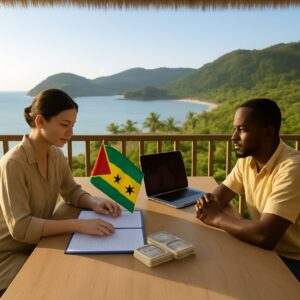
A Financial advisor for expats in São Tomé and Príncipe can help you manage local taxes, navigate investments, and optimize your wealth in the country’s small island economy.
Understanding the local financial landscape is essential before making long-term decisions.
This article covers:
- What is the main export of Sao Tome and Principe?
- How much would a financial advisor charge?
- How much money should you have to consider a financial advisor?
- How to tell if your financial advisor is bad?
Key Takeaways:
- São Tomé and Príncipe’s small, agriculture-based economy needs careful expat planning.
- Financial advisor fees go up to 1.5% of assets annually.
- Pick certified, expat-focused, transparent advisors with local market knowledge.
- Advisors help manage taxes, currency, and risk.
My contact details are hello@adamfayed.com and WhatsApp +44-7393-450-837 if you have any questions.
The information in this article is for general guidance only. It does not constitute financial, legal, or tax advice, and is not a recommendation or solicitation to invest. Some facts may have changed since the time of writing.

What is the main industry of Sao Tome and Principe?
São Tomé and Príncipe’s economy is still significantly anchored in agriculture, with cocoa production as its dominant cash crop.
Cocoa remains the top export, accounting for a large share of foreign earnings even as the economy diversifies; annual output is around 3,000–5,000 tons, and cocoa historically makes up a substantial percentage of commodity exports.
Despite its agricultural roots, the services sector now contributes the largest share of GDP (about 72–76 %), including tourism, trade, and transport, while agriculture, forestry, and fishing together contribute around 11–14 % of GDP.
Other important industries include fisheries, which support food security and local livelihoods, and tourism, which accounts for a growing share of economic activity thanks to the islands’ natural beauty.
Expats planning investments should consider how dependent the economy remains on a few sectors, and a financial advisor can help identify opportunities and manage risks in this concentrated market.
Is Sao Tome and Principe poor?
Yes, São Tomé and Príncipe is classified as a lower-middle-income country by the IFAD (International Fund for Agricultural Development, with modest GDP per capita compared with higher-income nations.
The country faces structural challenges, including relatively high unemployment, income inequality, and dependence on a few key sectors such as cocoa production.
Despite these limitations, the economy has demonstrated steady growth, supported by efforts to diversify services, expand tourism, and improve infrastructure.
For expats, these dynamics mean that investment and financial planning require careful attention.
Opportunities exist, but they are concentrated in specific industries and markets, and currency fluctuations (São Tomé and Príncipe uses the dobra) add another layer of complexity.
A qualified financial advisor can help navigate these challenges, identify high-potential sectors, optimize risk exposure, and organize investments to align with both local economic realities and international diversification goals.
How much should you expect to pay for a financial advisor?
Hiring a financial advisor in São Tomé and Príncipe costs between 0.5% and 1.5% of assets under management annually, based on the complexity of your portfolio and the advisor’s experience with expat clients.
Some local or regional advisors may also charge flat or hourly fees, especially for smaller portfolios or one-off consultations.
Expats should consider that the island’s limited number of certified financial advisors may affect pricing.
As a result, some individuals choose to work with international or offshore advisors who specialize in cross-border investments, currency management, and coordination with local tax compliance requirements.
Knowing costs upfront ensures you can evaluate whether the advisor’s services match your financial needs and long-term goals.
Is $500,000 enough to work with a financial advisor in São Tomé and Príncipe?
Yes, expats with $500,000 or more in investable assets are generally at a level where engaging a financial advisor is financially worthwhile.
In São Tomé and Príncipe’s small, agriculture- and tourism-driven economy, an experienced advisor can help structure investments to manage sector concentration risk, navigate local tax rules, and optimize returns while accounting for currency exposure to the dobra.
For portfolios involving cross-border holdings, retirement planning, or diversified investments, a financial advisor adds significant value by ensuring compliance with both local regulations and international financial considerations.
Expats with less than $500,000 may still benefit from professional guidance.
However, the cost-to-value ratio generally becomes more favorable once investable assets reach around $500,000 or more, making this a practical threshold where full advisory services tend to deliver the most value.
Is it worth paying for a financial advisor?
It can be worth it, especially for expats dealing with complex portfolios, cross-border finances, or retirement planning.
Financial advisors help structure investments efficiently, taking into account different tax systems, currencies, and long-term goals.
They can also help manage currency risk, particularly in countries like São Tomé and Príncipe where the dobra is used and exchange rates may fluctuate.
In addition, advisors provide ongoing monitoring and adjustments, which is valuable in less developed financial markets where access to reliable information may be limited.
For expats with multiple income sources or international assets, professional guidance can reduce costly mistakes and improve overall financial outcomes.
Is it better to have a financial advisor or do it myself?

For expats in São Tomé and Príncipe, working with a financial advisor is strongly recommended.
Advisors provide tailored guidance for managing investments in the island’s cocoa, tourism, and service sectors, navigating local taxes, and mitigating currency risk with the dobra.
Independent planning carries significant risks in this small, specialized economy. Without professional advice, expats may:
- Misunderstand local regulations and tax obligations
- Overexpose themselves to currency fluctuations
- Invest in illiquid or unfamiliar local markets
- Miss opportunities for diversification across jurisdictions
Doing it yourself may only be suitable if your finances are simple and you have the time and expertise to manage cross-border considerations effectively.
How to spot a bad financial advisor?
You can spot a bad financial advisor by looking for red flags such as unrealistic promises, lack of transparency, poor credentials, and limited understanding of your financial needs.
Steps to identify a bad advisor:
1. Check credentials and local certification – Ensure the advisor is licensed or recognized in São Tomé and Príncipe and has experience with expat clients.
2. Evaluate investment promises – Be wary of guarantees of high returns without mentioning risks, especially in a small, agriculture-based economy and with the local currency (dobra).
3. Assess local market knowledge – A trustworthy advisor should understand key sectors like cocoa, tourism, and fisheries and not push investments without proper research.
4. Review fees and billing transparency – Avoid advisors with hidden fees, unclear billing, or vague service agreements.
5. Test expat expertise – Ask about managing foreign investments, local taxes, and currency risks; limited knowledge is a red flag.
6. Trust your instincts – Pressure to invest quickly or evasive answers should raise concerns.
What is a key factor to consider when choosing between a robo-advisor and a human advisor?
The main factor to consider is how much personalized guidance you need.
Robo-advisors are cost-effective and automated, making them suitable for simple portfolios and standard investment strategies.
Human advisors, on the other hand, provide tailored advice, tax planning, and support for complex or international finances, which is particularly important for navigating local regulations and currency (dobra) risks.
Other factors to weigh include:
- Algorithm limitations – Robo-advisors may not account for unusual financial situations, local tax nuances, or sudden market changes.
- Behavioral guidance – Human advisors can help prevent impulsive decisions during volatile markets.
- Custom planning – Personalized strategies for retirement, property investments, or sector-specific opportunities (like cocoa, tourism, or fisheries) are better handled by a human advisor.
- Regulatory and compliance support – Understanding local rules and documentation requirements often requires human expertise.
- Service and communication – Human advisors can answer questions, adapt strategies dynamically, and provide guidance in your preferred language, while robo-advisors follow pre-set rules.
Conclusion
Expats in São Tomé and Príncipe are offered with a rare blend of natural beauty, niche investment opportunities, and a small, closely-knit market, but these same factors also demand vigilance.
Success in this environment isn’t just about hiring an advisor; it’s about understanding how limited market size, currency fluctuations (dobra), and reliance on a few key industries like cocoa and tourism affect returns.
Even small financial decisions can have outsized impact, so staying informed, asking critical questions, and regularly reviewing your portfolio can be just as important as professional guidance.
For expats willing to engage actively with the local economy, careful planning here can turn challenges into unique opportunities.
FAQs
Can foreigners own land in Sao Tomé and Principe?
Foreigners cannot buy land but can purchase buildings or negotiate long-term leases.
Legal reforms make registration more secure but still require careful navigation.
What are the interesting facts about São Tomé and Príncipe?
The country is made up of two main islands, is Africa’s second-smallest nation, produces high-quality cocoa, and has rich biodiversity and pristine beaches.
Is São Tomé and Príncipe expensive?
São Tomé and Príncipe is generally affordable for daily living, though imported goods, electronics, and some services are more expensive because it is an island nation.
Is it safe to go to São Tomé and Príncipe?
Yes, São Tomé and Príncipe is generally considered relatively safe for tourists and expats, with low levels of violent crime compared with many other countries.
However, petty crime like pick-pocketing and burglary does occur and normal precautions are recommended
What is São Tomé and Príncipe best known for?
São Tomé and Príncipe is best known for its lush tropical landscapes, cocoa production, and unspoiled beaches.
The islands are also famous for unique biodiversity, including rare bird species and endemic plants, as well as their colonial-era architecture and rich cultural heritage.
Pained by financial indecision?

Adam is an internationally recognised author on financial matters with over 830million answer views on Quora, a widely sold book on Amazon, and a contributor on Forbes.