Foreigners can legally establish a business in the UK without being residents, giving them access to one of the world’s most stable economies.
A UK limited company offers protection for personal assets, professional credibility, and a clear framework for growth.
This article covers:
- What is the definition of a limited company in the UK?
- What are the two main types of limited companies in the UK?
- Can I set up a UK limited company if I live outside the UK?
- What is the process of starting your own company?
- How much is LTD in the UK?
Key Takeaways:
- Foreigners can open a UK limited company without living in the UK.
- Limited liability helps protect personal assets from business risks.
- Setting up a Ltd company is relatively fast and cost-effective.
- A UK limited company enhances credibility with clients, banks, and investors.
My contact details are hello@adamfayed.com and WhatsApp +44-7393-450-837 if you have any questions. We also offer bespoke structuring solutions tailored to your situation.
The information in this article is for general guidance only, does not constitute financial, legal, or tax advice, and may have changed since the time of writing.

What is a limited company in the UK?
A limited company in the UK is a legal entity separate from its owners. It can enter contracts, own property, and incur liabilities in its own name.
The limited aspect means shareholders are only liable up to the amount they invest, offering protection for personal assets.
There are two main types of limited companies in the UK:
1. Private Limited Company (Ltd)
- Cannot sell shares to the public.
- Typically used by small to medium businesses.
- Shareholders’ liability is limited to their shareholding.
- Requires at least one director and one shareholder.
- Often preferred by foreign entrepreneurs due to simpler compliance and lower costs.
2. Public Limited Company (PLC)
- Can sell shares to the public, including on the stock market.
- Must have a minimum share capital of £50,000.
- Requires at least two directors and a qualified company secretary.
- Subject to stricter regulatory and reporting requirements.
- Usually chosen by larger businesses planning to raise capital publicly.
Understanding these two types helps foreigners decide which structure best fits their business goals, whether it’s a small startup or a larger enterprise looking to attract investors.
Can a foreigner open a limited company in the UK?
Yes, foreigners can open a UK Ltd company and fully operate it as shareholders or directors.
This allows international entrepreneurs to establish a formal business presence in one of the world’s most stable and business-friendly economies.
Foreign owners can manage company finances, enter contracts, hire employees, and trade with clients both in the UK and internationally.
Running a UK limited company as a foreigner comes with responsibilities, including maintaining proper accounting records, filing annual returns, and complying with UK company law.
Many foreigners engage professional service providers or accountants to handle administrative tasks and provide guidance on legal, banking, and tax compliance.
With careful planning and the right support, foreigners can successfully run and grow a UK limited company.
Can I set up a company in the UK without residency?
Yes, it is entirely possible to set up a UK limited company without being a UK resident.
While you do not need to live in the UK, every company must have a registered office address in the country to receive official correspondence, legal notices, and communications from Companies House and HMRC.
Many foreigners use professional registered office services or virtual office providers to meet this requirement while managing their business from abroad.
Non-resident directors can fully control the company’s operations, including opening bank accounts, signing contracts, and hiring staff, though banks may request additional documentation for non-resident account holders.
Despite not living in the UK, directors are legally responsible for ensuring the company complies with UK law, including filing annual accounts, paying Corporation Tax, and submitting confirmation statements.
Proper planning, combined with professional support, allows foreign entrepreneurs to operate a UK limited company efficiently and securely, taking advantage of the UK’s legal protections and international business opportunities.
What are the requirements to set up a limited company in the UK?
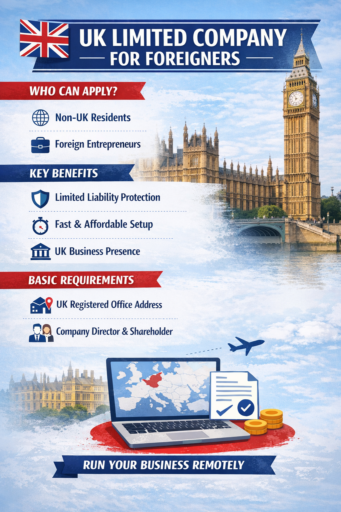
For foreigners, setting up a UK limited company requires at least one director and at least one shareholder, both of whom can live outside the UK.
In addition to people, you must meet the following requirements:
- Unique company name – Must comply with UK naming rules and not already be registered.
- Registered UK address – Needed for official correspondence and legal notices; foreigners often use professional registered office services.
- Memorandum and Articles of Association – These documents outline the company’s rules, governance, and shareholder rights.
- Director and shareholder details – Full legal names, dates of birth, nationality, and addresses must be provided.
- Identity documents – Copies of passports or national ID for directors and shareholders are usually required.
- Share allocation and capital details – Information on the number and value of shares issued to each shareholder.
Providing accurate documents and details ensures the company is legally recognized, avoids delays with Companies House registration, and allows foreign entrepreneurs to operate fully within the UK’s legal and business framework.
How to open a ltd company in the UK step by step?
To open a UK limited company, foreigners must choose a company name and register for taxes.
The steps include:
1. Choose a company name – Ensure it’s unique and complies with UK naming rules.
2. Appoint directors and shareholders – Foreigners can act as directors or shareholders.
3. Register a UK address – Use a registered office service if you’re not resident.
4. Prepare company documents – Submit the Memorandum and Articles of Association outlining company rules.
5. Register with Companies House – Submit your application online or via post.
6. Set up a business bank account – Many banks accept non-residents with proper identification and documents.
7. Register for taxes – This includes registering for Corporation Tax with HMRC and any other applicable taxes.
Following these steps ensures that foreign entrepreneurs can legally establish a UK limited company and operate it fully in compliance with local regulations.
How much does it cost to set up a ltd company in the UK?
Registering a UK limited company online with Companies House costs £100, which is the standard government fee for digital registration. If you need same-day processing, the fee rises to £156, and postal applications cost around £124.
Additional costs for foreigners may include:
- Formation agent services: £10–£200+, depending on package and extras like company documents and guidance.
- Registered office address service: £10–£150+ per year if you don’t have a UK address.
- Business bank account setup: Some banks may require extra documentation; fees vary.
- Accountant fees: Typically several hundred pounds per year for bookkeeping, tax filings, and compliance.
In total, most foreign entrepreneurs spend around £100–£200+ initially to fully set up a Ltd company, with ongoing annual costs for filings and professional services.
How long does it take to form a UK limited company?
It typically takes 24–48 hours to register a UK limited company online with Companies House. Postal applications usually take longer, around 8–10 business days.
Using formation agents can further speed up the process, provide guidance on required documents, and help ensure compliance for foreign directors.
Proper preparation of all necessary information and documents can also reduce delays and make the registration smoother.
How much tax do you pay as a limited company in the UK?
UK limited companies pay Corporation Tax on their profits at rates of 19% for profits up to £50,000, 25% for profits over £250,000, and a gradually increasing rate for profits in between.
- If your company’s taxable profits are £50,000 or less, you pay the small profits rate of 19%.
- If your profits are above £250,000, you pay the main rate of 25%.
- For profits between £50,000 and £250,000, marginal relief applies, meaning the effective rate gradually increases between 19% and 25%.
Foreign directors and shareholders should also plan for other taxes that may apply to the company or to the income they take (such as VAT on sales, employer National Insurance for salaries, and dividend taxes on profits distributed).
They may also have additional tax obligations in their home country depending on local tax rules and treaties.
Corporation Tax must be registered for within 3 months of starting business, and the company must file a CT600 return every year with HMRC, even if no tax is due.
What are the advantages of a limited company in the UK?
For foreign entrepreneurs, a UK limited company offers legal protection, operational flexibility, and access to international markets.
Key advantages include:
- Limited liability for non-residents – Shareholders are only responsible for the capital they invest, safeguarding personal assets in their home country.
- Credibility with UK clients and partners – Operating as a UK-registered company can boost trust with local suppliers, banks, and international customers.
- Efficient cross-border tax planning – Foreign directors can optimize tax obligations through allowable business expenses, dividends, and treaties.
- Easier access to UK funding and services – Being a UK entity allows foreign founders to open business bank accounts, obtain financing, or attract UK-based investors.
- Business continuity independent of location – The company continues operating even if foreign owners move, change countries, or step down as directors.
What are the disadvantages of a limited company in the UK?
For foreigners, running a UK limited company comes with administrative, legal, and cost-related challenges that require careful planning.
Key disadvantages include:
- Ongoing compliance obligations – Non-resident directors must file annual accounts, confirmation statements, and corporation tax returns with HMRC and Companies House.
- Public disclosure of directors and shareholders – Company records, including names and addresses, are visible on the public register, which may raise privacy concerns for foreign owners.
- Complex accounting and tax reporting – Foreign directors may face additional requirements, such as dealing with UK payroll, dividends, VAT, and reporting obligations in their home country.
- Higher professional costs – Many foreigners rely on formation agents, accountants, or legal advisors to manage compliance, which increases setup and annual expenses.
Is it better to be self-employed or a limited company in the UK?
For most foreign entrepreneurs, UK limited company formation is the better choice.
It provides liability protection, professional credibility, and potential tax efficiency that self-employment cannot match.
Self-employment involves simpler administration but may lead to higher personal tax rates, limited business credibility, and fewer protections for personal assets.
Choosing a limited company also makes it easier for foreigners to open UK bank accounts, hire employees, and attract investors, which can be critical when operating internationally.
How a UK Ltd Compares to Business Structures Abroad for Foreigners
A UK limited company gives foreign entrepreneurs strategic advantages that go beyond basic registration, including opportunities for cross-border structuring, intellectual property protection, and access to UK-specific business networks.
Unlike many foreign structures, a UK Ltd can hold international contracts, patents, and trademarks under UK law, offering an extra layer of legal security for global operations.
For foreign founders, currency management and banking flexibility are often overlooked but critical advantages.
UK accounts and payment systems allow easier handling of multi-currency transactions, facilitating trade with clients and suppliers worldwide.
Additionally, a UK Ltd is viewed favorably by international investors and venture capitalists, who often prefer investing in UK-registered entities for the clarity of governance, audited financials, and transparent legal framework.
This structure also allows foreigners to combine UK incorporation with home-country entities, creating holding or subsidiary companies for optimized tax planning and international growth.
By strategically leveraging a UK Ltd alongside other entities, foreign entrepreneurs can reduce cross-border risk, enhance credibility, and scale operations more efficiently than relying solely on local or home-country structures.
Conclusion
A UK limited company provides foreign entrepreneurs with a solid framework to operate confidently, protect personal assets, and engage with global markets.
The key to success lies in strategic planning, compliance management, and effective use of professional support, which can maximize tax efficiency and operational flexibility.
Choosing the right company structure and understanding ongoing obligations early helps prevent costly mistakes and ensures smooth growth.
Beyond compliance, a UK entity can enhance credibility with clients, suppliers, and potential investors, giving foreign business owners a competitive edge.
Ultimately, careful preparation and informed decisions allow a limited company in the UK to serve as a springboard for long-term international expansion and sustainable business success.
FAQs
What is an example of a limited company?
Famous UK limited companies include Vodafone Ltd, Rolls-Royce Holdings Ltd, and BP Plc.
These companies operate under the limited company structure, which allows them to separate personal and business liabilities while managing large-scale operations and international trade.
What is better, a CC or a PTY Ltd?
A PTY Ltd or Ltd structure is generally preferable because it provides limited liability and is widely recognized for private companies.
A CC (Close Corporation) is specific to South Africa, while a PTY Ltd is used in countries like Australia, making the Ltd the standard choice for UK companies.
Why should you buy a house in a limited company in the UK?
Holding property in a limited company can provide tax planning advantages, limit personal liability, and make ownership more structured for multiple investors.
Who owns the assets of a limited company?
The company itself owns its assets. Shareholders own the company but not the assets directly.
What are the 4 types of business ownership in the UK?
The four main types of business ownership in the UK are Sole Trader, Partnership, Limited Liability Partnership (LLP), and Limited Company (Ltd or PLC).
Pained by financial indecision?

Adam is an internationally recognised author on financial matters with over 830million answer views on Quora, a widely sold book on Amazon, and a contributor on Forbes.