Costa Rica Caja insurance for expats provides public healthcare coverage to legal residents, including essential medical services like doctor visits, hospital care, and medications.
Expats can enroll in Caja after obtaining residency, with the option to supplement coverage through private insurance.
Understanding how this insurance works helps newcomers plan for both routine care and unexpected medical needs.
This article covers:
- How does healthcare work for expats in Costa Rica?
- How to get insurance in Costa Rica?
- What is the Caja system in Costa Rica?
- How much does Caja Costa Rica cost?
Key Takeaways:
- Expats with residency must enroll in Caja; short-term visitors are not automatically covered.
- Caja covers most essential healthcare services, including doctor visits, hospital care, and medications.
- Costs vary based on income, employment, or pension status, generally 7–11% of declared income.
- Private insurance can complement Caja for faster service or elective procedures.
My contact details are hello@adamfayed.com and WhatsApp +44-7393-450-837 if you have any questions. We also offer bespoke structuring solutions tailored to your situation.
The information in this article is for general guidance only, does not constitute financial, legal, or tax advice, and may have changed since the time of writing.

Is healthcare free for foreigners in Costa Rica?
Healthcare in Costa Rica is not automatically free for foreigners.
Residents, including expats who obtain legal residency, can access the public healthcare system through the Caja Costarricense de Seguro Social (CCSS), commonly called Caja.
While citizens and residents pay contributions based on income, tourists and short-term visitors do not qualify for free public healthcare and must rely on private insurance or pay out-of-pocket for medical services.
For expats, eligibility for Caja requires legal residency, which can be obtained through work, retirement, or other residency categories recognized by Costa Rican immigration authorities.
Once enrolled, residents can access most essential healthcare services at public hospitals and clinics, including doctor visits, lab tests, emergency care, maternity services, and chronic disease management.
Can expats get health insurance in Costa Rica?
Yes, expats can obtain health insurance once they have legal residency.
There are two main pathways:
- Public insurance through Caja – Residents can enroll in the Caja system, paying contributions based on income or pension. This gives access to public hospitals, clinics, and essential healthcare services.
- Private insurance – Many expats supplement Caja with private plans for faster specialist access, elective procedures, or broader coverage not included in the public system. Private policies can also cover dental care, international travel, or emergency evacuation.
Choosing between public, private, or a combination of both depends on your healthcare needs, budget, and preference for speed and convenience in accessing services.
How do expats get health insurance in Costa Rica?
Expats get Costa Rica health insurance by registering with the Caja system if they have legal residency.
The process involves:
1, Obtain legal residency – Apply for residency through Costa Rica’s immigration authorities under a category such as Pensionado, Rentista, or Work Visa.
2. Gather required documents – Prepare your residency approval, passport, proof of income or pension, and any other documents requested by the CCSS.
3. Submit registration to CCSS – Present your documents in person at a local CCSS office to apply for enrollment.
4. Calculate and pay contributions – Monthly payments are determined by your income, pension, or employment status.
5. Receive your Caja insurance card – Once approved, this card grants access to public healthcare services across Costa Rica.
What does Caja cover in Costa Rica?
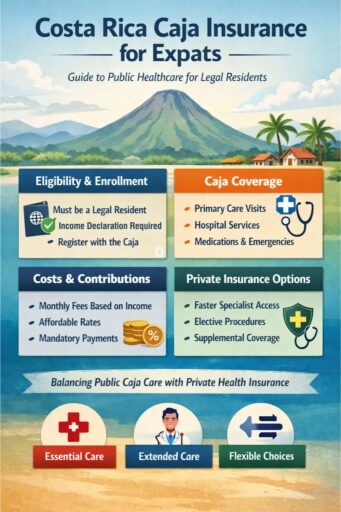
The Caja system in Costa Rica provides public healthcare coverage to residents, including expats with legal residency, covering services such as doctor visits, hospital care, and prescription medications.
Managed by the CCSS, Caja ensures access to essential medical care for a wide range of health needs.
Services included under Caja coverage:
- General doctor visits and specialist consultations
- Hospitalization and emergency care
- Prescription medications
- Maternity and pediatric care
- Vaccinations and preventive care
- Chronic disease management
While Caja provides comprehensive coverage, some elective procedures, private hospital stays, or faster specialist appointments may not be fully included.
Enrollment in Caja is generally mandatory for expats with residency who work or earn income in Costa Rica, with contributions based on income, pension, or employment status.
How much does Caja cost in Costa Rica?
Expats typically pay 7 %–11 % of their monthly income as Caja contributions to access Costa Rica’s public healthcare system, with the exact percentage based on residency category and income.
Because this contribution includes both health and pension components, and because the exact rate is tied to residency category and income declared, the exact monthly amount varies but most expats budget roughly $50–$300 USD per month for their Caja fees under current rules.
Caja contributions are usually structured like this:
- Employees: Total CCSS contribution is about 10.67 % of gross salary, though the employer also pays a larger share that doesn’t come directly from the employee.
- Pensionados (Retirees): Fees are based on the minimum monthly pension declared for residency (e.g., around $1,000/month), often resulting in a monthly Caja payment in the low hundreds of dollars.
- Rentistas or self‑employed residents: Contributions are based on declared income (e.g., minimum $2,500/month for Rentista), which can put monthly payments somewhere in the low‑to‑mid‑hundreds of dollars depending on income.
What is the best insurance for expats?
For most expats, the best insurance combines Caja public coverage with a private plan to ensure access to both essential healthcare and faster or elective services.
Some expats rely solely on Caja for cost-effective public healthcare, while others choose private international insurance plans for:
- Faster access to specialists
- Coverage for elective or non-Caja procedures
- Travel medical coverage outside Costa Rica
Popular private insurers for expats include international companies that offer comprehensive medical coverage tailored for foreigners.
How Costa Rica’s Healthcare Compares Regionally
Costa Rica’s Caja system is one of the strongest public healthcare programs in Latin America, offering comprehensive coverage, universal access for residents, and high-quality preventive care.
For expats, it’s helpful to see how it compares to nearby countries with notable healthcare systems:
- Panama: Offers a public healthcare system similar to Caja, with affordable services for residents and optional private insurance. Preventive care and hospital quality rank high in the region.
- Chile: Combines public (FONASA) and private (ISAPRE) coverage. Public services cover essential care, while private plans give faster access to specialists and elective procedures.
- Uruguay: Provides universal public healthcare through ASSE, complemented by private insurers. Known for strong primary care and quality hospitals.
- Mexico (select states): Public coverage is available through IMSS and IMSS‑Bienestar, but quality and wait times vary by location, so many expats rely on private insurance for faster access.
Costa Rica’s Caja system consistently ranks among the best in Latin America, offering affordable care and strong preventive programs.
While nearby countries such as Panama, Chile, and Uruguay also provide mixed public-private healthcare systems, Costa Rica is often preferred by retirees and long-term expats for its accessibility and English-friendly services.
Across the region, many expats use private insurance to supplement public coverage for elective procedures, specialist access, and faster care.
Conclusion
For expats, understanding how Caja ties healthcare access to legal residency and income declaration is critical, as missteps in enrollment or documentation can delay care or limit coverage.
The system’s strengths highlight Costa Rica’s commitment to accessible healthcare, but they also reveal areas where expats must proactively plan, such as elective procedures or specialist appointments.
Supplementing Caja with private insurance is not just optional; it is often a strategic tool to navigate wait times, gain faster access to specialized care, and cover gaps the public system doesn’t address.
Ultimately, Caja is more than a safety net.
For expats who understand its rules and limitations, it becomes a platform to optimize both cost and quality of healthcare, allowing long-term residents to make informed, flexible choices about their medical care in Costa Rica.
FAQs
What are the four types of insurance coverage?
In Costa Rica, the four main types of insurance coverage are Caja public healthcare insurance, private health insurance, life insurance, and vehicle or property insurance.
Is Costa Rica healthcare free?
Healthcare is free only for Costa Rican citizens and residents through Caja once contributions are paid.
Visitors must pay out-of-pocket or use private insurance.
What is Costa Rica’s healthcare system ranked?
Costa Rica’s healthcare system is ranked 36th in the world by the World Health Organization (WHO), placing it above countries such as the United States and New Zealand in global healthcare quality rankings.
The United Nations also places Costa Rica’s public health system within the top 20 worldwide and number 1 in Latin America.
What is the biggest health problem in Costa Rica?
The biggest health problems in Costa Rica are non‑communicable diseases, especially cancer and cardiovascular diseases.
Infectious diseases like dengue occur occasionally but account for far fewer cases and deaths.
Pained by financial indecision?

Adam is an internationally recognised author on financial matters with over 830million answer views on Quora, a widely sold book on Amazon, and a contributor on Forbes.