An NRI trust is a legal mechanism through which a Non-Resident Indian can manage and protect assets located in India.
It provides a structured way to oversee property, investments, and finances while staying compliant with Indian laws.
This article covers:
- Who is considered a non-resident Indian?
- Can NRI have a trust in India?
- What type of assets can you put into a trust?
- What assets cannot be included in a trust?
- What are the advantages and disadvantages of an NRI account?
Key Takeaways:
- NRIs can create and manage trusts in India with legal compliance.
- Trustees can be NRIs, but some local representation may be required.
- NRI accounts (NRE/NRO) facilitate asset management within a trust.
- Trusts help with estate planning, asset protection, and succession management.
My contact details are hello@adamfayed.com and WhatsApp +44-7393-450-837 if you have any questions. We also offer bespoke structuring solutions tailored to your situation.
The information in this article is for general guidance only, does not constitute financial, legal, or tax advice, and may have changed since the time of writing.

Who Qualifies as an NRI?
A Non-Resident Indian (NRI) is an Indian citizen who lives outside India for employment, business, or other personal reasons.
The Indian government defines an NRI based on the number of days an individual spends in India during a financial year.
Generally, anyone who stays in India for less than 182 days in a year (or under certain conditions, 365 days over four years) qualifies as an NRI for tax and legal purposes.
Being classified as an NRI has direct implications for managing finances, including opening NRI accounts, investing in Indian assets, and creating trusts.
For instance, NRIs have access to specialized bank accounts like NRE (Non-Resident External) and NRO (Non-Resident Ordinary) accounts, which can be linked to trusts for easier management of Indian income.
Additionally, NRIs must consider how their status affects taxation.
Indian-sourced income, such as rental income, dividends, or profits from assets held in a trust, is still subject to Indian tax laws.
Understanding these rules before creating a trust ensures compliance and prevents penalties.
Many NRIs also use this status strategically to plan succession, estate management, and wealth protection through trusts, making it important to clearly establish residency and NRI status with banks and authorities.
What is a Non-Resident Trust?
A non-resident trust is a trust in which at least one trustee or beneficiary is a Non-Resident Indian (NRI).
These trusts are specifically designed to help NRIs manage and safeguard assets in India while complying with Indian legal and tax requirements.
Non-resident trusts are recognized under Indian trust laws, primarily the Indian Trusts Act, 1882, but they must adhere to regulations related to taxation, repatriation, and residency.
For example, the tax treatment of income generated within the trust depends on whether the trust is classified as a resident or non-resident trust for tax purposes, and whether the beneficiaries are NRIs or residents of India.
There are two broad categories of non-resident trusts:
- Revocable trusts: The settlor retains the right to alter or revoke the trust during their lifetime. These are useful for flexible estate planning and managing investments.
- Irrevocable trusts: Once established, the settlor cannot modify the trust. These are often used for long-term wealth protection, inheritance planning, and minimizing tax exposure.
What is the Purpose of an NRI Account?
An NRI account is not just for personal banking as it plays a key role in managing funds within an NRI trust.
It provides a regulated channel for handling income, expenses, and distributions linked to assets held in India.
In the context of an NRI trust, these accounts are commonly used for:
- Receiving income generated by trust assets, such as rent or dividends
- Managing expenses related to property or investments held in the trust
- Distributing funds to beneficiaries in India or abroad
- Ensuring compliance with Indian tax and repatriation rules
In practice, most NRI trusts rely on NRE or NRO accounts to operate smoothly, making them an essential part of the overall trust structure rather than a separate financial tool.
What Assets Can You Hold in a Trust?
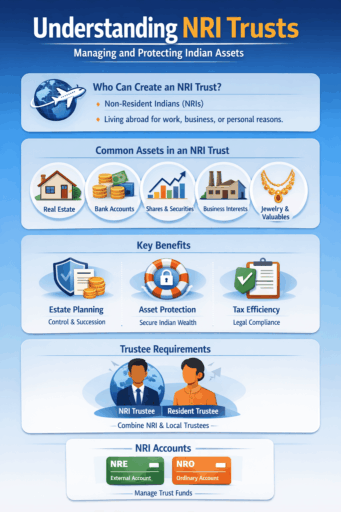
A trust can hold a variety of assets, such as real estate, bank accounts, shares, and other investments, for the benefit of its beneficiaries.
These commonly include:
- Real estate property – houses, apartments, land, or commercial property in India
- Bank accounts (including NRE/NRO accounts) – funds held to manage trust income and expenses
- Shares and securities – stocks, mutual funds, or bonds held in the name of the trust
- Business interests – ownership stakes in companies or partnerships
- Jewelry and other valuables – gold, precious stones, or collectible items
Assets placed in a trust are legally owned by the trustees, who manage them according to the trust deed for the benefit of the beneficiaries.
What Cannot Be Held in a Trust?
Certain assets cannot be held in a trust, such as jointly owned property without consent, government-regulated assets, or items with legal transfer restrictions.
- Assets owned jointly with third parties without consent – property or investments that require approval from co-owners before transfer
- Certain government-regulated assets – items like government bonds, defense land, or licenses that must be held personally
- Assets with legal restrictions on transfer or encumbrance – property under litigation, mortgaged assets, or items subject to inheritance limitations
NRIs should carefully review legal and regulatory restrictions before transferring any Indian or foreign assets into a trust to avoid disputes or compliance issues.
How Many Members Are Required to Form a Trust in India?
A trust in India requires at least one settlor, two trustees, and one beneficiary.
Specifically:
- One settlor: The person creating the trust
- Two trustees: Individuals responsible for managing the trust
- One beneficiary: Person or entity receiving benefits
Family trusts may involve additional trustees and beneficiaries depending on the trust deed and the complexity of asset management.
Can a NRI Be a Trustee?
A NRI can be a trustee, provided they meet certain legal requirements under Indian law.
Trustees are responsible for managing and administering the trust’s assets in accordance with the trust deed and applicable regulations, making their role central to how the trust operates.
In practice, an NRI trustee has the same legal duties as a resident trustee.
These include safeguarding trust assets, acting in the best interests of beneficiaries, maintaining proper records, and ensuring compliance with tax and reporting obligations in India.
This means NRIs must stay informed about Indian regulations, especially when the trust holds income-generating assets like property or investments.
However, there are some practical considerations when appointing an NRI as a trustee.
Many financial institutions, government offices, and registries in India may require at least one resident Indian trustee to handle administrative tasks such as signing documents, operating bank accounts, or representing the trust locally.
This helps avoid delays and simplifies compliance.
It is also common for trusts to appoint multiple trustees, combining an NRI (often a family member) with a resident trustee or even a professional trustee, such as a lawyer or financial advisor.
This structure ensures both control and operational efficiency.
Is it Good to Have a NRI Account?
Yes, having an NRI account provides flexibility, access to Indian financial markets, and easier management of income earned in India.
It also enables clearer separation between foreign and Indian income, which helps in maintaining accurate financial records.
For NRIs involved in trusts or structured investments, these accounts support smoother documentation and audit trails.
However, it comes with compliance responsibilities and limits on certain transactions, particularly around repatriation and taxation.
What are the Risks of Having an NRI Account?
NRI accounts carry risks related to currency exposure, regulatory compliance, and usage restrictions despite their benefits.
- Exposure to currency fluctuations – Exchange rate movements between the Indian rupee and foreign currencies can affect the real value of funds when converting or repatriating money.
- Compliance with Indian tax laws – NRIs must properly report income, as certain accounts (like NRO) are taxable, and non-compliance can lead to penalties or audits.
- Restrictions on certain types of investments – Not all financial instruments are accessible to NRIs, and some investments come with caps or regulatory limitations.
- Possible complications if NRI status is not declared properly – Failing to update residency status with banks can result in account misuse, penalties, or forced conversion of accounts.
Careful planning and consultation with a financial advisor can mitigate these risks.
Which is Better NRE or NRO?
For NRI trusts, NRO accounts are generally better for managing Indian-source income, while NRE accounts are better for holding and repatriating foreign funds.
The choice between NRE and NRO accounts is primarily driven by how income is generated and distributed:
- NRE accounts are better suited for funds originating from abroad, especially when full repatriation is needed and tax efficiency is a priority.
- NRO accounts are more appropriate for managing income earned within India, such as rent, dividends, or proceeds from assets held by the trust.
In practice, many NRI trust structures use both accounts together.
Choosing the right setup ensures smoother fund flows, proper compliance with Indian regulations, and efficient management of trust distributions.
Alternatives to NRI Trusts for Asset Management and Estate Planning
NRIs can manage and protect Indian assets using tools other than a trust, such as wills, companies, joint ownership, or offshore arrangements.
- Wills: NRIs can create a will in India to distribute assets according to their wishes. This is simple to set up and flexible, but probate can take time, and it doesn’t control asset management before death.
- Family Settlement Agreements: Legal agreements among family members to manage and distribute assets. These can avoid lengthy court proceedings but require full cooperation and offer less formal protection than a trust.
- Limited Liability Companies or Private Companies: Holding assets through an Indian company allows structured management and succession via shareholding. However, compliance requirements and costs are higher, and distribution flexibility is lower.
- Joint Ownership or Co-Ownership: Assets like property or bank accounts can be held jointly with family members. This is easy to implement but offers limited control and may lead to disputes.
- Offshore or International Trusts: NRIs with foreign residency can establish trusts in other jurisdictions to manage Indian or global assets. These may offer tax efficiency and broader control but are more complex and require compliance with Indian tax laws.
Each alternative has its pros and cons, but for centralized management, legal protection, and succession planning in India, an NRI trust often remains the most effective solution.
Conclusion
Creating an NRI trust is a way to actively shape how wealth flows across generations while managing the challenges of cross-border assets.
The decisions NRIs make about trustees, account types, and asset allocation have long-term consequences for control, tax efficiency, and family security.
A trust becomes a tool for strategic foresight, allowing NRIs to anticipate regulatory changes, streamline income management, and reduce potential disputes.
Approaching it with both legal precision and practical planning transforms a trust from a static structure into a dynamic instrument for preserving and optimizing wealth.
FAQs
Does NRI Need to Pay Taxes?
Yes, NRIs are liable to pay taxes in India on income sourced within the country, including dividends, rental income, and capital gains.
The tax rules differ from resident Indians, and certain exemptions or deductions may apply depending on the type of income and applicable double taxation avoidance agreements (DTAAs).
What Happens If You Do Not Declare NRI Status?
Failure to declare NRI status can lead to incorrect tax deductions, penalties, and interest on taxes that should have been paid at the appropriate NRI rates.
It can also create complications with banks, such as account misclassification, and may result in legal or compliance issues related to repatriation and Indian regulatory requirements.
Can Anyone Open a Trust in India?
Yes, any individual or entity can create a trust in India, provided they comply with legal requirements regarding the settlor, trustees, and beneficiaries.
The trust must be established through a valid trust deed and follow the provisions of the Indian Trusts Act or applicable state trust laws.
How Much Money is Required for a Family Trust?
There is no legally fixed minimum amount required to create a family trust in India.
The initial assets typically depend on the purpose of the trust, the types of assets being held, and the expected administrative costs, which should be sufficient to cover ongoing management and compliance.
Pained by financial indecision?

Adam is an internationally recognised author on financial matters with over 830million answer views on Quora, a widely sold book on Amazon, and a contributor on Forbes.