A non-UK resident can register a company in the UK without living in the country.
You do not need to be a UK citizen or resident to own, operate, or be a director of a UK company.
This article covers:
- Who is eligible to register a UK company?
- What is required to register a company in the UK?
- How much is it to register a company in the UK?
- What are the benefits of registering a company in the UK?
Key Takeaways:
- Non-UK residents can fully own and operate UK companies.
- At least one director is required, but they can also be non-resident.
- Company registration provides legal protection, credibility, and access to UK markets.
- Operating an unregistered business carries financial and legal risks.
My contact details are hello@adamfayed.com and WhatsApp +44-7393-450-837 if you have any questions. We also offer bespoke structuring solutions tailored to your situation.
The information in this article is for general guidance only, does not constitute financial, legal, or tax advice, and may have changed since the time of writing.

Who is eligible to register a company in the UK?
Any individual or legal entity can register a company in the UK, regardless of nationality or country of residence.
This means both UK residents and non-residents can fully own and operate a company, making the UK an attractive destination for international entrepreneurs.
Eligibility applies to several types of business structures, including:
- Private limited companies (Ltd) – The most common choice for small and medium businesses.
- Public limited companies (PLC) – Suitable for larger businesses planning to offer shares publicly.
- Limited liability partnerships (LLP) – Combines partnership flexibility with limited liability protection.
Every UK company must have at least one director who must be at least 16 years old and cannot be disqualified from acting as a director in the country.
Importantly, directors do not need to be UK residents.
In addition, every company must have a registered office address in the UK, which can be a physical office or a virtual address provided by a formation agent.
This address is where official correspondence, including legal notices, will be sent.
Shareholders (owners of the company) also face minimal restrictions: a company can have just one shareholder, and they can be an individual or another company from anywhere in the world.
This flexibility allows non-residents to maintain full control while leveraging the UK’s legal and financial system.
How to register a company in the UK as a non-resident?
A non-UK resident can register a company in the UK by completing the standard incorporation process through Companies House, which includes picking the structure, even without living in the country.
1. Choose a company structure – Most non-residents choose to form a private limited company (Ltd) because it offers limited liability and is easy to manage.
2. Pick a company name – You must select a unique company name that complies with UK naming rules and is not already registered.
3. Register with Companies House – You will submit your application to Companies House, the official UK government body responsible for company registration.
4. Appoint at least one director – Every company must have at least one director, and a non-UK resident is allowed to take this role.
5. Provide a UK registered office address – You must have a registered office address in the UK, which can be a virtual office or provided by a formation agent.
6. Submit incorporation documents – You need to file the Memorandum and Articles of Association along with the required incorporation form (IN01).
Once approved, Companies House will issue a certificate of incorporation, which confirms that your company legally exists in the UK.
What are the documents required to register a company in the UK?
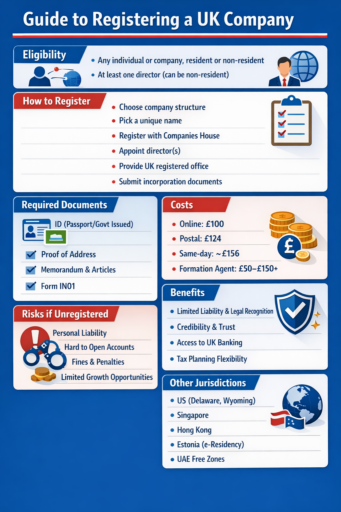
To register a UK company, you must provide identification details, incorporation documents, and a valid UK registered office address.
- Passport or government-issued ID of directors and shareholders
- Proof of residential address (this can be outside the UK)
- Memorandum and Articles of Association
- Completed incorporation form (IN01)
- UK registered office address
Some formation agents may also request additional documentation, especially when directors or shareholders are non-residents, to comply with identity verification and anti-money laundering checks.
These may include:
- Certified copies of identification documents (notarized or verified by a lawyer or accountant)
- Proof of address translated into English if originally issued in another language
- Bank reference letters or professional references to verify credibility
- Source of funds or source of wealth declarations
- Video or live identity verification checks conducted online
- Enhanced due diligence forms for higher-risk jurisdictions
These extra steps help ensure compliance with UK regulations and may vary depending on the formation agent and the applicant’s country of residence.
How much will it cost to register a business in the UK?
Registering a company in the UK typically costs £100 for online incorporation as of 2026, with higher fees for paper filings or additional services.
- Online registration via Companies House – £100
- Postal registration – £124
- Same-day incorporation (via software/agents) – around £156
- Using a formation agent – typically £50–£150+ on top of the government fee, depending on included services
Additional costs may include VAT registration, opening a UK business bank account, and professional services such as accounting, registered office services, and compliance support.
Should I register my small business in the UK?
You should register your small business in the UK if you want limited liability protection, plan to trade at scale, or expect your revenue to exceed key thresholds such as the £1,000 trading allowance for sole traders or the £90,000 VAT threshold.
Registration becomes particularly important once your business grows beyond these points, or if you want stronger legal and financial protection.
Registering your business offers several key advantages:
- Legal recognition and limited liability protection – Your business becomes a separate legal entity, protecting your personal assets from business debts.
- Stronger credibility and trust – A registered company is more credible to clients, suppliers, and financial institutions.
- Access to UK banking and financial systems – You can open business bank accounts, process payments, and engage with the UK financial ecosystem.
- Greater tax planning flexibility – Operating as a limited company can offer more structured and potentially tax-efficient options as your income grows.
What are the potential risks of operating an unregistered business?
Operating an unregistered business in the UK exposes you to personal liability, limited financial access, and potential compliance risks.
- Personal liability for debts and legal claims – You are personally responsible for all business obligations, meaning your personal assets can be used to settle debts or lawsuits.
- Difficulty opening a bank account or securing contracts – Many banks, clients, and suppliers require a registered business, making it harder to operate or scale.
- Fines and penalties from HMRC or Companies House – Failure to register when required or comply with tax obligations can result in financial penalties and legal consequences.
- Limited growth opportunities – Without formal registration, it can be harder to access funding, attract partners, or expand your business.
Other Jurisdictions That Allow Non-Residents to Register a Company
Non-residents can legally register companies in other countries, such as the United States, Singapore, Hong Kong, Estonia, and the United Arab Emirates.
- United States (Delaware or Wyoming) – Non-residents can form LLCs or corporations without living in the US, though tax obligations can be more complex.
- Singapore – Foreigners can register a company with at least one local resident director or corporate nominee, benefiting from low corporate tax and business-friendly regulations.
- Hong Kong – Non-residents can incorporate a company with a local registered address and rely on service providers for compliance, ideal for trading and international operations.
- Estonia (e-Residency) – Offers fully digital company formation and banking solutions, enabling remote management from anywhere in the world.
- United Arab Emirates (Free Zones) – Many free zones allow 100% foreign ownership, no corporate tax for certain periods, and simplified incorporation processes.
When comparing different jurisdictions, non-residents should carefully consider factors such as corporate tax rates and compliance obligations, the ease of opening a bank account, and processing international payments.
They should also evaluate the legal protections available for shareholders and directors, as well as the overall costs and ongoing administrative requirements.
Evaluating these factors will help ensure you choose the most suitable location for your business operations.
Conclusion
Registering a UK company as a non-resident shapes how your business interacts with global markets, investors, and partners from day one.
Decisions made during incorporation, from director structure to registered office setup, influence your ability to expand, access banking, and manage cross-border taxation efficiently.
For many non-residents, the real value lies in treating the UK entity as a strategic bridge: a platform that balances credibility, flexibility, and regulatory alignment while preserving the option to scale internationally.
Thinking ahead at this stage can turn what seems like a simple registration into a framework for long-term operational resilience and global reach.
FAQs
Can I run a business without registering in the UK?
Yes, you can operate as a sole trader or partnership without registering a company.
However, you must register with HMRC if your self-employment income exceeds £1,000 per year, and you will not have limited liability or the same credibility as a registered company.
Can a non-UK resident be a UK company director?
Yes, non-residents can serve as directors.
There’s no residency requirement, but each director must be at least 16 years old and not disqualified.
Can you have a business in the UK but live abroad?
Absolutely. You can own and operate a UK company while living overseas.
A UK registered office is required, but directors and shareholders can be abroad.
What is the 5 year non-resident rule?
This rule relates to UK tax residency for directors.
If a non-resident director spends more than 183 days per year in the UK over five years, they may be deemed UK tax resident, affecting personal and corporate tax obligations.
Pained by financial indecision?

Adam is an internationally recognised author on financial matters with over 830million answer views on Quora, a widely sold book on Amazon, and a contributor on Forbes.