A retirement visa in Italy, officially the Elective Residence Visa, allows non-EU retirees to live long-term in the country without working, provided they have sufficient passive income.
It is one of Italy’s primary long-stay visa options for financially independent individuals and can lead to renewable residency over time.
This article covers:
- What is the Elective Residence Visa for retirees in Italy?
- How long can I stay in Italy with a retirement visa?
- How to apply for Elective Residence in Italy?
- How much does a retirement visa cost in Italy?
- How long does it take to get an elective residency visa in Italy?
Key Takeaways:
- The retirement visa requires stable passive income and prohibits employment in Italy.
- Single applicants generally need around €31,000+ per year, with higher amounts for couples or families.
- Residency is renewable and can lead to permanent residence and eventual citizenship.
- Southern regions provide the most affordable cost of living for retirees.
My contact details are hello@adamfayed.com and WhatsApp +44-7393-450-837 if you have any questions.
For digital nomad or residence visas that require income, assets, or qualifying investments, we can help structure suitable investment solutions that may align with those requirements, depending on your circumstances.
The information in this article is for general guidance only. It does not constitute financial, legal, or tax advice, and is not a recommendation or solicitation to invest. Some facts may have changed since the time of writing.

What is a retirement visa in Italy?
An Italian retirement visa is officially known as the Elective Residence Visa (ERV).
It is designed for non-EU nationals who can support themselves financially without working in Italy.
The visa is governed under Italy’s immigration framework (notably the Testo Unico sull’Immigrazione, Legislative Decree No. 286/1998).
Unlike work visas, the ERV strictly prohibits employment or business activity, meaning applicants must rely entirely on passive income sources.
To maintain this status, applicants must:
- Demonstrate consistent and sufficient passive income
- Maintain valid health insurance coverage
- Secure residential accommodation in Italy
- Renew their residence permit periodically after arrival
This visa is particularly suited for retirees because it offers a clear legal pathway to residency without requiring investment or employment.
Why this visa is popular among retirees:
- It requires passive income, not employment
- It allows long-term residence with renewals
- It can lead to permanent residency after 5 years
- It provides a pathway to citizenship after 10 years
How long can you stay in Italy on a retirement visa?
You can initially stay in Italy for up to 1 year on a retirement visa, based on the validity of your first residence permit, with the option to renew it long-term as long as you continue meeting the requirements.
The Elective Residence Visa itself allows entry into Italy, but your actual stay is governed by the residence permit (permesso di soggiorno) issued after arrival.
Typical stay timeline:
- Initial stay: Apply for a residence permit within 8 days of arrival
- First residence permit: Typically valid for 1 year
- Renewals: Extendable annually or every 2 years, depending on your situation
- Long-term residency: Available after 5 years of continuous legal residence
- Citizenship: Possible after 10 years of legal residence
How to apply for a retirement visa in Italy?
You apply for a retirement visa in Italy by submitting an Elective Residence Visa application through the Italian consulate in your home country before traveling.
Here are the steps:
1. Prepare documents – Gather all required paperwork, including proof of passive income, accommodation, and health insurance
2. Submit application – File your visa application with the Italian consulate that has jurisdiction over your residence
3. Attend interview – Appear for an interview if requested by the consulate
4. Wait for decision – Allow time for processing and possible additional document requests
5. Enter Italy and apply for permit – Travel to Italy and apply for your residence permit (permesso di soggiorno) within 8 days of arrival
What are the requirements for a retirement visa in Italy?
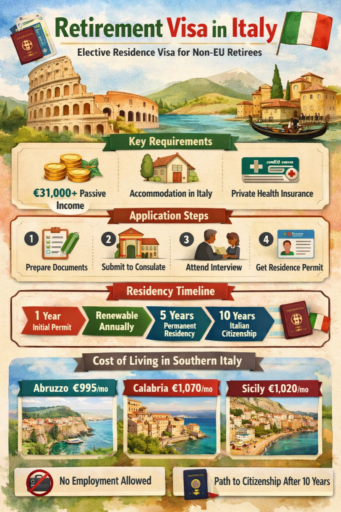
To qualify for a retirement visa in Italy, you must show sufficient passive income and secured accommodation in Italy, proving you can live there without working.
Key requirements:
- Proof of passive income – Pensions, dividends, rental income, or similar non-employment sources
- Minimum income threshold – Varies by consulate but must be stable and sufficient
- Accommodation in Italy – A rental contract or proof of property ownership
- Comprehensive health insurance – Valid coverage for your stay in Italy
- Clean criminal record – Background checks may be required
- No intention to work – You cannot be employed under this visa
How much money do you need for a retirement visa in Italy?
For Italy’s retirement visa (Elective Residence Visa), Italian law does not set a fixed national income limit. However, most consulates use a ballpark minimum of €31,000 per year for one applicant to demonstrate sufficient financial means without working in Italy.
In practice, the amount varies based on your situation and where you apply:
- Single applicant: usually ~€31,000 per year (approximately €2,580/month) as a legal minimum
- Couple: typically ~€38,000 – €40,000+ per year combined
- Family: consulates may add roughly 20% for a spouse and ~5% for each child on top of the base amount
Many Italian consulates actually expect proof of more than the legal minimum, often significantly higher, to demonstrate you can live comfortably in Italy without work.
Additional costs and fees to prepare for:
- Visa application fee: ~€116 (varies slightly by consulate)
- Residence permit (permesso di soggiorno) fee: €30–€160 based on duration
- Health insurance: €300–€1,000+ per year for comprehensive coverage
- Document translations and legalization: €50–€200 depending on consulate requirements
Factoring these fees, it’s important to budget not only your annual passive income but also one-time application and setup costs when planning to retire in Italy.
How long does it take to get a retirement visa?
Obtaining a retirement visa in Italy usually takes about 1 to 3 months from the date you submit your application to the consulate, though some cases can take longer based on documentation and consulate workload.
Common causes of delays:
- Incomplete documents – Missing income proof, accommodation papers, or health insurance
- High application volumes – Consulates often handle many long-stay visa requests simultaneously
- Additional verification – Extra scrutiny may be applied to income sources or criminal background
This timeline applies before your arrival in Italy; once in the country, you must also apply for the residence permit (permesso di soggiorno) within 8 days.
Is it difficult to get a retirement visa in Italy?
Getting an Elective Residence Visa in Italy can be moderately challenging, but it is achievable if you meet the financial and documentation requirements.
Why it may be difficult:
- You must provide strict proof of passive income that clearly demonstrates you can support yourself without working in Italy.
- The documentation requirements are detailed and comprehensive, including income statements, property proof, and health insurance.
- Working in Italy is not allowed under this visa, so all income must come from passive sources.
- Approval depends on consulate discretion, which can vary based on your personal situation and the completeness of your application.
Applicants with a strong financial profile and well-prepared paperwork generally succeed without major issues.
How much money is needed to retire in Italy?
To retire comfortably in Italy, you typically need around €1,200 to €2,500+ per month, based on where you live and your lifestyle.
Estimated monthly costs:
- Small towns: €1,200–€1,800
- Mid-sized cities: €1,800–€2,500
- Major cities: €2,500+
Your actual monthly expenses in Italy will depend on several factors.
Housing costs, whether renting or buying property, can significantly impact your budget.
Lifestyle choices, including dining, travel, and leisure activities, will also influence how much you need each month.
Finally, while public healthcare is affordable, opting for private insurance or private care can increase overall costs.
Where is the cheapest place to live in Italy for retirees?
Some of the most affordable regions for retirees in Italy are Abruzzo and Calabria, where property prices and everyday living costs are significantly lower than the national average.
- Abruzzo – Average regional monthly living cost is around €995 per person, significantly below the Italian national average of about €1,300, making everyday expenses more manageable. Housing prices in places like Chieti hover around €950/m², far cheaper than many central regions.
- Calabria – With a regional living cost around €1,070 per month and some of the lowest property prices in Italy (averaging ~€912/m²), Calabria is one of the most affordable areas for retirees.
- Sicily – Offers a low cost of living (~€1,020 per month) and property prices often around €1,000–€1,175/m² or even lower in smaller towns, making it attractive for retirees on a budget.
- Puglia – Slightly higher than Calabria and Abruzzo but still below national averages for living costs (~€1,083 per month), Puglia delivers affordable coastal and countryside options.
Southern and some central regions tend to have lower rental and housing markets (often half or less than northern cities like Milan or Rome), plus cheaper local services and food.
Smaller towns within these regions are especially cost‑effective for retirees who prefer quieter lifestyles.
Healthcare and Insurance Options for Retirees in Italy
Healthcare is one of the most important practical considerations when retiring in Italy, and every retiree needs a clear plan for coverage from the moment they arrive.
Public healthcare (SSN)
Once you have legal residency (a permesso di soggiorno), you can enroll in Italy’s Servizio Sanitario Nazionale (SSN), the national public healthcare system, by registering with your local health authority (ASL).
This gives you access to a general practitioner, specialist referrals, hospital care, diagnostic tests, and subsidized medications at minimal cost.
- GP visits are free and unlimited once enrolled.
- Hospital stays and emergency care are typically free or low‑cost through the SSN.
- Non‑EU retirees must pay a voluntary SSN contribution each year (often around €2,000–€2,800 depending on income) to join the system.
Private health insurance (visa and beyond)
For the Elective Residence Visa, non‑EU retirees must show a private health insurance policy that meets consular requirements (usually valid for at least 12 months and covering urgent care and hospitalization).
Private insurance options include:
- International policies that are often accepted for the visa and valid from day one in Italy.
- Italian‑based plans that integrate with the SSN and may cost roughly €800–€2,000 per year depending on age and coverage level.
- Many retirees start with private insurance to meet visa requirements, then enroll in the SSN once residency is established.
Costs and practical tips
- Basic private coverage designed for visa compliance can cost €450–€1,000 for a year; broader plans range higher.
- Some international policies may be €3,000–€7,000 per year but include wider global coverage.
- Even after SSN enrollment, many retirees keep private insurance for faster specialist access or English‑friendly services.
Quick comparison
- SSN: Best for ongoing, comprehensive care at low cost once enrolled.
- Private insurance: Mandatory for visa entry and useful for faster and broader coverage in the first year or ongoing supplemental care.
Understanding how healthcare works in Italy and planning for both public and private coverage, can greatly improve your retirement experience and help you make the most of the healthcare system available to residents.
Is retiring in Italy a good idea?
Retiring in Italy can be an excellent choice for retirees who have a stable income and want a relaxed lifestyle enriched with culture, cuisine, and scenic surroundings.
Pros:
- Healthcare: Italy has an excellent healthcare system that provides affordable public medical services to residents.
- Culture and history: The country offers a rich cultural heritage, with historic cities, art, and traditions at every turn.
- Climate: Many regions enjoy a Mediterranean climate with mild winters and warm summers.
- Quality of life: Italy provides a high quality of life, combining good food, outdoor living, and strong community ties.
Cons:
- Bureaucracy: Administrative processes in Italy can be slow and sometimes complicated.
- Language barrier: In rural areas, limited English is spoken, which can make daily interactions challenging.
- Visa requirements: The retirement (elective residence) visa has strict financial and documentation requirements that must be met and maintained.
Overall, retiring in Italy is a strong option for those who are financially prepared and value a culturally rich, leisurely European lifestyle.
Conclusion
Securing an Elective Residence Visa lays the groundwork for a smooth and rewarding retirement in Italy.
Beyond meeting income and documentation requirements, retirees benefit most when they align their visa planning with lifestyle choices, such as selecting regions with strong local communities and affordable healthcare.
Many overlook how seasonal living costs, cultural integration, and access to services can impact long-term satisfaction, even if financial thresholds are met.
By approaching the retirement visa as a tool for strategic life design rather than just paperwork, retirees can create a more resilient and enriching experience in Italy.
FAQs
How much bank balance is required for an Italy visa?
For an Italy visa, you generally need €30–€50 per day for short stays or ~€31,000+ annual passive income for a retirement visa to prove you can support yourself.
There’s no fixed requirement beyond demonstrating sufficient funds for your stay.
How many years do you have to stay in Italy to become a citizen?
You can apply for citizenship after 10 years of continuous legal residence in Italy.
How old is the retirement age in Italy?
Italy’s official retirement age is around 67 years, though this varies slightly based on employment history and pension schemes.
Can I buy a house in Italy for $100,000?
Yes, in certain regions like southern Italy or rural towns, properties can be found for $100,000 or less, and sometimes significantly cheaper based on location and condition.
Pained by financial indecision?

Adam is an internationally recognised author on financial matters with over 830million answer views on Quora, a widely sold book on Amazon, and a contributor on Forbes.