Owning real estate abroad usually means you do pay tax on overseas property, either where the property is located, where you are a tax resident, or both.
The exact tax you owe is based on rental income, capital gains, and how your home country treats foreign assets.
This article covers:
- Do I have to declare my foreign property?
- Do I need to report a sale of foreign property?
- How is real property tax computed?
- What are ways to reduce your taxes?
Key Takeaways:
- You may be taxed in both the property’s country and your country of residence.
- Double taxation is often reduced through foreign tax credits or treaties.
- Rental income and capital gains are the most commonly taxed components.
- Non-disclosure of overseas property can lead to penalties and audits.
My contact details are hello@adamfayed.com and WhatsApp +44-7393-450-837 if you have any questions.
The information in this article is not tax advice and may have changed since the time of writing. I can connect you with expert tax support for your specific situation.

What is the basic property tax?
The basic tax on overseas property includes annual ownership tax, plus taxes on any income, profit, or transfer related to that property.
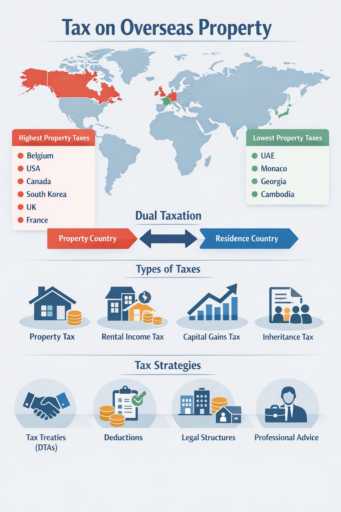
When you own overseas property, taxes typically fall into four main categories:
- Property ownership tax (real property tax)
Annual tax based on assessed property value (varies widely by country) - Rental income tax
Tax on income earned if you lease the property - Capital gains tax (CGT)
Applies when you sell the property at a profit - Inheritance or estate tax
Charged when the property is transferred after death
How to compute real property tax?
Real property tax is calculated by multiplying the property’s assessed value by the applicable tax rate (Real Property Tax = Assessed Value × Tax Rate).
Example:
Suppose you own a condo in Spain valued at €250,000, with a local property tax rate of 0.8%. The annual property tax would be calculated as follows:
- Property value: €250,000
- Tax rate: 0.8%
- Annual tax = €2,000
Factors that can affect the calculation include:
- Different assessment methods – Some municipalities base tax on market value, others on outdated purchase price or cadastral value.
- Local government adjustments – Certain cities apply additional municipal or regional levies.
- Exemptions or caps – Senior citizens, primary residences, or newly built properties may qualify for reduced rates.
Some countries reassess property annually, while others use older valuations, which can significantly impact your final tax bill.
Do I need to declare overseas property?
Yes. In most cases, you must declare overseas property to tax authorities, even if it does not generate income.
Typical reporting requirements include:
- Declaring foreign assets
Many countries require you to disclose ownership of overseas real estate as part of annual asset reporting or separate foreign asset declarations. - Reporting rental income
Any income earned from leasing the property must be reported, usually as part of your worldwide income, even if tax was already paid abroad. - Disclosing capital gains on sale
If you sell the property, you must report any profit made, including details of purchase price, sale price, and applicable taxes paid in the foreign country.
For example:
- Many countries require foreign asset disclosures (e.g., FATCA-style or similar frameworks)
These systems are designed to track offshore assets and income, often requiring detailed reporting thresholds and documentation. - Failure to declare can trigger audits or penalties
Non-compliance may result in fines, back taxes, interest charges, or deeper investigations by tax authorities.
If you’re a tax resident in a country that taxes worldwide income, disclosure is almost always mandatory.
Do I pay tax on overseas property?
Yes. You are generally required to pay tax on overseas property both in the country where the property is located and in your country of tax residence.
- Source country (where the property is located) – Taxes such as rental income tax and capital gains tax are applied locally according to the country’s rules.
- Residence country (where you live or are a tax resident) – Most countries tax residents on their worldwide income, including income and gains from foreign property, such as the United States, United Kingdom, Canada, and Australia.
To prevent double taxation, many countries allow you to claim foreign tax credits or rely on Double Tax Agreements (DTAs), although you must still report the property and its income in both jurisdictions.
Which country has the lowest property tax?
The United Arab Emirates and Monaco are among the countries with the lowest property taxes, offering little to no annual property tax for owners.
Countries known for relatively low property taxes include:
- United Arab Emirates – No annual property tax (though some registration or service fees may apply)
- Monaco – No property tax for residents
- Georgia – Very low annual property tax rates ranging roughly from 0.05% to 1% of assessed value, with exemptions at lower income brackets and typically closer to the 0.05%–0.2% band for most individual owners under local rules
- Cambodia – Annual property tax is 0.1% of assessed value above about USD 25,000; below that threshold no property tax is generally charged
However, low property tax doesn’t always mean a low overall tax burden.
Other costs, such as municipal fees, transfer taxes, and income taxes, can add up, so it’s important to consider the total tax environment before investing in overseas property.
Which country has the highest property tax rate?
Belgium has one of the highest effective property tax rates in the world, with municipal surcharges often pushing total annual taxes above 2–3% of assessed value.
Other high property tax jurisdictions include:
- United States – Some states, particularly in the Northeast and Midwest (e.g., New Jersey, Illinois), have effective property tax rates that exceed 2% of assessed value per year, making holding costs very high for property owners.
- Canada – Municipal property tax rates vary by city but generally range from 0.7% up to over 2% of assessed value annually, depending on location and property classification.
- South Korea – Base property tax rates for most residential properties start low (0.1–0.4%), but high-value properties face additional levies, with effective annual rates rising above 1% in some cases.
- United Kingdom – While the Council Tax varies by property band, additional costs such as stamp duty land tax increase overall ownership and transaction expenses.
- France – Owners pay multiple property-related taxes, including taxe foncière (land tax) and taxe d’habitation, which can add a moderate annual burden.
In all of these countries, high property tax rates and associated fees can significantly reduce net returns, so overseas investors must carefully consider both recurring taxes and other holding costs before purchasing property abroad.
How to pay foreign taxes?
You pay foreign property taxes by registering with the local tax authority and submitting payment through approved channels in the country where the property is located.
Common payment methods include:
1. Local banks – Many countries allow tax payments at designated banks.
2. Online government portals – Some jurisdictions provide secure digital platforms for tax submission.
3. Authorized agents – Certain countries allow certified agents or tax representatives to handle payments on your behalf.
For non-residents:
- You may need a local tax representative to act on your behalf.
- Some countries require a local bank account to process payments.
Always keep records of tax receipts and payment confirmations, as they are essential for claiming foreign tax credits in your home country.
Is it worth investing in overseas property?
Investing in foreign property can boost your rental income, provide potential capital gains, and diversify your portfolio across global markets, although it comes with complex tax and regulatory obligations.
Pros:
- Geographic diversification – Owning property in different countries spreads your investment risk across multiple markets.
- Potential higher yields – Some overseas markets offer rental returns or property appreciation that exceed those in your home country.
- Currency upside – Favorable exchange rate movements can increase the value of rental income or the property itself.
Cons:
- Complex tax compliance – You must navigate both local and home-country tax rules, including reporting, deductions, and potential double taxation.
- Legal and ownership restrictions – Some countries limit foreign ownership or require permits and local approvals.
- Currency and political risks – Exchange rate volatility, inflation, or regulatory changes can affect property value and income.
Even if a property seems profitable, the tax layer alone can significantly reduce net returns, making careful planning essential before investing.
What are some strategies to reduce taxes?
You can reduce taxes on overseas property through careful planning, use of legal structures, and taking advantage of available deductions and treaties.
- Use tax treaties (DTAs) – Take advantage of Double Tax Agreements to claim foreign tax credits and avoid paying tax twice on the same income.
- Own through a legal structure – Holding property via companies, trusts, or other legal entities can help optimize tax liability, depending on the jurisdiction and type of income generated.
- Claim allowable deductions – Deductible expenses often include property maintenance costs, property management fees, mortgage interest, and insurance premiums, which reduce taxable rental income.
- Time the sale strategically – Planning the sale of a property based on holding period or local capital gains rules can minimize capital gains tax exposure.
- Choose tax-efficient jurisdictions – Selecting countries with favorable property tax regimes or exemptions for foreign investors can significantly lower your overall tax burden.
Professional advice is critical, as cross-border tax rules are highly technical and penalties for errors or non-compliance can be severe.
Navigating Taxes and Legal Rules with Professional Guidance
Owning property abroad requires managing taxes, reporting obligations, and legal rules across multiple jurisdictions.
Even straightforward matters like claiming deductions, applying foreign tax credits, or structuring ownership can become complicated without local knowledge.
Professional guidance can help you:
- Optimize your tax position – Cross-border tax advisors ensure you claim available credits, avoid double taxation, and structure ownership efficiently.
- Ensure legal compliance – Local lawyers or notaries verify property titles, contracts, and compliance with foreign regulations.
- Manage accounting and reporting – Accountants track rental income, expenses, and generate documentation for both local authorities and your home country.
- Plan for inheritance and estate taxes – Estate planners help structure property transfers to minimize taxes and protect your beneficiaries.
Failing to seek professional support can lead to overpaid taxes, penalties, or missed opportunities to legally reduce your obligations, making expert guidance a critical part of successful overseas property investment.
Conclusion
Investing in overseas property offers opportunities for income, diversification, and long-term growth, but the complexity of cross-border taxes and legal requirements is often underestimated.
Strategic planning, careful selection of jurisdictions, and professional guidance are what separate a profitable investment from a costly one.
Approaching international real estate with a proactive mindset on compliance, reporting, and tax efficiency not only protects your assets but also maximizes the true potential of your investment.
FAQs
What is the 2% rule for property?
The 2% rule is a real estate guideline stating that a property’s monthly rent should be roughly 2% of its purchase price.
For example, a $100,000 property would need about $2,000 in monthly rent to meet this benchmark.
How to get 100% tax exemption?
Full property tax exemption is rare but can be achieved in countries with no income or property tax, by qualifying for primary residence exemptions, or through careful tax residency planning.
However, anti-avoidance rules are increasingly strict, so professional guidance is essential.
What is the most overlooked tax deduction?
The most overlooked property tax deductions are expenses such as property management fees, repairs and maintenance, depreciation, and travel costs related to managing the property.
Claiming these deductions can significantly reduce your taxable rental income.
What happens if I don’t declare my foreign income?
If you don’t declare your foreign income, you may face financial penalties, interest charges, tax audits, and in severe cases, criminal liability.
Automatic global information sharing has made non-disclosure increasingly risky.
Pained by financial indecision?

Adam is an internationally recognised author on financial matters with over 830million answer views on Quora, a widely sold book on Amazon, and a contributor on Forbes.