Setting up a UK company as a non-resident typically costs £150 to £800+ in the first year, which covers registration, a UK address, and basic compliance services.
While the registration itself is cheap, the real cost comes from compliance, address services, and ongoing maintenance.
This article covers:
- Can I have a business in the UK but don’t live there?
- How much money is needed to start a business in the UK?
- What are the requirements to register a company in the UK?
- What is the procedure to start a company in the UK?
- What are the benefits of registering a company in the UK?
Key Takeaways:
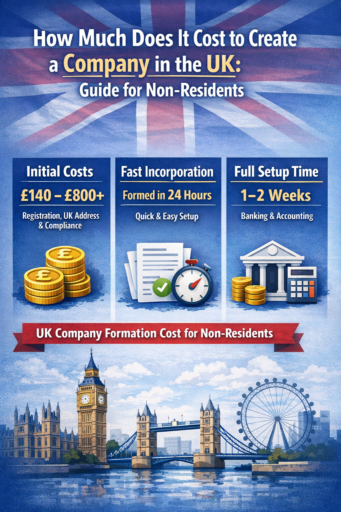
- First-year costs typically range from £140–£800+, including registration, UK address, and compliance.
- A UK registered office and professional support are essential for meeting legal and tax obligations.
- Most companies can be formed in 24 hours online.
- The UK is cost-effective, but banking and tax compliance are the main hurdles.
My contact details are hello@adamfayed.com and WhatsApp +44-7393-450-837 if you have any questions. We also offer bespoke structuring solutions tailored to your situation.
The information in this article is for general guidance only, does not constitute financial, legal, or tax advice, and may have changed since the time of writing.

Can I setup a company in the UK without residency?
Yes. Non-residents can legally register and own a UK company without living in the UK.
Under the Companies Act 2006, there is no residency requirement for directors or shareholders, making the UK highly accessible to foreign entrepreneurs.
Through Companies House, you can:
- Register a company fully online
- Appoint foreign directors and shareholders
- Own 100% of the business without a UK partner
However, you must still meet ongoing compliance and tax obligations.
Tax Obligations
- Register for Corporation Tax with HM Revenue and Customs
- File annual tax returns
- Register for VAT if applicable
In practice, most non-residents use formation agents or accountants to stay compliant.
You don’t need to live in the UK, but you do need to follow UK company law and reporting rules.
How much does it cost to set up a company in the UK?
A lean setup with basic registration and a standard UK address typically costs around £140–£200 in the first year.
A fuller service, including formation agent support, compliance assistance, and premium registered office services, usually falls in the £300–£800+ range.
Basic Registration Costs
The core government fee for company incorporation with Companies House is £100 for standard online filing (processed within ~24 hours) or £156 for same-day service.
Paper filings are also possible but take longer and cost more.
Some formation agents bundle the filing fee into packages, while others list it separately.
Formation Agent Fees
While filing directly with Companies House is possible, many non-residents use an agent to simplify the process and meet UK address requirements.
Basic digital packages often start very low (sometimes under £20), with more comprehensive packages including registered office or compliance support, typically ranging from £50–£150. Premium service bundles with extra features may cost more.
Registered Office and Address Services
Every UK company must have a UK registered office address; providers typically charge £39–£99+ per year, depending on location (standard or central London).
Directors also require a service address, which is often included or can be added for a similar cost.
Business mailing or virtual office services for correspondence and client communication incur additional fees.
Ongoing and Professional Costs
After incorporation, recurring obligations include:
- Annual confirmation statement filing (fee applies)
- Preparation of accounts and corporation tax returns (accountant fees vary widely)
- Optional services such as bookkeeping, payroll, or VAT returns
Professional accounting and compliance support can add several hundred pounds per year, depending on the level of service required.
In what ways can a company reduce costs?
Reducing overhead by choosing basic formation packages is one effective strategy, while additional measures like limiting optional services, can further manage expenses without compromising essential support.
Cost-Saving Strategies
- Choose formation packages wisely: Basic incorporation bundles reduce upfront costs, though premium packages may provide extra compliance support and faster processing.
- Evaluate nominee or secretary services: Limiting these can save fees, but professional nominees can help ensure privacy and reduce administrative errors.
- Leverage digital accounting tools: Online bookkeeping software can handle routine tasks at lower cost, while full-service accountants offer expert guidance that can prevent costly mistakes.
- Register for VAT only when required: Avoiding early registration can reduce reporting burdens, but voluntary registration may provide benefits for reclaiming VAT on business expenses.
- Operate remotely: Working from home or virtually lowers overhead, though a physical office may strengthen business credibility for certain clients.
For small or solo businesses, balancing lean operations with strategic investment in professional services is key to maintaining profitability while ensuring compliance and operational efficiency.
How do I register a company in the UK for non-residents?
Registration for a UK company can be completed fully online, with the official incorporation and basic tax registration handled efficiently through formal channels.
Step-by-Step Process
1. Choose a company name: Submit a unique name that meets Companies House regulations.
2. Prepare company structure: Specify directors, shareholders, and share allocation for filing purposes.
3. Submit incorporation documents: File all necessary forms with Companies House online.
4. Receive Certificate of Incorporation: Obtain legal confirmation of company formation.
5. Register for Corporation Tax: Complete registration with HM Revenue and Customs to comply with tax obligations.
6. Open a business bank account: Set up a bank account to manage company finances and transactions.
Timeline
- Online registration: Usually processed within 24 hours.
- Full setup: Including bank account and any professional compliance services, generally takes 1–2 weeks.
What do I need to form an UK company as a non-resident?
UK company formation for a non‑resident requires a clearly defined company structure, appropriate documentation, and a UK registered address to satisfy regulatory and compliance requirements.
Core Requirements
- Company name: Must be unique and compliant with UK naming rules (no offensive or restricted terms).
- Director: At least one director aged 16 or over (no residency requirement).
- Shareholder(s): At least one shareholder (can be the same person as the director).
- UK registered office address: A physical address in the UK for official correspondence and public record.
- Standard Industrial Classification (SIC) code: A code that describes the nature of the company’s primary business activity.
Documents Required
- Passport or government‑issued ID: For directors and shareholders (copies are usually sufficient for registration).
- Proof of address: Recent utility bill or bank statement to support compliance checks (may be required by formation agents or service providers).
Common Additional Services
- Nominee services: Optional directors or secretaries provided by a service provider for privacy or administrative convenience.
- Virtual office address: An add‑on address service for mail handling and professional presentation.
- UK‑based accountant: Commonly engaged to manage tax registrations, bookkeeping, and ongoing compliance.
Is it worth starting business in the UK?
Starting a UK business is generally worthwhile for non-residents seeking a credible international presence and access to global markets.
Advantages
- Strong global reputation: UK companies are recognized worldwide, enhancing credibility with clients and partners.
- Access to UK and international markets: The UK serves as a gateway for European and global trade.
- Transparent legal system: Clear corporate and tax regulations support predictable business operations.
- Relatively low setup cost: Incorporation and basic compliance are affordable compared with many other jurisdictions.
- 100% foreign ownership allowed: Non-residents can fully own and control their company without local partners.
What are the challenges of businesses in the UK?
Non-resident businesses in the UK face specific challenges in banking, taxation, and compliance that require careful planning.
Common Challenges
- Opening a UK business bank account remotely: Many banks require additional verification for non-residents, making account setup slower or more complex.
- Understanding UK tax obligations: Corporation tax, VAT, and payroll requirements can be complex for international owners.
- Ongoing compliance and reporting: Annual confirmation statements, accounts filing, and record-keeping must be maintained accurately.
- Currency exchange and international transfers: Managing foreign currency payments and transfers can add operational complexity.
- Potential double taxation: Companies may be subject to tax in both the UK and the home country, depending on double taxation treaties.
Professional guidance from a UK accountant or advisor can help mitigate most of these challenges and ensure compliance.
Choosing the Right Company Structure for Cost Efficiency
The type of company chosen directly affects both initial UK company formation costs and ongoing operational expenses, making it a key factor for non-residents aiming to optimize resources.
- Private Limited Company (Ltd):
The most common choice for non-residents, offering a balance between affordable registration (£140–£200 for a lean setup) and predictable compliance costs. Formation agent packages and registered office services are widely available at varying price points, allowing flexibility in managing expenses. - Public Limited Company (PLC):
PLCs require higher setup fees, mandatory share capital, and extensive reporting, resulting in significantly higher costs. They are typically suitable only for businesses planning to raise capital publicly. - Limited Liability Partnership (LLP):
LLPs provide management flexibility and pass-through taxation, but formation, accounting, and compliance fees can be higher, especially with multiple partners. - Sole Trader (not a company, but a business structure):
Simple and inexpensive to start, yet offers no limited liability and may reduce credibility in international markets. While tax filings are straightforward, operational risks fall directly on the owner.
By evaluating initial setup fees, annual compliance costs, and long-term operational needs, non-residents can select a structure that minimizes unnecessary expenses while still supporting growth, credibility, and legal compliance.
Conclusion
Forming a UK company as a non-resident provides access to a stable legal framework, international markets, and full ownership rights, making it an attractive option for entrepreneurs looking to establish a credible global presence.
However, success is not automatic.
Careful planning, a clear company structure, and strategic support are essential to navigate compliance, banking, and taxation effectively.
Investing in professional guidance early can prevent costly mistakes, streamline operations, and unlock potential tax efficiencies, while also helping to select the right formation package, registered office service, and ongoing accounting support.
By balancing cost-conscious decisions with targeted professional support, non-resident business owners can leverage the UK’s regulatory advantages, ultimately creating a scalable and sustainable platform for international growth.
FAQs
How long does it take to form a company in the UK?
Most UK company registrations submitted online via Companies House are processed within about 24–48 hours once the application is submitted and identity checks are completed.
Full operational setup, including opening a business bank account and arranging compliance support, often takes around 1–2 weeks.
What are the different types of companies in the UK?
The main types of companies in the UK are Private Limited Company (Ltd), Public Limited Company (PLC), Limited Liability Partnership (LLP), and Sole Trader (a business structure rather than a company).
For non-residents, the Private Limited Company (Ltd) is the most common choice due to its simplicity and flexibility.
What are 5 disadvantages of a private company?
Private companies face more administrative obligations, public disclosure of company information, annual filings, corporation tax, and potential complexity for non-residents.
These factors make management more formal and regulated compared with simpler business structures like sole traders.
Is it worth setting up a limited company in the UK?
Setting up a UK limited company is worthwhile for businesses seeking limited liability protection, a professional image, and the ability to scale or operate internationally.
For small or locally focused operations, however, the compliance requirements may outweigh the benefits.
Pained by financial indecision?

Adam is an internationally recognised author on financial matters with over 830million answer views on Quora, a widely sold book on Amazon, and a contributor on Forbes.