Transferring assets to a trust as an NRI involves legally moving ownership of your property, investments, or funds into a trust structure through a trust deed and compliant transfer process.
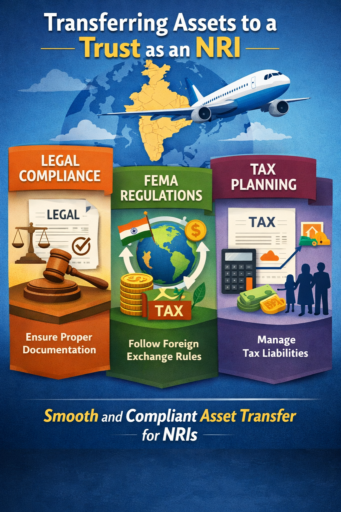
It requires careful coordination of Indian laws, FEMA rules, and tax implications to ensure the transfer is valid and efficient.
This article covers:
- What assets are settled into a trust?
- How to transfer assets to a trust in India?
- What are the tax implications of transferring assets to a trust?
- What are the benefits of starting a trust in India?
Key Takeaways:
- Asset transfer to a trust means changing legal ownership to the trust entity.
- Tax treatment is determined by whether the trust is revocable or irrevocable.
- FEMA and RBI rules apply to NRI-related transfers.
- Trusts give control over assets and facilitate succession planning while requiring legal oversight and ongoing compliance.
My contact details are hello@adamfayed.com and WhatsApp +44-7393-450-837 if you have any questions. We also offer bespoke structuring solutions tailored to your situation.
The information in this article is for general guidance only, does not constitute financial, legal, or tax advice, and may have changed since the time of writing.

Can an NRI set up a trust in India?
Yes, an NRI can set up a trust in India under the Indian Trusts Act, 1882.
NRIs are allowed to act as settlors (the person creating the trust), trustees, or beneficiaries, subject to compliance with FEMA (Foreign Exchange Management Act) regulations.
There are generally two types of trusts NRIs use:
- Revocable trusts (can be altered or dissolved)
These trusts allow the settlor to retain control and make changes or revoke the trust during their lifetime. They are more flexible but may offer limited tax advantages since income is often taxed in the hands of the settlor. - Irrevocable trusts (fixed structure, often used for tax and estate planning)
Once established, these trusts generally cannot be modified or terminated without beneficiary consent or court approval. They are commonly used for long-term wealth transfer and may provide stronger asset protection and potential tax efficiencies.
However, if foreign assets or beneficiaries are involved, cross-border regulations and reporting requirements must be carefully managed.
Why do you put your assets in a trust?
You put your assets in a trust to protect, manage, and transfer your wealth according to predefined terms rather than relying on default inheritance laws.
NRIs often use trusts as part of long-term financial and estate planning strategies.
Key reasons include:
- Asset protection from creditors or legal disputes
Assets placed in certain types of trusts, especially irrevocable ones, are no longer legally owned by the settlor. This can help shield them from future claims, lawsuits, or financial liabilities. - Estate planning to ensure smooth succession
A trust allows you to clearly define beneficiaries and distribution terms, reducing ambiguity and family disputes. It ensures your assets pass on according to your wishes without complications. - Avoiding probate delays in India
Assets held in a trust do not typically go through probate, which can be time-consuming and costly. This allows faster access and transfer of assets to beneficiaries after death. - Tax planning (depending on trust structure)
Certain trust structures may offer tax efficiencies depending on how income is distributed and taxed. However, the benefits vary and require careful structuring to comply with Indian tax laws. - Control over distribution of wealth across generations
Trusts let you set conditions, timelines, or milestones for asset distribution. This is especially useful for managing wealth for minors or ensuring long-term financial discipline.
How are assets transferred to a trust?
As an NRI, transferring assets to a trust involves legally moving ownership of your India-based (and sometimes foreign) assets into the trust while complying with Indian laws and FEMA regulations.
The process typically includes:
1. Drafting the trust deed
This is the foundational legal document that establishes the trust and defines its terms, beneficiaries, and trustee powers.
For NRIs, it should also account for cross-border elements such as foreign assets, beneficiaries, or governing laws.
2. Identifying assets for transfer
You must clearly list all assets being transferred, including their current ownership details and valuation.
For NRIs, this step may involve assets held in India, NRO/NRE accounts, or even overseas holdings depending on the trust structure.
3. Executing transfer documents
Ownership of each asset must be formally reassigned to the trust using the appropriate legal process.
-Real estate: A registered transfer deed is required to legally move property into the trust
-Bank accounts/securities: Ownership is changed or accounts are retitled in the name of the trust, subject to banking rules
-Shares: Transfer forms must be executed and company records updated to reflect the trust as the new owner
4. Stamp duty and registration
Certain transfers, especially immovable property, require payment of stamp duty and formal registration with authorities.
The applicable cost and process vary by state and can significantly impact the overall transfer.
5. Compliance with FEMA and RBI regulations
Since NRIs are involved, all transfers must comply with foreign exchange rules governing repatriation, ownership, and reporting.
This is particularly important when funds or assets move between India and another country.
Once completed, the trust becomes the legal owner of the assets, and the settlor no longer holds direct ownership over them.
Costs of Transferring Assets to a Trust as an NRI
Moving assets to a trust as an NRI involves legal, registration, valuation, tax advisory, and ongoing administration costs, which can range from ₹1 lakh to ₹10 lakhs or more based on the complexity of the assets and the scope of services required.
1. Legal and professional fees
Hiring a lawyer or trust professional to draft the trust deed, review compliance requirements, and handle registration is essential.
Depending on the complexity of assets and cross-border considerations, fees can range from ₹50,000 to several lakhs.
2. Stamp duty and registration charges
For immovable property, the transfer requires paying stamp duty, which varies by state (usually 5%–10% of property value) and registration fees.
Financial assets such as shares or mutual funds may also have nominal transfer fees.
3. Valuation and documentation costs
Accurate valuation of assets such as property, securities, or business interests is often required.
Certified valuations and notarized documents may add to the cost.
4. Tax compliance and advisory costs
NRIs may need to consult tax advisors to plan for capital gains, gift tax, and trust income taxation.
These advisory fees help prevent costly errors or penalties.
5. Ongoing trust administration costs
Trustees may charge fees for ongoing management, accounting, and filing of tax returns.
Depending on asset size, this could be a fixed annual fee or a percentage of assets under management.
Planning for these costs upfront, ensures efficiency to transfer assets to a trust as an NRI, maintain compliance, and maximize the trust’s benefits.
What type of assets can I put into a trust?
As an NRI, you can put assets like real estate, bank deposits, shares, and other investments into a trust, subject to Indian laws and FEMA restrictions.
NRIs can transfer a wide range of assets into a trust, including:
- Immovable property (residential or commercial real estate in India)
You can transfer residential and commercial properties you legally own into a trust through a registered deed. However, acquisition and transfer must comply with NRI property ownership rules. - Bank deposits and cash
Funds held in NRO or permitted accounts can be transferred into a trust, subject to banking and regulatory guidelines. Proper documentation is required to reflect the trust as the new owner or beneficiary. - Shares, mutual funds, and bonds
Financial securities can be reassigned to a trust by updating ownership records with the relevant institutions. This process must follow SEBI regulations and may involve additional compliance for NRIs. - Business interests or partnership stakes
Ownership in companies or partnerships can be transferred to a trust if permitted by governing agreements. This may require consent from other stakeholders and adherence to applicable corporate laws. - Jewelry and other valuables
Tangible assets like gold, jewelry, or collectibles can be included in a trust by clearly documenting and assigning ownership. Valuation and proper record-keeping are important for legal and tax purposes.
However, certain assets, especially agricultural land, may have restrictions depending on NRI eligibility rules.
Are transfers to a trust taxable?
Transfers to a trust are not automatically taxable for NRIs, but they can trigger tax based on how the transfer is structured, the type of trust, and the relationship between parties.
Taxation works as follows:
- Revocable trusts: Income is taxed in the hands of the settlor
Any income generated from the trust assets is clubbed back to the NRI settlor and taxed at applicable slab rates (up to 30% plus surcharge and cess). - Irrevocable trusts: Tax depends on structure
If the trust is specific, income is taxed in the hands of beneficiaries. If discretionary, it is typically taxed at the maximum marginal rate (around 30% plus surcharge and cess).
Key tax considerations for NRIs:
- Transfer of assets may trigger capital gains tax
If the transfer qualifies as a transfer under tax law, capital gains may apply depending on the asset type and holding period. Long-term capital gains for NRIs are commonly taxed between 12.5% and 20%, depending on the asset. - Gifts to trusts can be taxable in certain cases
If assets are transferred without consideration, they may be treated as gifts. Amounts above ₹50,000 can be taxable in the hands of the recipient unless exemptions apply (e.g., transfers involving relatives). - Clubbing provisions may still apply
Even in some irrevocable structures, income may be taxed back to the settlor if conditions for control or benefit are met.
For NRIs, tax exposure may arise in both India and the country of residence, making Double Taxation Avoidance Agreements (DTAA) important to avoid double taxation.
What are the disadvantages of using a trust?
Using a trust as an NRI can be costly, complex, and require ongoing compliance, making careful planning essential.
- Initial setup costs and legal complexity
Establishing a trust requires professional legal assistance, drafting a detailed trust deed, and registering assets, which can be expensive and time-consuming. - Ongoing compliance and administrative burden
Trusts must maintain proper records, file taxes, and comply with regulations, which requires continuous management and sometimes professional oversight. - Irrevocable trusts lack flexibility
Once created, irrevocable trusts generally cannot be altered or dissolved easily, limiting the settlor’s ability to respond to changing circumstances. - Taxation can be complex and sometimes unfavorable
Depending on the type of trust and structure, income may be taxed at high rates in the trust or in the hands of beneficiaries, requiring careful planning to avoid unexpected liabilities. - Regulatory scrutiny, especially for cross-border structures
NRIs transferring assets to Indian trusts may face additional compliance checks under FEMA and reporting obligations, making errors costly.
Improper structuring can negate the intended benefits and may expose assets to unnecessary taxes or legal challenges.
Conclusion
For NRIs, a trust can be more than a legal vehicle. It can act as a strategic anchor for navigating cross-border financial complexities.
Beyond protecting and transferring wealth, it can help manage currency and geopolitical risks, ensuring assets in India retain value even as global conditions shift.
Thoughtful trust planning also allows NRIs to shape family governance and financial habits, guiding how wealth is accessed, spent, or invested across generations.
By approaching a trust as a dynamic tool rather than a static structure, NRIs can achieve long-term flexibility, control, and clarity in both Indian and international financial landscapes.
FAQs
What is the 5% rule for trusts?
The 5% rule typically refers to withdrawal guidelines used in investment or retirement trusts, where beneficiaries withdraw 5% annually.
It is not a legal requirement in India but a financial planning concept.
How much does it cost to set up a trust in India?
Setting up a basic trust in India typically costs ₹50,000–₹2 lakh, while complex trusts with multiple assets or cross-border considerations can exceed ₹5–10 lakh.
This includes legal drafting fees, stamp duty (which varies by state and asset type), and registration charges.
Does NRI need to disclose foreign assets?
Yes. NRIs must disclose foreign assets in their country of residence according to local laws, and in India only if they become resident for tax purposes under Indian income tax rules.
Disclosure obligations depend entirely on residency status and applicable tax regulations.
What are the restrictions of NRI?
NRIs cannot purchase agricultural land in India, must comply with FEMA rules for fund transfers, and face limits on repatriating certain assets.
They also have ongoing compliance obligations for foreign income and assets, which affect how assets can be moved into trusts.
What should an NRI do first when their status changes to a resident Indian?
When an NRI becomes a resident, they should immediately update their residential status with banks and financial institutions, convert NRE/NRO accounts as required, and review Indian tax obligations.
They should also reassess trust structures and global assets to ensure full compliance with disclosure and reporting requirements.
Pained by financial indecision?

Adam is an internationally recognised author on financial matters with over 830million answer views on Quora, a widely sold book on Amazon, and a contributor on Forbes.