Digital nomads need international life insurance that provides financial protection for their loved ones and coverage for medical emergencies, income loss, and travel risks.
Premiums are calculated based on age, health, travel frequency, and destination.
This article covers:
- What is the importance of life insurance?
- Can you get life insurance from another country?
- What is the best insurance for nomads?
- How to evaluate life insurance policies
- How to calculate premium of life insurance?
Key Takeaways:
- Digital nomads need life insurance to protect family and financial obligations globally.
- Term life with international portability offers affordability, flexibility, and global coverage.
- Life insurance premiums are based on age, health, travel risks, and policy type.
- Check exclusions, limits, residency rules, and riders to ensure full coverage.
My contact details are hello@adamfayed.com and WhatsApp +44-7393-450-837 if you have any questions. We can also help you explore and secure insurance plans that suit your mobile lifestyle.
The information in this article is for general guidance only. It does not constitute financial, legal, or tax advice, and is not a recommendation or solicitation to invest. Some facts may have changed since the time of writing.

What is life insurance and why is it important?
Life insurance is a policy that pays a lump sum or ongoing benefits to your beneficiaries if you pass away.
For digital nomads, it is crucial because your income, assets, and family may be spread across multiple countries, making financial protection more complex and essential.
Without coverage, unexpected events such as accidents, serious illness, or travel-related risks, could leave your loved ones with debt, unpaid bills, or insufficient funds to maintain their lifestyle.
Life insurance also serves as a long-term financial tool.
Some policies build cash value over time, which can be used for emergencies, investments, or retirement planning.
Additionally, having life insurance can make it easier to obtain loans, mortgages, or rental agreements abroad, since it demonstrates financial responsibility.
For mobile professionals who rely on a flexible, global lifestyle, life insurance is not just a safety net but also a key part of financial planning and peace of mind.
What are the 4 types of life insurance?
The four main types of life insurance that digital nomads can choose from are term life, whole life, universal life, and travel or expat life insurance.
- Term Life Insurance – Covers a set period, typically 10–30 years, and pays out if you pass away during the term.
Affordable and straightforward, it’s suitable for temporary coverage needs or specific financial obligations like mortgages or tuition.
- Whole Life Insurance – Provides lifetime coverage with a cash value component that grows over time.
Premiums are higher, but it offers long-term financial planning and can act as a forced savings tool.
- Universal Life Insurance – Flexible policies where you can adjust premiums and coverage.
Part of your payment goes into a cash value account that can grow based on interest rates, offering both protection and investment potential.
- Travel or Expat Life Insurance – Tailored specifically for people living abroad, these policies cover life insurance along with travel-related risks, medical emergencies, and international incidents.
Can I get life insurance if I live abroad?
Yes, digital nomads can obtain life insurance while living outside their home country.
Many international insurers specialize in providing coverage for people who travel or reside abroad, offering flexible policies suited for mobile lifestyles.
Coverage options may depend on factors such as country of residence, age, health, and the length of time spent abroad.
Some insurers may require proof of residency, limit coverage in high-risk regions, or adjust premiums to account for travel-related risks.
Comparing multiple providers and carefully reviewing policy terms is essential to ensure coverage remains valid across countries.
Can you get life insurance if you are not a citizen?
Absolutely. Non-citizens are often eligible for life insurance, though each insurer may have specific rules.
Policies may be tailored to long-term visa holders, expatriates, or permanent residents, with coverage and premiums reflecting the applicant’s legal status.
While citizenship is not a disqualifier, some companies may ask for additional documentation, such as residency permits or proof of employment.
Selecting an insurer familiar with non-citizen clients can simplify the application process and ensure comprehensive protection.
What are the key factors to consider when choosing a life insurance policy?
The most important factors for selecting a life insurance policy for digital nomads include coverage, policy type, cost, restrictions, and optional riders.
- Coverage Amount – The payout should be sufficient to protect dependents, cover debts, and maintain financial stability in case of death.
It should also account for future expenses such as education, mortgages, or long-term care.
- Policy Type – Choose between term, whole, universal, or other variations based on long-term financial goals and lifestyle needs.
Different policy types offer distinct benefits, such as cash value accumulation or flexible premiums, which should align with personal objectives.
- Premium Cost – The premium should balance affordability with adequate protection, considering both current income and future financial commitments.
It is also important to review how premiums may change over time or with policy adjustments.
- Expat Restrictions – Verify any country-specific exclusions, residency requirements, or limitations on international coverage.
Some insurers may restrict benefits in certain high-risk countries, which could impact overall protection.
- Riders – Optional add-ons, such as accidental death, critical illness, or disability coverage, can enhance protection and address specific risks.
Each rider may have additional costs and eligibility requirements, so it is important to assess which options add real value.
What is the best insurance for digital nomads?
The best life insurance for digital nomads is an international plan that provides portable coverage across countries, including options such as term life insurance and broker-sourced global plans tailored to mobile lifestyles.
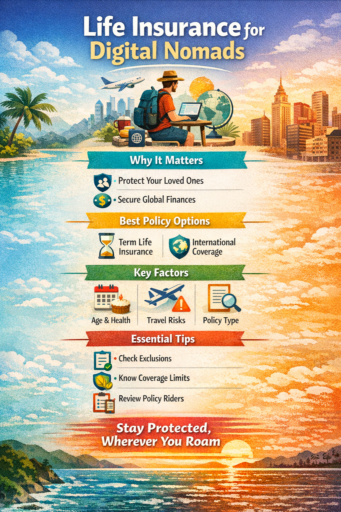
- Term Life Insurance with International Coverage – Provides straightforward death benefit protection for a defined period. Affordable and easy to understand, these policies do not build cash value and must be renewed or replaced when the term ends.
- Expat/Broker‑Sourced Global Life Plans – Brokers help secure international life insurance from reputable carriers suited for people living and working abroad. These plans offer worldwide validity, higher coverage limits, and portability, with application processes designed for international circumstances.
Other options include high-net-worth or private client international plans, which may combine life coverage with additional financial planning features, as well as nomad-focused platforms that bundle life insurance with travel and emergency support.
Selecting the right policy involves evaluating coverage benefits, premium costs, residency considerations, and individual travel patterns to ensure the plan aligns with a nomad lifestyle.
How are life insurance premiums calculated?
Life insurance premiums are calculated based on factors that measure risk and determine the likelihood of a payout.
- Age – Younger applicants generally pay lower premiums because statistically, they have a longer life expectancy and lower risk of death. Premiums increase with age.
- Health – Pre-existing conditions, BMI, smoking status, and lifestyle habits are evaluated. Poor health or high-risk habits typically increase premiums.
- Occupation and Travel Risks – High-risk jobs, frequent international travel, or residence in certain countries can raise premiums. Insurers may require additional documentation or adjust coverage accordingly.
- Policy Type and Coverage Amount – Policies with larger death benefits or permanent coverage cost more than term policies. Optional riders and cash value features also affect premium calculations.
Actuarial tables and statistical models are then applied to assess life expectancy and risk factors, ensuring premiums reflect the likelihood of a payout.
Example Calculation:
Imagine a 35-year-old digital nomad applying for a $500,000 term life policy:
- Base Risk Premium: $200/month
- Age Factor: 1.2 (reflecting slightly higher risk than a 25-year-old)
- Health Factor: 1.1 (healthy, non-smoker)
- Occupation/Travel Factor: 1.15 (frequent international travel)
- Policy Factor: 1.05 (standard term policy with minimal riders)

This example illustrates how insurers combine multiple risk factors to determine the monthly premium.
The actual premium may vary by insurer, underwriting process, and additional optional riders.
What are the pitfalls of life insurance?
The main pitfalls of life insurance involve choosing the wrong coverage, overlooking policy terms, and mismanaging applications.
- Choosing inadequate coverage – Selecting a policy with a payout that is too low can leave dependents or beneficiaries underprotected. Coverage should reflect debts, living expenses, and future financial obligations.
- Ignoring exclusions or residency restrictions – Many international or expat policies include country-specific exclusions or residency limitations. Overlooking these can result in denied claims or lapses in coverage while living abroad.
- Not comparing quotes from multiple insurers – Failing to review multiple policies may lead to higher premiums or less favorable terms. Comparing options ensures the policy matches both coverage needs and budget constraints.
- Overpaying for unnecessary riders – Optional add-ons like accidental death or critical illness coverage can increase costs. Evaluate which riders are truly relevant to your lifestyle and financial goals.
- Failing to disclose pre-existing conditions – Omitting medical history or lifestyle details can invalidate the policy. Full transparency during underwriting is essential to ensure claims are honored.
Common Myths About Life Insurance for Digital Nomads
Many digital nomads avoid life insurance due to misconceptions that can limit financial protection.
Understanding these myths helps nomads make informed decisions and choose the right coverage.
- Myth 1: Life insurance is unnecessary if I’m young and healthy – Even healthy travelers can face unexpected events such as accidents, critical illness, or sudden death. Early coverage often comes with lower premiums, making it both protective and cost-effective.
- Myth 2: I cannot get life insurance if I live abroad – While some restrictions may apply based on country or insurer, most global and expat-focused carriers provide coverage for international residents. Policies can often be structured to remain valid across multiple countries.
- Myth 3: Only citizens of a country can purchase life insurance there – Non-citizens, permanent residents, and long-term visa holders are usually eligible for policies, though documentation such as residency proof or visa status may be required.
- Myth 4: Life insurance is too expensive for nomads – Premiums vary by age, health, and coverage type. Affordable options like term life or basic international plans can provide substantial protection without breaking the budget.
- Myth 5: All life insurance policies are the same – Policies differ in terms of coverage limits, exclusions, riders, and flexibility.
Comparing multiple insurers and reading policy details is essential to ensure the plan fits a mobile lifestyle.
Addressing these myths helps digital nomads make confident decisions, ensuring coverage that is practical, portable, and tailored to their unique lifestyle.
Conclusion
Life insurance for digital nomads is about financial protection and managing uncertainty across borders.
Mobility introduces risks and opportunities that static policies rarely account for, so the smartest coverage is adaptable, globally recognized, and aligned with personal travel patterns.
Rather than seeing life insurance as a reactive safety net, it can be a strategic layer of resilience, giving nomads confidence to take calculated risks, pursue remote work opportunities, and plan for long-term financial goals without geographic constraints.
The key insight is that the right policy transforms protection from a static obligation into a dynamic tool that travels with the lifestyle itself.
FAQs
Can I get life insurance with lupus?
Yes, but coverage may be limited and premiums higher. Insurers assess risk based on severity and treatment.
How much does a $100,000 life insurance policy pay out?
A $100,000 policy pays the designated beneficiaries $100,000 tax-free upon your death, minus any unpaid premiums or outstanding loans on the policy.
Can a person with dementia get life insurance?
It is challenging to obtain coverage. Most insurers require detailed medical evaluations, and individuals with advanced dementia are often denied standard life insurance.
Some specialized or guaranteed-issue policies may be available, but these typically come with higher premiums and lower coverage amounts.
Who really needs life insurance?
Anyone with dependents, significant debts, or financial obligations should consider life insurance.
For digital nomads, it ensures that family members or business partners are financially protected even if you are abroad.
Pained by financial indecision?

Adam is an internationally recognised author on financial matters with over 830million answer views on Quora, a widely sold book on Amazon, and a contributor on Forbes.