Putting property into an offshore life insurance policy allows you to hold assets like cash, investments, or real estate within an international life insurance structure.
This strategy provides estate planning advantages, potential tax efficiency, and wealth protection outside your home country.
This article covers:
- What is an offshore life insurance policy?
- What are some pros and cons of offshoring?
- What are the tax benefits of life insurance?
- How to choose the best insurance policy?
Key Takeaways:
- Offshore life insurance can protect assets and bypass probate.
- Policies can provide tax efficiency when established in favorable jurisdictions.
- The right insurer and jurisdiction protect your wealth, support estate planning, and secure long-term policy benefits.
- Offshore structures carry complexity, costs, and regulatory considerations.
My contact details are hello@adamfayed.com and WhatsApp +44-7393-450-837 if you have any questions. We also offer bespoke structuring solutions tailored to your situation.
The information in this article is for general guidance only, does not constitute financial, legal, or tax advice, and may have changed since the time of writing.

What is offshore life insurance?
Offshore life insurance is a life insurance policy issued by a company located outside your country of residence.
Its purpose is to provide financial security while offering benefits that are often not available in domestic policies, including estate planning, tax efficiency, and asset protection.
It allows individuals to hold and grow their wealth within a legally recognized insurance structure in a stable international jurisdiction.
This type of policy is particularly useful for high-net-worth individuals, expatriates, and globally mobile investors who want to manage assets across borders while maintaining privacy and flexibility.
Offshore life insurance can serve both as a protective measure for your loved ones and as a strategic investment tool.
How Offshore Life Insurance Works
When you set up an offshore life insurance policy, you pay premiums to the insurer.
The insurer then invests those funds according to the type of policy you choose, whether it’s a whole life, universal life, or investment-linked structure.
Upon your death, the policy pays a death benefit to your named beneficiaries.
Some policies allow you to make withdrawals or take loans against the policy’s value during your lifetime, giving you access to liquidity while keeping assets within the offshore structure.
What property can you put in offshore life insurance?
Offshore life insurance policies typically hold financial assets rather than physical property. These are usually structured as investment-linked components within the insurance wrapper.
- Cash deposits: The most straightforward way to fund a policy. Cash is flexible, can be used for premium payments, and forms the base for most investment-linked policies.
- Securities and stocks: Many offshore policies allow you to allocate funds to shares, bonds, or mutual funds, which can grow within the policy tax-efficiently.
- Real estate or other property: While direct property ownership is uncommon, some specialized investment-linked or universal life policies enable exposure to real estate through pooled investments or property-backed funds.
Overall, these allocations allow diversification within a single insurance wrapper, combining investment flexibility with insurance-based structuring features.
What are the benefits of offshore life insurance?
Offshore life insurance benefits include tax efficiency, estate planning flexibility, investment diversification, and enhanced privacy and asset protection.
- Tax efficiency: Certain offshore jurisdictions allow the growth of policy investments to accumulate with minimal or deferred taxation, helping maximize the value of your assets.
- Estate planning flexibility: Policies can be structured to deliver funds directly to beneficiaries according to your wishes, avoiding delays and costs associated with probate.
- Investment diversification: By placing assets in a different currency or market, you can reduce exposure to domestic economic fluctuations and currency volatility.
- Privacy and asset protection: Offshore structures can offer an added layer of confidentiality and legal protection against claims or disputes, helping safeguard your wealth.
What are the disadvantages of offshoring?
The main disadvantages of offshore life insurance are higher costs, regulatory complexity, limited accessibility, and the need for professional management.
- Complexity: Managing policies across multiple jurisdictions often requires specialized legal and financial advice to ensure compliance and proper structuring.
- Higher costs: Offshore life insurance typically involves higher premiums, administrative fees, and setup expenses compared with domestic policies.
- Regulatory risk: Changes in local or offshore tax laws or reporting requirements can impact the expected benefits and performance of the policy.
- Limited accessibility: Making withdrawals, reallocating investments, or modifying policy terms can be more cumbersome and time-consuming than with domestic policies.
Is a life insurance policy subject to tax?
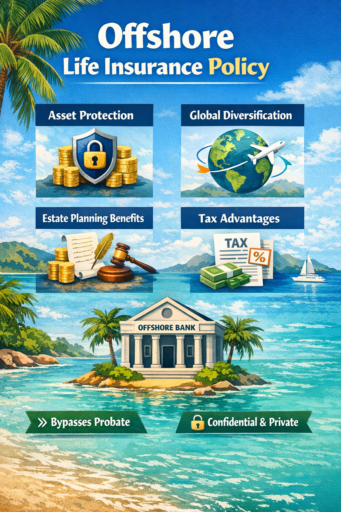
Life insurance policies can be subject to taxes on premiums, investment growth, or death benefits under the laws of the policyholder’s country.
Some countries may tax the contributions you make to the policy, while others may tax the gains that accumulate within the policy over time.
Death benefits paid to beneficiaries can also be subject to taxation depending on local rules.
Certain policy structures, however, allow investments to grow within the insurance wrapper without immediate taxation.
Consulting experienced tax and legal advisors is essential to ensure compliance and to plan your policy in a way that optimizes tax outcomes.
How to choose the right life insurance company?
The right life insurance company is one that operates in a stable and reputable jurisdiction, has financial strength, offers flexible policies, and complies with relevant regulations.
1. Jurisdiction stability. Choose an insurer located in a reputable and politically stable financial center, as the jurisdiction determines the legal protections, regulatory oversight, and tax treatment of your policy.
Popular jurisdictions for offshore life insurance include Singapore, Hong Kong, Switzerland, the Cayman Islands, and Luxembourg.
Each offers different advantages: Singapore and Hong Kong provide strong regulation and legal safeguards, the Cayman Islands allow flexible investment-linked policies, and Luxembourg offers robust policyholder protection laws.
Selecting the right jurisdiction ensures your assets are secure, your policy is recognized internationally, and your estate planning objectives are achievable.
2. Financial strength. Review the insurer’s credit ratings, solvency, and long-term financial track record to ensure it can meet obligations over the life of the policy.
3. Policy flexibility. Verify that the policy allows the types of property or investments you intend to hold and includes features such as withdrawals, loans, or investment allocation options.
4. Regulatory compliance. Ensure the insurer understands local and international tax laws, reporting requirements, and cross-border estate planning regulations.
Offshore Life Policy Flexibility and Exit Strategies
The main ways to exit an offshore life insurance policy are through withdrawals, loans, surrender, or transferring ownership to beneficiaries.
Policyholders can typically access funds via withdrawals or loans, but these actions may reduce the death benefit or incur fees depending on the policy terms.
Terminating or surrendering the policy entirely should be done carefully, as early surrender may trigger penalties, tax obligations, or a loss of investment gains.
Some policies also allow transferring ownership or naming new beneficiaries, which can help align the policy with changing estate planning needs.
Tips for a smooth exit or adjustment:
- Review your policy terms carefully to understand fees, penalties, and restrictions before taking any action.
- Plan withdrawals or loans to minimize tax consequences and preserve the death benefit.
- Consult a professional advisor experienced with both domestic and offshore regulations.
- Consider transferring ownership or updating beneficiaries rather than surrendering the policy to maintain coverage while achieving estate planning goals.
Following these tips helps ensure that any adjustments or exits from your policy are strategic, compliant, and aligned with your financial objectives.
Conclusion
Offshore life insurance is as much about flexibility in decision-making as it is about wealth protection.
Beyond estate planning or tax considerations, the real advantage lies in structuring your financial life so that you can respond to unexpected events, global opportunities, or changes in personal priorities.
When designed with foresight, it becomes a tool that not only safeguards assets but also supports strategic choices like reallocating investments, adapting beneficiary structures, or leveraging policy value without disrupting your broader financial plan.
The key insight is that its value is realized not just in the policy itself, but in how deliberately it is integrated into your evolving financial strategy.
FAQs
What are the 4 types of life insurance?
The four main types of life insurance are term life, whole life, universal life, and variable (or investment-linked) life.
Term life provides coverage for a set period, whole life offers lifetime protection with guaranteed cash value, universal life adds flexible premiums, and variable life allows investment of policy funds in markets.
Does a life insurance policy go to the estate?
Typically, no. Offshore policies often pass directly to named beneficiaries, bypassing probate, unless the policyholder designates the estate as the beneficiary.
Can life insurance be used as an asset?
Yes, life insurance proceeds usually go directly to named beneficiaries, bypassing the estate.
However, if no valid beneficiaries exist, all contingents have predeceased the insured, the policy is owned by the estate, or legal claims apply, the proceeds may become part of the estate.
Why do people put money in an offshore account?
People put money in offshore accounts to diversify assets, reduce exposure to domestic risks, and access favorable tax and estate planning opportunities.
Pained by financial indecision?

Adam is an internationally recognised author on financial matters with over 830million answer views on Quora, a widely sold book on Amazon, and a contributor on Forbes.