A second passport for South Sudan citizens is most commonly obtained through Caribbean citizenship-by-investment programs such as Dominica and St. Kitts and Nevis.
Countries like Portugal offer residency-to-citizenship pathways, while Uganda provides long-term naturalization routes.
These options are used to improve mobility, stability, and long-term relocation opportunities.
This article covers:
- What are the different types of Sudanese passports?
- What was the main factor driving the migration of people?
- What is the strength of South Sudan passport?
- What is the best second passport to have?
Key Takeaways:
- South Sudan allows dual citizenship, making a second passport legally straightforward.
- Caribbean programs offer the fastest route, typically taking 3–6 months.
- Neighboring countries provide the most affordable naturalization paths.
- A second passport expands visa-free travel, improves work and relocation options, and provides greater long-term security.
My contact details are hello@adamfayed.com and WhatsApp +44-7393-450-837 if you have any questions.
For digital nomad or residence visas that require income, assets, or qualifying investments, we can help structure suitable investment solutions that may align with those requirements, depending on your circumstances.
The information in this article is for general guidance only, does not constitute financial, legal, or tax advice, and may have changed since the time of writing.

What are the different types of passports in South Sudan?
South Sudan issues three main types of passports: ordinary, official, and diplomatic, each designed for a specific category of traveler.
- Ordinary Passport – Issued to regular citizens for international travel, including tourism, work, or study abroad
- Official Passport – Issued to government officials traveling abroad for official state duties or assignments
- Diplomatic Passport – Reserved for diplomats and high-ranking government representatives on international missions
For most individuals, the ordinary passport is the only accessible type, but it comes with limited global mobility.
South Sudan also issues emergency or temporary travel documents in urgent cases, but these are not considered standard passport types.
Why are people migrating from South Sudan?
People are migrating from South Sudan primarily due to ongoing conflict, economic collapse, and a worsening humanitarian crisis that continues to displace large parts of the population.
- Political instability and renewed violence – Recent breakdowns in power-sharing agreements have triggered fresh clashes, reportedly displacing hundreds of thousands in 2026 alone.
- Escalating risk of civil war – Rising tensions between government and opposition forces have led to deadly attacks and fears of a return to full-scale war.
- Economic hardship and collapse – Cash shortages, inflation, and shrinking economic activity are making daily survival increasingly difficult.
- Severe humanitarian crisis – Millions face hunger, displacement, and lack of basic services due to conflict, climate shocks, and aid disruptions.
- Mass displacement and insecurity – Ongoing violence has forced families to flee repeatedly, often living without shelter, food, or healthcare.
These conditions, combined with current instability and uncertain peace prospects, are pushing many South Sudanese to seek better living conditions, safety, and long-term opportunities abroad.
Which country has the most South Sudanese immigrants?
Uganda hosts the largest population of South Sudanese refugees and migrants, with over 1.5 million South Sudanese refugees and asylum seekers, making it the primary destination for displacement from South Sudan.
- Uganda – Hosts about 1.7–1.8 million refugees in total, with the majority (around 55–60%) coming from South Sudan, supported by one of the world’s most open refugee policies allowing freedom of movement and work.
- Sudan – Hosts hundreds of thousands of South Sudanese, including long-term migrants and displaced populations, though exact figures vary due to ongoing conflict and population movement.
- Ethiopia – Around 300K South Sudanese refugees, mainly in camps in Gambella region
- Kenya – Around 200,000 South Sudanese refugees and asylum seekers, concentrated in Kakuma and urban areas
Uganda remains the most significant host country due to its settlement-based refugee model, which allows access to land, education, and employment opportunities.
Does South Sudan do dual citizenship?
Yes, South Sudan allows dual citizenship under its nationality laws, meaning citizens can legally hold another nationality without automatically losing their South Sudanese citizenship.
This makes it easier for individuals to pursue a second passport through investment, residency, or naturalization routes in other countries.
In practice, it provides more flexibility compared to countries that require renunciation of citizenship before acquiring another passport.
However, applicants are still expected to comply with the citizenship laws of the second country they are applying to, as not all countries permit dual nationality.
Which country is best for a 2nd passport?
The main options for a second passport for South Sudanese include Caribbean citizenship-by-investment programs, along with residency-to-citizenship pathways in Portugal and long-term naturalization routes such as Uganda.
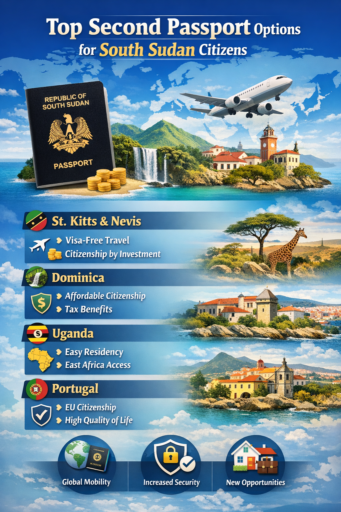
Caribbean Citizenship by Investment (Fastest Route)
This is the quickest pathway to a second passport, often completed within a few months.
- St. Kitts and Nevis
- Route: Government contribution or approved real estate investment
- Requirement: Financial investment only, no residency obligation
- Minimum investment: $250,000
- Processing time: Around 3–6 months
- Dominica
- Route: Economic Diversification Fund donation or real estate investment
- Requirement: Background checks plus qualifying investment
- Minimum investment: $200,000
- Processing time: Around 3–6 months
- Saint Lucia
- Route: Donation, real estate, government bonds, or business investment
- Requirement: Flexible investment options across multiple categories
- Minimum investment: $240,000
- Processing time: Around 4–6 months
Naturalization-Friendly Countries
These options require longer residence but have lower upfront financial barriers.
- Uganda
- Route: Long-term legal residency leading to naturalization
- Requirement: Extended stay and integration into local society (typically up to 20 years of legal residence)
- Key benefit: Regional proximity and relatively easier settlement
- Kenya
- Route: Residency followed by standard naturalization process
- Requirement: Several years of continuous legal residence (around 7 years)
- Key benefit: Strong economy and education opportunities
Residency-to-Citizenship Programs
These pathways offer stronger passports after a longer residency period.
- Portugal
- Route: Residency permit leading to citizenship after qualifying period
- Requirement: Legal residence for 5 years (current law), with potential changes extending this to 7–10 years under proposed reforms plus integration requirements
- Key benefit: Access to EU mobility and high-quality services
- Brazil
- Route: Residency leading to citizenship after legal stay period
- Requirement: Continuous lawful residence (typically 4 years, reduced to 1–3 years in certain cases such as marriage or having a Brazilian child)
- Key benefit: Relatively accessible naturalization timeline
In practice, many applicants combine approaches by securing residency in one country while planning for citizenship in another, balancing speed, cost, and long-term mobility goals.
What is the easiest 2nd passport to get?
The easiest second passport for citizens of South Sudan can be ranked by speed, cost, and accessibility, with Caribbean programs in St. Kitts and Nevis, Dominica, and Saint Lucia offering the fastest approval, while nearby countries like Uganda and Kenya provide the most affordable long-term routes.
Some programs require only a financial contribution and basic due diligence checks, making them significantly faster and simpler to process.
In contrast, traditional naturalization routes typically require long-term legal residency, integration, and physical presence over several years.
As a result, the definition of easy often comes down to whether the priority is speed of approval or lower overall cost and long-term settlement.
How strong is a South Sudan passport?
South Sudan has one of the weakest passports in the world, consistently ranking near the bottom across major global passport indices.
| Index / Ranking System | Typical Global Standing | What It Measures |
| Henley Passport Index | Bottom 15 globally | Visa-free and visa-on-arrival access based on IATA data |
| Arton Capital Passport Index | Bottom 10 globally | Real-time mobility score including visa-free, VOA, and eVisa access |
| Nomad Capitalist Index | Bottom 15 globally | Broader factors including mobility, taxation, perception, and personal freedom |
- Visa-free or visa-on-arrival access – Limited to around 40-50 countries depending on methodology
- Restricted access to major destinations – Requires visas for the Schengen Area, UK, and US
- Limited global mobility – Affects travel, business, education, and relocation opportunities
This restriction is a major driver behind the growing interest in second citizenship for South Sudanese.
Documentation Challenges for South Sudanese Applicants
For applicants from South Sudan, one of the key challenges in second passport applications is ensuring that personal documents are consistent, verifiable, and internationally recognized.
This is partly due to historical and structural factors, where civil registration records may be less centralized or have been issued across different administrative systems over time.
In addition, displacement and cross-border movement have meant that some applicants may need to reconstruct or re-validate identity documents such as birth certificates, marriage records, or national IDs before they are accepted by foreign immigration authorities.
This can add extra steps compared to applicants from countries with fully digitized civil registries.
As a result, many citizenship and residency programs require additional verification checks for applicants from certain jurisdictions, making early document preparation and authentication an important step to avoid delays in the application process.
Conclusion
Second citizenship planning for South Sudanese is best understood as a long-term mobility strategy rather than a single transactional decision.
The most suitable route often reflects trade-offs between speed, cost, and the level of stability or rights gained in the destination country.
An important insight is that accessibility does not always mean simplicity; programs that are faster on paper may require stricter financial scrutiny, while slower residency routes can ultimately provide deeper integration and stronger long-term security.
Successful applicants tend to think beyond the first passport and instead focus on building a progression of legal statuses that gradually expand mobility, security, and optionality over time.
FAQs
Is South Sudan banned from US visa?
Yes. South Sudan has faced US visa measures that included revocation of existing visas and suspension of new visa issuance for most categories.
While not a permanent legal ban under immigration law, it has effectively halted standard visa processing, with only limited exceptions possible.
Where do refugees from South Sudan go?
Most refugees from South Sudan primarily flee to neighboring countries such as Uganda, Sudan, Ethiopia, and Kenya.
These countries host large refugee settlements and humanitarian programs, with Uganda in particular receiving the largest share of South Sudanese refugees due to its open settlement policy.
What’s happening in South Sudan right now?
South Sudan is currently facing renewed political tensions, localized armed clashes, and a worsening humanitarian crisis marked by food insecurity and large-scale displacement.
Despite peace agreements, instability persists as millions continue to rely on humanitarian aid amid ongoing economic and security challenges.
Is South Sudan a rich country?
South Sudan is not a rich country economically, despite having significant natural resources such as oil reserves.
It remains one of the world’s poorest countries due to weak infrastructure, limited economic diversification, and high reliance on humanitarian aid.
Pained by financial indecision?

Adam is an internationally recognised author on financial matters with over 830million answer views on Quora, a widely sold book on Amazon, and a contributor on Forbes.