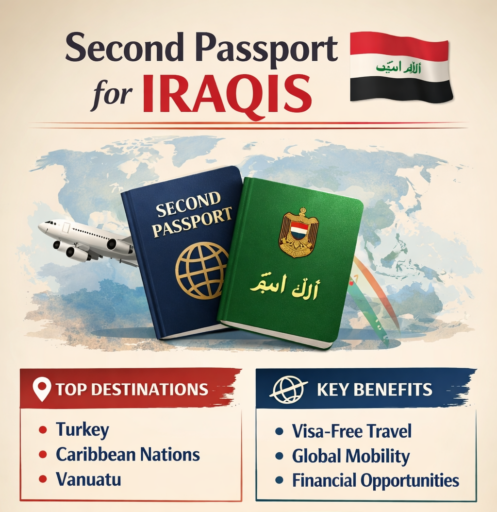
A second passport for Iraq typically involves citizenship options such as Caribbean investment programs like St. Kitts and Nevis or Dominica, Turkey through real estate investment, and fast-track alternatives like Vanuatu,
These are among the more accessible pathways for Iraqi citizens seeking greater travel freedom and global mobility.
This article covers:
- Is Iraq allowing dual citizenship?
- Why do people have two passports?
- What is the best country to get a second passport?
- How do I get my second citizenship?
- How powerful is the Iraqi passport?
- What are the risks of dual citizenship?
Key Takeaways:
- Second passports are legal for Iraq.
- Turkey, Caribbean programs, and Portugal are among the most practical routes.
- Investment-based programs are usually the fastest route, but require strong due diligence.
- A second passport significantly expands visa-free travel and global mobility beyond the limits of the Iraqi passport.
My contact details are hello@adamfayed.com and WhatsApp +44-7393-450-837 if you have any questions.
For digital nomad or residence visas that require income, assets, or qualifying investments, we can help structure suitable investment solutions that may align with those requirements, depending on your circumstances.
The information in this article is for general guidance only, does not constitute financial, legal, or tax advice, and may have changed since the time of writing.

Can Iraqis have dual citizenship?
Yes. Iraqi citizens are permitted to hold another nationality without automatically losing their Iraqi citizenship.
However, there are important considerations:
- Dual citizens must still comply with Iraqi laws when in Iraq
- Some government positions may restrict dual nationals
- Travel and legal obligations may vary depending on the second country
In general, Iraq’s policy is considered flexible compared to countries that strictly prohibit dual nationality.
Why would you want two passports?
A second passport for Iraqis is primarily obtained to improve travel access, increase personal security, and unlock global opportunities that are limited with the Iraqi passport alone.
- Stronger global mobility (visa-free access to more countries), allowing easier international travel without repeated visa applications
- Security and stability in case of political or economic uncertainty, providing an alternative nationality for greater personal and financial protection
- Better education opportunities abroad, including access to universities, scholarships, and lower international tuition rates in some countries
- Business expansion and international banking access, enabling easier company formation, cross-border trade, and global financial services
- Family relocation options, making it simpler to move or sponsor dependents in countries with stronger residency rights
- Healthcare access in higher-ranking systems, offering access to better medical services and insurance frameworks in developed countries
A second passport is often less about leaving Iraq permanently and more about increasing freedom, flexibility, and long-term global planning options.
Which country is best for a second passport?
The best second passports for Iraqis include Caribbean citizenship-by-investment countries such as St. Kitts and Nevis, Dominica, and Antigua and Barbuda, Turkey through real estate investment, Vanuatu as a fast-track citizenship option, and Portugal as a long-term EU residency route to citizenship.
Caribbean citizenship-by-investment programs
St. Kitts and Nevis, Dominica, Antigua and Barbuda
- Route: Citizenship through government-approved donation or real estate investment
- Requirements: Qualifying financial contribution, strict due diligence checks, and proof of lawful funds
- Minimum investment:
- St. Kitts and Nevis: from $250,000
- Dominica: from $200,000
- Antigua and Barbuda: from $230,000
- Processing time: Typically 3–6 months
- Why it’s suitable: Fast processing, no residency requirement, and strong visa-free travel access
- Route: Citizenship through qualifying real estate investment
- Requirements: Property purchase, valuation checks, legal documentation, and holding the asset for at least 3 years
- Minimum investment: From $400,000 in real estate
- Processing time: Typically 3–6 months, but more realistically 6–12 months
- Why it’s suitable: Geographic proximity, accessible property market, and strong regional ties
- Route: Citizenship through government donation
- Requirements: Background checks and proof of funds
- Minimum investment: From $130,000
- Processing time: Around 1–3 months
- Why it’s suitable: One of the fastest citizenship programs globally
- Route: Residency leading to citizenship (e.g., Golden Visa or other permits)
- Requirements: Maintain legal residency, meet minimum stay periods, and fulfill integration requirements
- Minimum investment: From €250,000 (if using investment routes)
- Processing time: Around 5 years to citizenship
- Why it’s suitable: Access to EU mobility and long-term relocation opportunities
Each option varies in cost, timeline, and travel strength, with Caribbean programs offering the fastest direct citizenship, Turkey and Vanuatu balancing speed and accessibility, and Portugal providing long-term European settlement benefits.
What is the easiest 2nd passport to get?
The easiest second passports for Iraqis are typically found in Caribbean countries like Dominica and St. Kitts and Nevis, as well as Vanuatu and Turkey through investment-based routes, with processing times ranging from 1–3 months (Vanuatu) to around 6–12 months (Turkey and some Caribbean cases).
These options are considered easiest because they rely on financial investment and background checks rather than long-term residency, language tests, or complex integration requirements, making the process faster and more predictable.
The best choice ultimately depends on your budget, preferred timeline, and long-term mobility goals.
How strong is the Iraqi passport?
The Iraqi passport is considered one of the weaker passports globally, offering visa-free travel access to around 30–40 countries.
| Index | Ranking of Iraqi Passport | Overall Assessment |
| Henley Passport Index | 99th | Very limited global mobility |
| Arton Capital Passport Index | 92nd | Restricted travel access |
| Nomad Capitalist Passport Index | 196th | Weak due to visa restrictions, taxation, and perception factors |
What are the disadvantages of dual citizenship?
For Iraqi citizens, dual citizenship can lead to double tax exposure, legal conflicts between jurisdictions, and restrictions on certain government roles.
- Tax obligations in both countries (depending on jurisdiction), which may require filing taxes or reporting global income in more than one country
- Military service requirements in some nations, potentially creating conflicting obligations if both countries impose service rules
- Legal conflicts between two countries’ laws, especially in matters like inheritance, business ownership, or family law
- Complex travel documentation rules, including when to use each passport and how to enter or exit certain countries
- Potential restrictions on government or security jobs, particularly in Iraq where some positions may limit dual nationals
- Loss of diplomatic protection clarity in certain cases, where one country may not recognize the other citizenship during legal issues
It is important to understand both countries’ legal frameworks before applying for second citizenship to avoid conflicts and ensure compliance.
How do I get my second passport?
Second passport for Iraqis can be obtained through legal pathways such as citizenship-by-investment programs, long-term residency leading to naturalization, ancestry-based citizenship, marriage to a foreign national, or employment and talent-based visa routes.
1. Citizenship by Investment (CBI): Invest in approved options such as real estate, government funds, or national development projects in countries that offer direct citizenship in exchange for financial contribution.
2. Naturalization through Residency: Live legally in a foreign country for a required number of years, maintain continuous residence, and meet integration requirements before applying for citizenship.
3. Ancestry or Heritage Claims: If you have parents, grandparents, or sometimes even great-grandparents from another country, you may qualify for citizenship through descent or heritage laws.
4. Marriage-based Citizenship: Marriage to a foreign national can lead to residency rights, which may eventually allow application for citizenship after meeting time and legal requirements.
5. Special Talent or Work Visas: Skilled professionals may qualify for fast-track residency through employment, which can later lead to citizenship depending on the country’s immigration rules.
Each pathway differs in cost, timeline, documentation, and eligibility requirements, so Iraqi applicants typically choose based on speed, budget, and long-term mobility goals.
Approval Risks and Due Diligence for Iraqi Applicants
Iraqi citizens applying for a second passport often face stricter due diligence, higher rejection sensitivity, and more complex financial verification requirements.
These are due to global anti-money laundering (AML) regulations, geopolitical risk classifications, and enhanced compliance standards applied to higher-risk jurisdictions.
Key risk factors:
- Limited integration with global financial systems
Iraq’s banking and credit infrastructure is less connected to international verification networks, making it harder to independently confirm income, assets, and transaction history. - Higher geopolitical risk classification
Due to regional instability and historical sanctions exposure, Iraq is often placed in higher-risk categories under global compliance frameworks, triggering enhanced due diligence. - Stricter document verification requirements
Civil records, business documents, and notarization from Iraq may require additional validation steps because international systems have less direct access to standardized databases. - Cash-heavy and informal economic activity
A larger informal economy increases scrutiny on proof of funds, requiring applicants to provide stronger evidence of legitimate and traceable financial sources. - Banking and transfer friction
International fund transfers from Iraq may involve intermediary banks and additional compliance screening, increasing processing time and documentation requirements. - Higher sensitivity to incomplete profiles
Missing documents, inconsistent financial records, or limited travel history can result in delays or higher rejection risk compared to lower-risk jurisdictions.
Conclusion
Second citizenship for Iraq is less about selecting a popular country and more about navigating how different jurisdictions interpret risk, documentation, and financial traceability.
In many cases, approval outcomes are shaped more by how verifiable an applicant is under global compliance standards than by the specific passport being pursued.
Because of this, the same pathway can produce very different outcomes depending on preparation quality.
Applicants with clear wealth origin, consistent financial records, and strong documentation tend to see smoother approvals.
It is also important to recognize that fastest and best are not always the same; some of the quickest programs come with stricter due diligence, while slower residency routes may offer higher long-term stability and lower scrutiny intensity.
Ultimately, second citizenship for Iraqis is best viewed as a structured mobility strategy rather than a transactional purchase, where success depends as much on compliance readiness and profile strength as on the passport itself.
FAQs
What disqualifies you from getting a passport?
You can be disqualified from getting a passport due to serious criminal convictions, fraud or identity issues, national security concerns, or submitting false or incomplete documentation.
Unresolved legal or immigration violations may also prevent approval, depending on the country’s rules.
How many countries can you go to with an Iraq passport?
The Iraqi passport allows visa-free or visa-on-arrival access to roughly 30–40 countries.
Most destinations in Europe, North America, and much of Asia still require a pre-approved visa.
What is Iraq famous for?
Iraq is known for being the cradle of ancient Mesopotamian civilization, home to historic cities like Babylon and Baghdad, and for its deep cultural, literary, and religious significance in Islamic history.
It is also one of the world’s most resource-rich countries, particularly in oil and natural gas reserves.
Can you go to America with an Iraqi passport?
Yes, but Iraqi passport holders must obtain a US visa before traveling.
This requires an embassy interview, supporting documents such as proof of funds and travel purpose, and approval based on immigration eligibility assessment.
Pained by financial indecision?

Adam is an internationally recognised author on financial matters with over 830million answer views on Quora, a widely sold book on Amazon, and a contributor on Forbes.