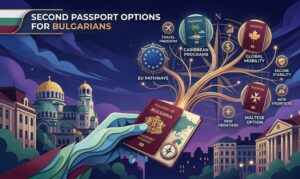
A second passport for Bulgarian citizens is typically pursued through diversification-focused options like Paraguay, Uruguay, and selective Caribbean programs such as Grenada, offering advantages that go beyond existing EU mobility.
As an EU citizen of Bulgaria, the goal is not access, but speed, optionality, and global positioning.
This article covers:
- Can Bulgarians hold dual citizenship?
- Why are people leaving Bulgaria?
- Where do most Bulgarians migrate to?
- What is the best second passport to have?
- What are the advantages and disadvantages of dual citizenship?
Key Takeaways:
- Bulgarians already have strong mobility; second passports add strategy, not access.
- Non-EU second passport options provide diversification and geopolitical flexibility.
- Latin America offers low-cost, residency-based citizenship pathways.
- The right choice for Bulgarians is based on speed vs. long-term relocation goals.
My contact details are hello@adamfayed.com and WhatsApp +44-7393-450-837 if you have any questions.
For digital nomad or residence visas that require income, assets, or qualifying investments, we can help structure suitable investment solutions that may align with those requirements, depending on your circumstances.
The information in this article is for general guidance only, does not constitute financial, legal, or tax advice, and may have changed since the time of writing.

Does Bulgaria allow multiple citizenships?
Yes. Bulgaria permits dual and multiple citizenship under the Bulgarian Citizenship Act, with no requirement to renounce your original nationality.
This creates a clear legal pathway for Bulgarians to add a second passport for mobility, business, or relocation purposes.
The framework is broadly permissive, with no general caps or special approvals required for holding multiple nationalities.
Any constraints usually arise from the second country’s rules such as residency periods, investment thresholds, or documentation requirements.
Why are so many people leaving Bulgaria?
Bulgaria has experienced sustained emigration driven by structural economic gaps and demographic pressure, even as recent trends show some stabilization.
- Wage disparity: Salaries remain significantly lower than in Western Europe, pushing workers, especially in healthcare and skilled sectors, abroad.
- Demographic decline: Bulgaria has one of the fastest-shrinking and aging populations in the European Union.
- Brain drain: A large share of emigrants are working-age, reinforcing labor shortages at home.
- Established migration routes: Countries like Germany, Spain, and the United Kingdom continue to attract Bulgarian workers.
Recent data shows emigration declining from pre-pandemic highs, with some return migration balancing outflows.
However, mobility remains structurally embedded.
Current dynamics, political instability, repeated elections, and cost-of-living pressures, are also shaping decisions, particularly among younger professionals.
Importantly, this is no longer purely about permanent relocation.
Many Bulgarians maintain ties and use a second passport to expand access to opportunities across multiple countries.
Where do most Bulgarians immigrate?
Most emigrants from Bulgaria move within the European Union, where free movement and stronger labor markets make relocation easier.
Recent migration data shows Germany consistently as the top destination, followed by the Netherlands and Spain, with Italy also hosting a significant Bulgarian community.
- Germany – largest share of Bulgarian migrants due to high wages and strong demand for skilled and semi-skilled labor
- Spain – long-established community, especially in construction, services, and seasonal work
- Italy – significant diaspora with strong regional clusters in major cities
- United Kingdom – historically a major destination, particularly before Brexit tightened migration rules
Overall, Germany alone accounts for around 40% of Bulgarian migration flows to OECD countries in recent years, highlighting how concentrated movement remains toward higher-income EU economies.
These destinations consistently attract Bulgarians due to higher salaries, broader career mobility, and stronger social systems compared to the domestic labor market.
Which country is best for a second passport?
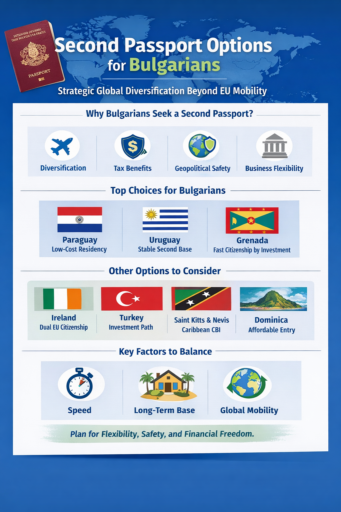
The most relevant options for a second passport for Bulgarians include Paraguay, Uruguay, and Grenada, each aligned with a different priority such as fast acquisition, low-cost entry, long-term relocation, or broader global mobility diversification.
These options are particularly relevant because Bulgarian passport holders already have EU mobility, so choices for a second citizenship for Bulgaria are typically focused on diversification, tax positioning, and access beyond Europe rather than basic travel rights.
Paraguay is one of the simplest residency-to-citizenship pathways in the world, but it is not a direct citizenship-by-investment program.
- Route: Temporary residency → permanent residency → citizenship
- Timeframe: ~3 years after obtaining permanent residency (effective total ~4–5 years including setup time)
- Requirements: Permanent residency status, proof of economic activity or self-sufficiency,
- Key advantage for Bulgarians: One of the lowest-cost pathways to a second citizenship globally, with simple residency entry and relatively light financial barriers compared to most programs.
Uruguay offers a more stable but slower naturalization process.
- Route: Residency → citizenship
- Timeframe: ~3–5 years
- Requirements: Proof of residence and integration
- Key advantage for Bulgarians: High political and economic stability, making it a safe second base outside the EU.
Grenada is a fast-track citizenship-by-investment option.
- Route: Citizenship by investment
- Timeframe: ~3–6 months
- Investment: Minimum contribution of USD 235,000
- Requirement: No residency obligation
- Key advantage for Bulgarians: Strong global mobility plus eligibility for the US E-2 investor visa pathway.
Other strong second passport for Bulgaria
Beyond the main routes, several alternatives may be relevant depending on budget and long-term goals:
- Ireland – Provides citizenship through naturalization after about 5 years, but with stricter enforcement of continuous physical residence and proof of integration. Its main advantage is access to one of the strongest passports globally, though it demands genuine long-term stay.
- Turkey – Citizenship by investment, typically requiring a real estate purchase of around USD 400,000 held for at least three years, with processing often completed in 3–6 months. For Bulgarians, the key benefit is fast acquisition combined with strategic access between Europe, the Middle East, and Asia.
- Saint Kitts and Nevis – Citizenship by investment starting at roughly USD 250,000+ via donation or real estate, with no residency requirement and processing in a few months. Its advantage is long-established global visa-free access and strong program reputation.
- Dominica – Provides one of the lowest-cost citizenship programs at around USD 200,000+ through a donation route, also with no residency requirement and fast processing. Its key advantage for Bulgarians is affordability combined with straightforward approval and minimal ongoing obligations.
What is the easiest second passport to get?
The easiest second passports for Bulgarian citizens are typically citizenship-by-investment programs that combine fast approval, low bureaucracy, and no residency requirement, most commonly in the Caribbean and selected smaller jurisdictions such as Dominica, Saint Lucia, Saint Kitts and Nevis, and Vanuatu.
These programs are considered the simplest globally because they typically require only a financial contribution (starting around USD 130,000+ depending on the country), standard background checks, and no physical residence either before or after approval.
Processing times are usually around 2–6 months, making them significantly faster than residency-based citizenship routes.
A lower-cost but more niche alternative is Sao Tome and Principe, which has periodically offered investment-based citizenship with relatively low entry thresholds (USD 90,000 for a single applicant), though it is less established and more limited in global acceptance compared to Caribbean programs.
Overall, these options are best suited for applicants prioritizing speed and convenience over long-term relocation or passport strength.
Is Bulgaria a strong passport?
Bulgaria has a strong passport, with visa-free or visa-on-arrival access to around 170+ countries globally.
| Index | Ranking | Key insights |
| Henley Passport Index | 11th | Strong mobility driven by EU membership and broad global travel access |
| Arton Capital Passport Index | 6th | High global mobility score, reflecting balanced travel freedom across regions |
| Nomad Capitalist Passport Index | 6th | Lower tax flexibility score compared to non-EU jurisdictions, despite strong mobility |
Is it worth it to have two passports?
Having a second passport for Bulgarian citizens is worth it when the goal is diversification rather than basic travel access.
A second passport can provide:
- Greater visa-free travel flexibility
- Backup residency options
- Access to different tax or business jurisdictions
- Risk diversification in uncertain geopolitical or economic conditions
Think of it as a Plan B that expands global mobility and long-term optionality beyond the baseline rights already available through Bulgaria and the European Union.
What are the negatives of dual citizenship?
Dual citizenship can create practical and legal complications, especially in areas like taxation, compliance, and long-term obligations.
Some potential drawbacks include:
- Tax complexity: Possible reporting requirements in multiple jurisdictions
- Legal conflicts: Overlapping obligations between two countries’ legal systems
- Costs: Application fees, legal assistance, or investment requirements can be significant
- Civic obligations: In some cases, military service or civic duties may apply depending on the second country
For most Bulgarian citizens, however, these issues are manageable when the structure is planned properly, and they are often outweighed by the added mobility and flexibility.
EU vs Non-EU Second Passports and How Bulgarians Typically Structure Them
Planning for second citizenship for Bulgaria is less about gaining basic global access since the country already provides strong EU mobility, and more about choosing between different legal, tax, and residency systems outside their existing framework.
EU-based pathways
EU naturalization routes (such as Ireland-style residency-to-citizenship programs) primarily differ in legal residence requirements, not travel access.
They involve sustained physical presence and integration over several years in exchange for another high-value passport within the European Union, effectively changing the country of citizenship rather than expanding mobility.
Non-EU citizenship programs
Caribbean-style citizenship routes remain attractive for their administrative simplicity and speed.
However, their strategic value lies less in visa-free travel (which overlaps with Bulgaria’s baseline access) and more in providing an additional legal identity outside the EU framework, useful for diversification and contingency planning.
Residency-based hub strategies
Residency systems such as those in the United Arab Emirates are used primarily for tax residency and business structuring rather than citizenship outcomes.
They function as operational bases for income optimization and lifestyle flexibility rather than long-term nationality planning.
How Bulgarians typically structure second passports
Second passport planning for Bulgaria is often layered.
Many maintain an EU citizenship base and add either a non-EU citizenship for jurisdictional diversification or a residency hub for tax and business purposes.
More advanced strategies combine both, separating citizenship (legal identity) from residency (tax and lifestyle base) to reduce reliance on any single country system.
Conclusion
Planning second citizenship for Bulgarians is ultimately about reducing reliance on a single jurisdiction and structuring greater personal and financial flexibility across borders, rather than simply improving travel access through Bulgaria’s already strong EU position.
The trade-offs between fast-track citizenship, long-term naturalization, and residency-based systems come down to how quickly access is needed versus how deeply one is willing to integrate into another country’s legal and tax framework.
Each pathway serves a different function—speed, stability, or structural diversification.
In most cases, the most resilient strategies combine multiple layers rather than relying on one solution, separating citizenship, residency, and tax exposure across different jurisdictions to avoid overdependence on any single system.
FAQs
Which countries do not allow two passports?
Some countries restrict or prohibit dual citizenship, including China, India, and Saudi Arabia.
Always check both sides: your current nationality and your target country.
Is Bulgaria a rich or a poor country?
Bulgaria is classified as an upper-middle-income country within the European Union.
It has a growing economy but remains one of the lower-income members of the EU.
What are the benefits of a Bulgarian passport?
A Bulgaria passport provides full EU freedom of movement, access to education and healthcare across the European Union, and visa-free or visa-on-arrival access to around 170+ countries.
It is already a strong mobility passport, with relatively flexible rules for holding dual citizenship.
Can I go to Japan with a Bulgarian passport?
Yes. Japan allows Bulgarian citizens visa-free entry for short stays (typically up to 90 days), making it easy for tourism and short business visits.
Pained by financial indecision?

Adam is an internationally recognised author on financial matters with over 830million answer views on Quora, a widely sold book on Amazon, and a contributor on Forbes.